A baby octopus held my hand. It really did. I say “baby” because it was little—maybe it was a full-grown small variety. I don’t know much about octopus species.
We were snorkeling, and I startled it among a school of little fish. It tried to scrunch up under a rock and look like stone, but of course, as I saw it find the hiding spot, I could still see it. I watched it for a while. I motioned Hernan over to look, and after he left, I kept on watching it. The water was so shallow that it was easy for me to hold onto the stones while floating on the surface. I moved one of my hands over and let it lay on a stone close to the little octopus. I thought it would zoom away, but it didn’t. After a moment, it slowly reached out one curly tentacle toward my finger. Then it touched me. I didn’t move. It reached that snaky spiral around my finger and I felt its little sticky suction cups take ahold of my skin and it pulled on my finger just a little, as if it wanted to draw my hand closer. I didn’t move my hand. I had an idea that if the little guy discovered exactly how big its catch was, it would disappear in a second.
When I didn’t move, it let go. And lost interest and swam away. I guess it decided that while I wasn’t going to try to eat it, it didn’t want a bite of me, either. I swam away too. And was very happy and amazed. And didn’t tell anyone about it, until now.
Si Dios Quiere
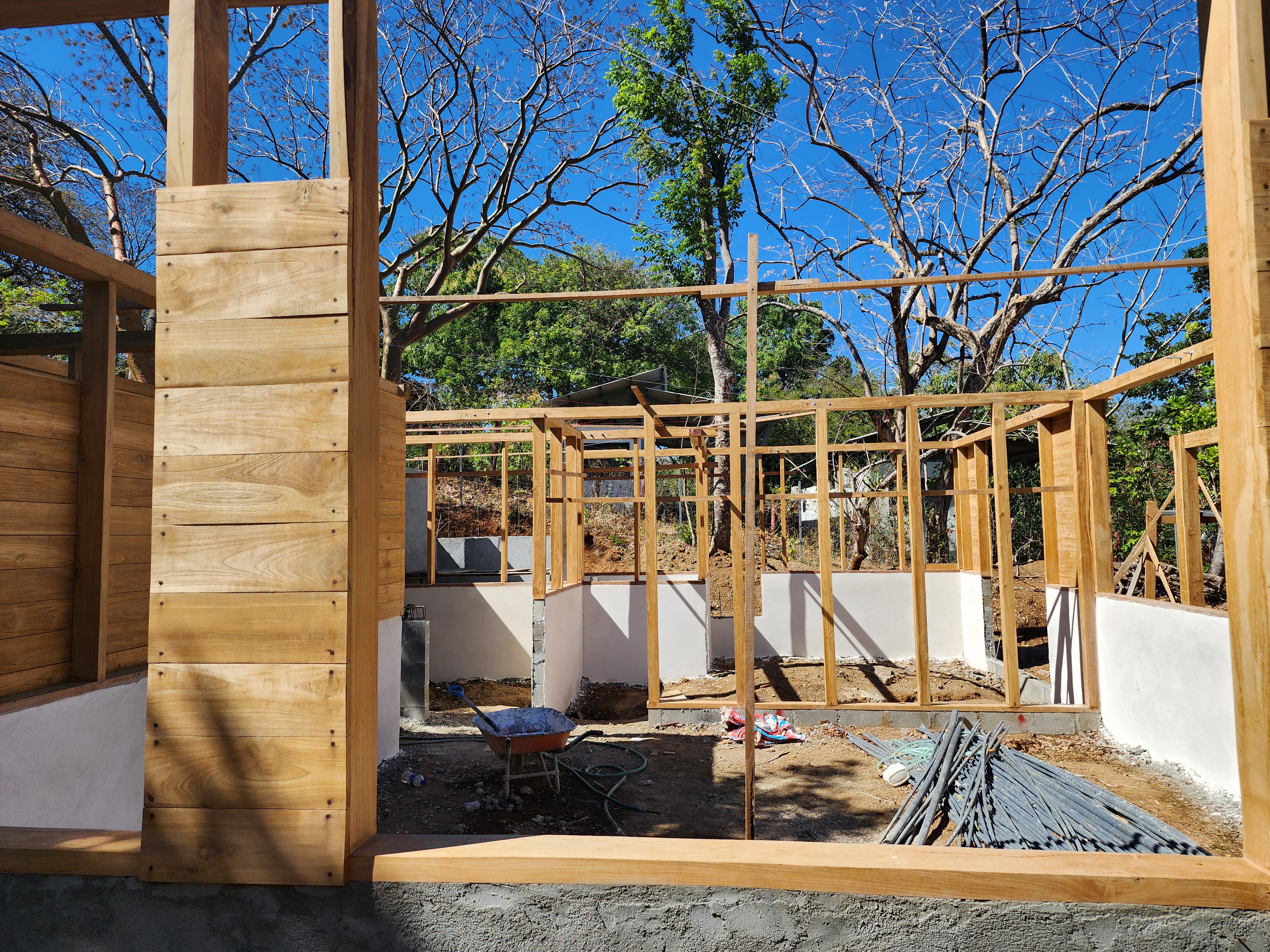
In other news, my future house is still a construction site with most of the walls, no floor, and no roof. They were supposed to put the roof on two weeks ago, but the foreman left because he wanted more money and the contractor didn’t have anyone else to send. His primary team was finishing a house in Liberia that belongs to his son who is, evidently, much more important than I am. So for two weeks there has been a guy doing repello which is necessary and all but what I need is a roof. The beautiful teak boards and posts, in the meantime, are cracking literally up one side and down the other in this fierce sun.
Last week the Liberia crew supposedly finished the son’s house and they were set to come on Monday, March 2. Tomorrow. But now that’s not going to happen. Because the contractor has been summoned to a pre-op appointment on Tuesday, March 3 at a CCSS hospital in Alajuela. For a heart surgery that he has been waiting 5 years for.
Yes, you read that right.
The latest version of the tale is that, “Si Dios Quiere” he will be there at my roofless house on Wednesday with his guys to start working. Because the heart surgery isn’t going to be immediately—it’s going to be sometime within the next 3 months.
I’ve just started saying Si Dios Quiere, too, because I freaking give up and I’m starting to think it really must all be the doings of God. Who just really either doesn’t want me to have a house to live in or wants to make sure it is ridiculously hard for me to get it.
I haven’t quite given up on this contractor, but I have to confess I don’t expect that, after a Tuesday afternoon appointment in the capital city, he is going to arrive with a team of workers on Wednesday. O how I would love to be wrong. O how I would love to know how you know when to be patient a little longer and when to give up and try to find (another) new contractor.
Good Vibes
They say that you get back from the universe what you put out there. Is this true? Is it my fault I’m having these construction problems, then? All I want is a house to live in. It’s not a castle or anything, just a house. I’m trying to be organized and positive and patient and efficient and realistic and grateful and all the things that, as far as I know, are right and good. If these snarls are being created by me, I swear I don’t know how or where I am doing it. I would like to stop, but I don’t know how.
Back to the Octopus
It’s a really good thing that little octopus wanted to hold my hand the other day. I keep going back to that moment. How it reached out with what looked like curiosity to see what I might be. That was pretty brave of it considering how much bigger than it I am. That felt like some serious love from the universe.
If a baby octopus likes me, I must be doing something right, wouldn’t you say?
Off the Hook
The cooking business is off the hook so I guess I’ve got the right vibes going out here, too. It’s been merciless for the last few months. I can see that my booking tactic of saying yes to every possible reservation does not serve me in the high season. I keep telling myself and everyone else that my schedule is going to “settle down” soon. But I’m realizing that unless I book days off the way I book reservations, it isn’t. So I’m doing that—blocking the calendar when enough is enough. And doing a little better at delegating.
That’s the news from here and now. Stay tuned for more adventures with sea life, perhaps some catering anecdotes, and updates from the construction site, Si Dios Quiere.
The last thing I knew, it was the middle of November and now suddenly it’s almost February. This busy season blindsided me. And it’s not over, I’m just lucky enough to have a little break. I’m pretty sure the angels arranged this to prevent me from losing my mind which is not entirely off the table and would be a real shame.
Eighteen years ago today on a very hot and windy afternoon in Tamarindo, I married Pio. And we lived mostly happily ever after until, in fact, death did us part. Many things did not go the way we imagined them that day, especially the fact that we only had 9 years. The great thing about learning from your experiences is that you can keep learning from them even after they are over, for as long as you remember them. In that way, we still have a very present relationship and I am still learning from him, being formed by the fact that he was present with me for a time.
Today I am sitting on a rocking chair on the front porch of a mountain cabin. My sister came to visit me at the most dreadfully busy time of year and by some miracle we had a few free days from the mad catering schedule. So she whisked me away to the mountains where I can read a little, write a little, sleep, breathe, sit and stare at the sky. That sitting and staring at the sky part is so good for me.
Blessed are those who live in places or have jobs that provide a steady stream of income all year long. For they can choose to have reasonable schedules if that is important to them, and lives that retain some kind of balance. A little bit less blessed are those who depend on seasonal tourism and know what balance is when they see it but don’t get to experience it personally. If I had a nickel for every time I say to myself, “Suck it up. It’s high season,” I would probably save enough to make it through the low season. No mercy.
And there’s the house. How do you like that? I can now call it “the house” and not just “the lot.” Because there is a “house” on it–the beginnings of one. You can hire builders who will charge you a fee and present you with your house, or you can do what I did: hire a builder for a smaller fee and source all the materials yourself. Advantage: you choose everything down to the last nail. Disadvantage: you have another job. One that is extremely important no matter how much time you do not have for it.
It’s all good. So very very very many blessings all at once. So many things to remember. So many things to coordinate, and only one car. Only two hands and one mind to do all of this with. Only 24 hours in each day and some of them have to be spent sleeping. So many reasons to feel happy and lucky. In between the absolute exhaustion and constant bass note of the terror of having forgotten something extremely important and probably obvious. All the blessings. Simultaneously.
The biggest blessing right now is this pause. To step out of all of that (oh and I forgot to say it’s also so very very hot) and come up here to the cool mountain with the hot springs and rest for a moment. It’s the eye of the hurricane, but how lucky I am to have it pass directly over me.
And then one day you wake up and it’s your 55th birthday. Which amuses you because that’s an awfully big number and doesn’t really feel like it belongs to you. Although, clearly, it does. If you think about your stories, you have to admit you can’t collect this many of them in 25 years or 30.
Your cats are somewhere on the periphery taking naps and the sun is burning off the dawn fog. Your significant other is off serving breakfast to tourists—something you refuse to do—in your favorite beach town about 20 minutes away. You’ll make the coffee cake and the gallo pinto for them, but no one is taking away your mornings. They belong to you.
You can make statements like that, stuff your hands in your pockets, and refuse to budge if you want when you’re 55. Nice.
You feel an ache in your heart, though, because your husband was 55 when he suddenly got cancer and died. You aren’t worried about repeating that yourself, but you are aware of the juxtaposition between how he felt on his 55th birthday (perpetually exhausted) and how you feel on yours (tired from last night’s big catering job). You miss him. You can’t believe how you have learned to live without him, but you had to. It was the best/only choice.
You don’t have any plans for today other than cooking up more coffee cake and gallo pinto for the breakfasts in the coming days, and you hope you finally sit down and write the blog post you‘ve been meaning to write. You hope you think of something to say. And as the temporada alta is unleashing over Guanacaste, you have emails to answer and accounting to do at your desk no matter who’s birthday it is.
They’re going to break ground for your house on Wednesday, si dios quiere. And you really hope s/he does. You are trying not to think about it because if you think about it, you might get too excited to sleep. And you need your sleep. You HAVE to be lucid and well-organized to keep your catering business going while building your house, both of which are happening in opposite directions of your physical location, which is in the middle of nowhere and you only have one car. No pressure. But you have to spend the night sleeping, not wondering (like you did the night before last) where the workers are going to go to the bathroom.
So this is the year. You are going to have your very own house on your very own lot, with your very own cats and your very own trees and your very own jasmine bushes. You never minded renting and have always loved moving, but for whatever reason, you suddenly felt possessed to do this instead. And you try to follow the voice inside your heart as best you can.
In the kitchen, you can hear the sound of the cat food bowl bumping on the floor which means that big fat sapo who lives under the refrigerator is stealing the cat food, and let’s just say it’s not the cheap kind. It’s time to get moving. And you are very hungry and need more coffee. You think that although by “the world’s” definition of success you are definitely a bit of a failure, you have, in fact, succeeded at what you care about. And you love knowing that if the 10 or 25 or 35 year-old version of you could see you now, they would be so very proud.
A lot of things have happened since I last checked in. We had a hurricane, for one. It didn’t hit us like it hit the Caribbean islands, but it dumped several feet of rain on us and made a real mess. The crazy thing about hurricanes is how long we watch them forming and heading toward us, and how quickly they are over and the sky acts like nothing even happened, like it didn’t just try to wipe us all off the face of the earth. Like why on earth are we all muddy and wet down here?
Another thing is that I got the go-ahead to build my house. Finallyyyyyy! I didn’t start yet because, you know, hurricanes. I don’t think a builder in his right mind would start a house in October at this spot on the planet, anyway. It would be a muddy mess of wasted time and money. One of these days the clouds will blow away and it will be November, the most beautiful month of the year. Things with the bank never really did resolve. Maybe they would have, but maybe they never would have. Fortunately, we won’t have to find out because I found the money elsewhere. I say “found” like it’s now mine and I don’t have to pay it back, which is not true.
After almost 12 calendar months of struggles with the bank, it is taking me a long time to wash all of that worry out of my hair. I still wake up every morning and my first two thoughts are, “Maybe today will be the day the bank…” followed by, “Oh yeah! Screw the bank!”
And then, I have realized that the only hope for this blog is for me to change its style/focus. Or I just won’t do it anymore. Which may not be a great loss to humanity, but I have determined that I am not ready for that because the idea makes me very sad. Scrap trying to write about enlightening and meaningful subjects all the time, and just continue a bit of an on-line diary. It’s that or nothing. And I’m so sorry but there might not be lovely and pertinent pictures either. The only things I have to take pictures of right now are cats, piles of wood, and food. Which, I will say, are some of my favorite things.
Last year in the pouring rains of August, I was busy meeting with architects. We tramped around the tall wet grass in my lot looking at the trees, the ground, the spaces, the shapes, and talking about what kind of wood would be good for a house like the one I was dreaming up. I spent hours drawing and re-drawing the house on sketch paper with a pencil, a ruler, and a calculator so that it would be to scale. I drew 3D sketches of rooms and taped the whole thing out with electrical tape on the floor of the house we live in now. Then I picked an architect and started making payments to him.
One of my many sketches.
I took the water letter to the town’s ASADA and asked them to hook up my water, but it turns out you can’t get water hooked up in Costa Rica without building permits. Which, clearly, I wasn’t going to have until the architect got done with his part of job, so there wasn’t much to do except wait. Same with the electricity. So, I waited.
I contacted one of the banks where I have an account and asked about a building loan. I sent them the plano catastro of the lot and I sent them the building plans as they were forming, and I sent them info about my income and employment. It was all shaping up quite well until they learned that I am planning to build a house at least partly out of wood. The house I am planning is called a “zocalo.” The walls of the house will be cement block up to about a meter, and from there to the ceiling, the walls will be wooden. This is common type of construction in Guanacaste and other parts of Costa Rica. But the bank said that they don’t finance wooden houses. Never mind that the house is not entirely wood—they simply won’t finance a house that is made of even SOME wood. So that was the end of that.
I moved on to the next bank. A friend of Hernan’s recently got a building loan from them, so he gave me the name of his contact there and I wrote her a message. It was January. She wrote back immediately and we started the process all over again.
In the back of my lot there is a steep hill with some beautiful trees—Indio Pelado and Ronron. Before building the house, I wanted to build a little retaining wall there to keep their roots happy far into the future. I talked to my parents about this because I didn’t want to drain the last cent out of my bank account before starting construction on the house, and they were happy to lend me the money to build the little wall.
I spoke to my friend Cesar, a contractor I have known for almost a decade, about building the wall for me and he said yes. We didn’t have water, though, so I had to call the nice neighbor and ask if we might run a hose from his property onto mine for the time being so that the workers could mix cement for the wall. This fantastic neighbor said that would be fine and that we could split the water bill when it came. So that is what we did. The wall went up in the scalding February sun.
During the time the retaining wall was going up, all the permissions for building came through. I went immediately back to the ASADA to resolicit the water connection. This time they approved it. And sent a brave soul with a digging iron to locate the pipe in the ground by the gate where the connection would be built. This poor guy dug for weeks on end, pit after pit in the blazing February sun until the ASADA finally gave him permission to quit and to just hook up the water on the other side of the lot where there was a newer pipe that they knew the exact location of.
The other thing that happened during the time the wall was going up is that Cesar told me about an acquaintance of his who was selling mature teak trees. She was selling them at what he felt was an excellent price. He calculated the amount of teak he would need to build my house and said that if I gave him a deposit, he would take care of the rest for now because he was going to be doing work for her, and she would be owing him money. I decided to go for it. I wired myself some money from my account in the states and paid him.
On the February new moon, they felled the trees at low tide for optimum wood quality and hauled enough wood for my house and also what Cesar was purchasing for other projects all out to Cesar’s home in the rural area between Huacas and Cartagena. In the coming months, I paid thousands of dollars to begin turning tree trunks into boards.
So, by the end of February, I had a little retaining wall, water, and a lot of horizonal teak trees. Ana from the bank said my income was more than enough to qualify for the loan I wanted and I’d managed to collect everything we needed for my application. I signed it and it was filed at the beginning of March.
With all of this working so well, I went back to the electric company to order the electric connection. They came out to do their evaluation and determined that I was going to need to purchase a transformer. That’s how it works here. If you have a name that looks suspiciously foreign, you can be sure that the electric company is going to say that you need a new transformer for your building project even if it is only a 2-bedroom house, and you will have to pay for it yourself. Yes, that’s right. They do not provide this—you do. The electric company is a “cooperative” and the only sense I can make out of it is that you must “cooperate” with what they tell you to do. The transformer was going to cost a little over $2,000, which, after paying the architect, building permits, the INS insurance policy for the future workers, the water hook-up, and having the constant payments for the wood process, I decided could wait.
March went by, and April, and still no word from the bank. I would message Ana from time to time and she would occasionally answer, but the answers were always that everything is fine and we need to wait. So I waited.
May came, and at the end of the month I left for Italy. Before I left, Ana told me that she was going to have everything ready for me to sign the day after I came back, si dios quiere. While I was in Italy, the bank evaluator finally evaluated the property and the project. The evaluation was fantastic! Cesar kept messaging me for more money and sending me beautiful photos of the wood.
Half way through my trip, Cesar sent me a message with a raspy voice telling me that he hospitalized for pneumonia, but that he was getting better and that he would be ready to get to work on the house when I got home. But he didn’t. Cesar passed away while I was on my way back across the Atlantic.
That day, I lost a friend, my builder, and the only person in the world who knew what was going on with that mountain of teak. And needless to say, no, the lady from the bank did NOT call me to sign for the money the day after I got back. She said we had to wait more. So I waited.
While I unpacked, I madly sent messages to everyone asking for recommendations for builders. Then I interviewed them, and finally made a very difficult choice because I am sure they all would have done a great job. Although none of them are Cesar. The builder I chose is the father of the architect I so much appreciated.
And the bank still said we had to wait. So, I waited.
I went back to Coopeguanacaste with borrowed money and paid for the transformer. That done, they had to come re-inspect the installation, and this time it was the pole I’d installed months ago on my property line that was found faulty. While I was at the office ordering the reinspection, I bumped into a long-ago friend who works there in the admin offices, so when my inspection was rejected, I called Armando for help. He sent his son out with a crew to tear out the old pole and install a new one that met the specs. It passed approval on this 3rd try and now I have electricity, as well as water, as well as a retaining wall, as well as a mountain of teak, as well as building permits, as well as a builder but…STIL NO MONEY. So, I waited.
At the end of July, the bank lady finally informed me that my paperwork was going to the Approvals office the next day. And it all went fine until it hit the Income part. She called me to say that my application was rejected because the bank won’t consider the portion of my income that I receive in the USA. Why she only came up with this important piece of information in JULY after we’d been working on this since JANUARY, I have no idea. Is it possible that she didn’t know?
She told me to have my accountant prepare a certification that includes all of my declared income in Costa Rica and that of our catering company, Tamarindo Grill Master. So I scrambled around collecting income tax declarations and driving everybody involved in that process completely crazy with my desperation. He pulled it together, sent it in, and then the bank lady called me and said, “Is all of the income from your company yours?”
And I said, “Well…no.” I feel this is rather obvious.
She said, then why did the accountant prepare the document this way, and I said I don’t know, and the accountant said I only did exactly what she asked me to do, and in the end? That was a huge waste of time and money.
Simultaneously, Hernan and I spent a day with Juan, the new builder, out among the weeds, half-prepared boards, tree trunks and mosquitoes “measuring” the wood. Cesar’s widow was there with us, watching. She needs the money I owe her. I want to pay her with all my heart, but with what?? We climbed around counting, measuring, calculating… What I mostly learned is that I don’t understand a single solitary thing about how you measure and calculate wood volume. I like to think I’m generally intelligent and fairly teachable, but although I am able to repeat the formula we used to measure and calculate, it doesn’t make a shred of sense to me. So I don’t know what we have. Cesar said there was plenty of wood. The new builder says there’s not nearly enough.
I can say that while I see what has got to be more than enough boards for the walls, I don’t see the tablilla for the cielorasso and I don’t see a single viga or columna. I have no idea how to determine whether I am going to need to buy more wood, or whether some of what is there in the uncut trunks should belong to me. There is no one to ask. Hernan is able to form opinions about this much more easily than I am, and even get into arguments defending his point of view. My point of view is that I DO NOT KNOW. We can wave our arms around all day supposing whatever we want, but the only person who has the answers to my questions no longer has a voice to speak. Or not one that am picking up.
At present, I am doing what is possibly the last resort to get the bank to cough up the money they have been leading me to believe I can expect since the beginning of the year. Turns out I have a friend from college who is a CPA and who drafted me an income certification and had it notarized and mailed it to an Apostille office and did not charge me a penny. I will pay to have this apostilled, pay to have it FedExed to me here in Costa Rica, pay to have it translated by an official translator, and pray to the baby Jesus and all the angels that this checks the final box at the bank.
We have an appointment with a huge truck and the sawmill next Thursday to haul a truckload of wood off of Cesar’s lot to the sawmill and finish processing it. What I am going to pay the sawmill with, I actually couldn’t say, but we have to get the wood out of there. Both my builder and my boyfriend are wildly adamant about this and I am no match for all that certainty. I’m just having faith that somehow it will be ok. Not that the track record suggest that it will, but I guess that’s what faith is, right?
After the wood leaves the sawmill, it will go to my lot where Juan will have constructed a bodega to store it and a installed a guard to babysit it. I can only imagine Juan and the guard are going to want money too, so when the bank gets my apostilled certification and accepts it and finally coughs up the money, it will be just in the nick of time.
Right?
But if you are or know of a private lender, this would be a fantastic time to speak up. Just in case.
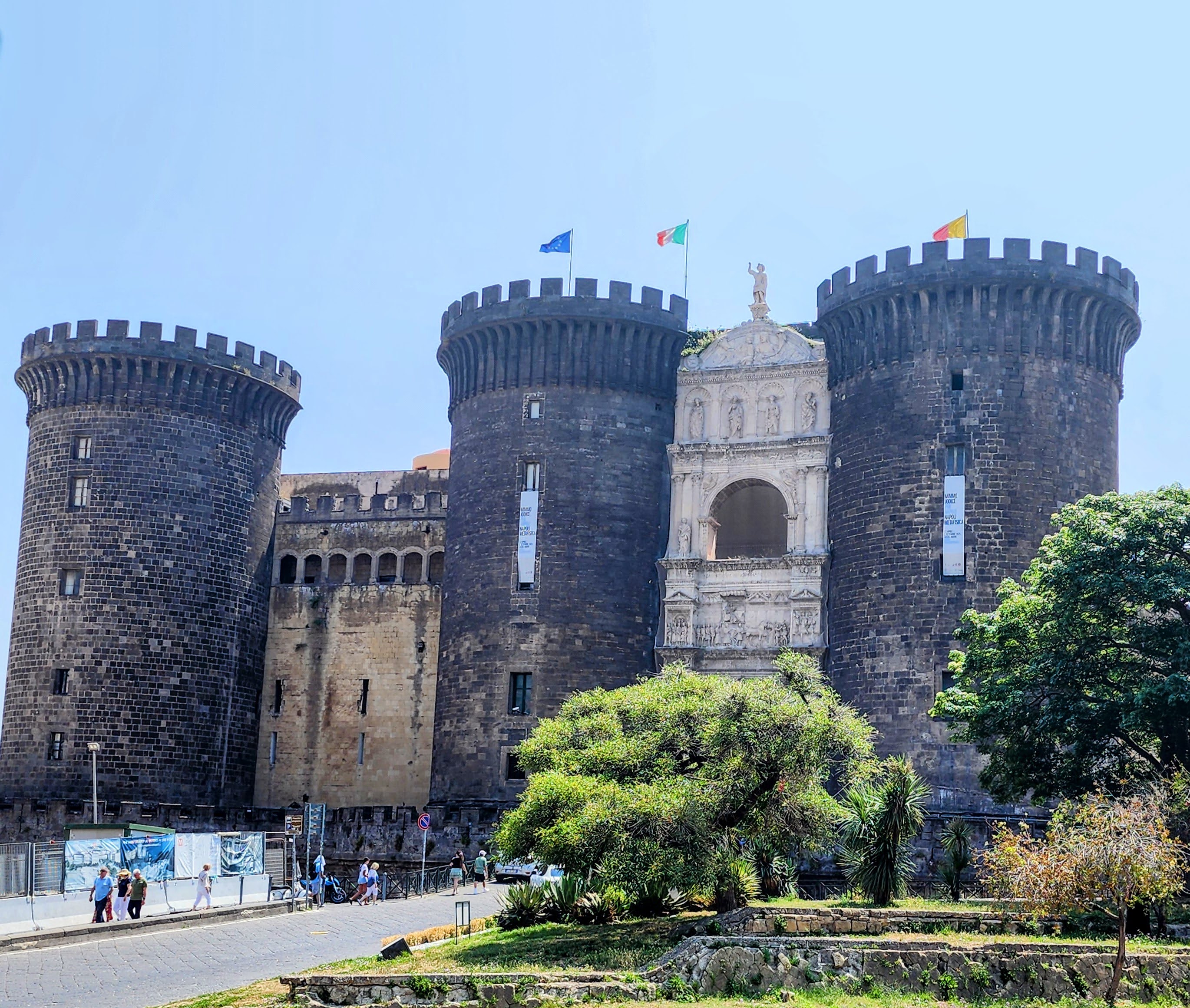
I’m riding a tour bus through the streets of Naples. If you’ve never been to Naples, put it on your list. I’m riding the bus with—that’s a good question. Who am I riding the bus with? I don’t have a term for this type of relationship. We’ll call her Rosa. Once, we were married to brothers, so you might say she is my sister-in-law. But the brothers are dead, and the one that was once my husband has been dead for so long that I now have another husband, so who am I riding the bus with? I could say she’s my friend, which would be somewhat true, but also somewhat false. You choose your friends, but Rosa and I didn’t choose each other. We are family, but I no longer have a name for how. We did choose to take this trip to Naples together, though, and to get on this bus.
Castello dell’Ovo, Naples
The port, the castles, the zillion churches, and beeping herds of motor scooters are zooming by us on all sides and I think, “What a shame Pio didn’t get to bring me to Naples. He would have loved that.” Then a little giggle bubbles up inside me as I realize OF COURSE Pio brought me to Naples. Why else would I be on this bus with Rosa, listening to the Italian guide channel, humming along to the songs? How else could this have happened? And I feel quite delighted.
It’s cheaper when only one of you has to buy a plane ticket, a bus ticket, and pizza. It’s easier when only one of you has to figure out how to be gone from work. One of us is more of a particle (that would be me) and one of us is more of a wave, now. One of us is denser and the other lighter.
It’s easier, in ancient cities, to feel less bound to things like time. It’s easier, after you live through a death, to feel less bound to things like density. I love to consider the fact that everything is mostly made up of nothing, anyway. That atoms are mostly “empty” space, so that what “is” and what “isn’t” are more the same than different. When I say I “love to consider” that, I mean it literally. I love to sit with it and try to feel it, try to imagine it. Tangible, imaginary, present, past, future…are all made up almost entirely of the same material. The difference is negligible.
All of that is very lovely. But in the evening Rosa turns the tv on and all of the sudden the world is full of war and inconceivable suffering. Which doesn’t feel at all like the peaceful nothing of empty space where time is a big pond you can swim in. How can all of this be possible, simultaneous?
I don’t know. One minute I’m on a tour bus humming along to “O Sole Mio” and the next minute I am aware of the apocalypse that is also happening.
We had a fantastic view of Vesuvius from the second story of the bus. How in the name of common sense can so many people be living so close to this enormous volcano? All of us know what volcanoes are capable of and all of us know that Vesuvius is not to be trusted. Even though lava and crumbling buildings are mostly made of nothing, I wouldn’t like to be beneath either one of them.
Ironies are everywhere.
On the subject of war and exploding volcanos, I don’t think it’s actual death that I am afraid of. I’m already mostly made of nothing. I’m afraid of suffering. Of pain. That small percentage of particle that is physical and can feel sensations changes everything. At all cost, I don’t want it to be cut, burned, crushed.
Let’s not talk about that anymore. Let’s get back on the bus. Let’s not look at Vesuvius. Let’s admire the Castello dell’Ovo. How it sits between the land and the sea for 2000 years. Let’s think about how 8 years can go by after your husband dies and how both of your spirits go through a transition. And then both of you are ok. Different, but quite alright. And the castle is full of tourists, not knights in armor, and the ocean still laps at its feet.
Rosa and I get off the busand are walking back to the hotel, trying not to get run over by motor scooters. Her husband has only been dead for 4 years and she still fights it. The suffering makes her denser, it seems to me, and further from the lightness that is everything. Our lives have been so different that we are an inconceivable pair.
I’d like to sit at a table by the street after getting off the bus and have a cold drink—a Spritz, to be exact. I would ponder the castle and pray to Vesuvius to be nice. But Rosa wants to go to the hotel room to lie down. I wouldn’t mind sitting at a table “alone,” but I decide to go with her. The dead brothers would appreciate that. I can have a Spritz another day. Besides, I have writing to do.
Medieval cities sound romantic. They are stunning, quaint, and mysterious from the outside. Inside, their rooms, however, are rather dark and cold. It makes sense. The windows are made to let in enough light so that people didn’t bump into each other or suffocate. In the times before glass, I guess, luminous interior spaces were not a thing.
Here in my mini apartment in the citta’ vecchia of Sanremo, I have a window and the window has a view of other windows. The neighbors, luckily, are a little more private than I am, and I guess more used to dark chilly spaces. I pulled a chair over from the little table and sat it up against the mini refrigerator. The space is so small that my feet are sticking out the window. A patio would have been nice, but there aren’t a lot of patios in medieval cities either. The apartments with terraces were out of my budget.
Not all of Sanremo is medieval, just the part called La Pigna (“pinya”) but I wanted to stay here. It seemed romantic, quaint, and mysterious. And I wouldn’t say that in that regard it has been a disappointment. It’s also chilly and a very steep hike in all directions from the door. I like it. Next time, though, I’ll choose something with more light.
My stepdaughter Kiara lives here. We grew up together, kind of. She’s beautiful, confident, and 26 years old—a force to be reconned with. Being a step parent is not the easiest thing I’ve ever done. There is a lot of pride-swallowing involved in the beginning, and opinions you get to keep to yourself, and things you just have to breathe through because that’s the best/only option. But it isn’t easy for the children either, and they are children and you are the adult. So you get to suck it up. The good news is that happy endings are possible. Case in point. You might get to visit medieval cities overlooking the Medeterranean Sea.
Tomorrow we are taking the train to France together for the day. Who would have thought? When she was little, we collected clams from the beach on Sunday mornings, and raked mango leaves out of the yard, and puzzled over how to add and multiply fractions.
You can sleep deeply in medieval cities. The stone walls block everything from street noise to wifi. I’m not one who minds sleeping in rooms where others have been born and died. It seems to me that, among other things, that’s what houses are for.
Homes in general are small in Italy–smaller than in the USA anyway. Italy is small and if people weren’t tidy, it would be unlivable. There are no extra spaces, no extra things, and every object has a place it belongs. Tidiness is knit into the fabric of how people live their lives. For as much as Italy is known for chaos, daily life is made of processes of order and correctness. Although, I admit, I haven’t been to Napoli yet. That’s next week’s trip.
By now, a hot day is under way above the medieval city, but my feet sticking out the window (an egregious violation of order and tidiness) are cold. I’ll pull the shutters closed over the window now, put on my shoes, and head down the stone stairs that are the public street until I reach the Mediterranean. People have done exactly that right here for 1000 years. And in 1000 more I expect they still will.
I like the sound of my footsteps blending with theirs.
This is not a commercial or anything, but I have a recommendation–a little unsolicited advice, perhaps.
. . . . . . . . . .
I paid for Netflix for mostly no reason for a lot of years. It figured out that I’m not in the USA, so almost everything I tried to watch gave me back a message that this isn’t available in my area. And yes, VPNs, but I never managed to succeed at that. So I discontinued Netflix and subscribed to Gaia. Best move ever. I’m not saying you will love it as much as I do, but…you might. Costs about the same as Netflix. And it will trip you out and not fill you with mental junk food.
Recommending you try it. Start with the movie called Secret of Water. Then move along to the Divine Science series, or the one called Rewired. Or Missing Links. If you like alien life forms and such, there is plenty there for you on that, too, although that’s not my area of greatest interest. I’m a more Here and Now kind of girl.
Here are a few take-aways to ponder:
Turns out happiness is good for you. And if you can’t be happy right now, that’s ok. Pretend you are. Your brain doesn’t distinguish between what you imagine and “real life,” so you can start reaping some of the happy-people benefits even if you’re actually sad or grumpy. Isn’t that awesome?
And there’s another thing. It’s about Time. We draw timelines to express time, but I’ve always felt certain that time doesn’t really go in a line. And what do you know—it doesn’t. In fact, “time” is basically a function of us being stuck on a spinning planet with a sun and all. If you go away from Earth out into the rest of the universe, seconds and minutes and weeks and years cease to have any meaning. You don’t even have to go into outer space. Get on a transatlantic flight and see what happens to your timeline. Ha.
And plants. This is another one I’ve “known” without knowing. Just because something doesn’t have a brain doesn’t mean it has no awareness. Scientists hooked a plant up to a machine that reads electromagnetic signals the way a lie detector does. They played different types of music to the plant to see how it responded. As it responded differently to different types of music, the experimenter thought, “Gee I wonder what would happen if I took my lighter and burned one of the leaves.” And the plant flipped out. It sent out electromagnetic stress signals the way you do when you tell lies. The guy didn’t even do anything—he just thought about it. Huh.
Or this one. Your heart has neurons and it can “think.” We all know that our heart and brain don’t agree sometimes—turns out this is no metaphor, it’s the literal truth. Who knew? Not only that, but your heart knows things before they even happen. It’s like it hears the thunder before the rain starts falling. They (scientists, not the Gaia people) did an experiment where they hooked people up to machines that monitored their hearts and brains, and they flashed random images on a screen. Some images were boring, some funny, some disturbing. And the human heart reacted to the disturbing images not only before the brain, but in the seconds before the actual image appeared on the screen.
Again: huh.
Curious yet? Seriously. Watch Secret of Water.
. . . . . . . . . . .
I’m hoping I’ll be a better blogger. That said, I suppose I could not be worse than I have been for the last while.
I had a psychic reading recently, and he told me I should write because my stories are good and people like them. Hahahaha. And that I give good advice and can help people to heal. Lovely things to be told, and I hope all of them are or will be true.
I’m leaving for a trip to Italy in a few days. I’m also about to start building a house. So there will certainly be stories to tell.
how deep is the air above us? I will swim to the surface and look down all of this at the bottom
there we are like twin hermit crabs sharing a shell scurrying along a ribbon of road in our white car fluctuations of the sea floor look to us like valleys, mountains
we are passing the curve where decades ago the Vallejos family planted mangos trees to form the letter V we are looking at the sheep grazing there, wondering how they survive this heat in those coats
clouds are moving toward us from the east we can’t see them as we creep along, but every day they come closer
later, when the rains begin the heavy sky will seem small, as if it barely clears the mountains we will think thunderheads tower to the top of it
but we will be wrong even they are only eddies in an undercurrent
When did it get away from us? It’s definitely gone. Out of the gate and taken off to who-knows-where. Leaving in its wake a cloud of incomprehensible noise and traffic jams.
Tamarindo. This is a lament.
What happened? In the beginning, we wanted the town to grow, to progress. Is this progress? Is this better? It’s more, that’s for damn sure. But is it better? For whom?
It sure seemed like progress when they first paved the road into town, and for a period of about 20 years you could actually drive on it. But now the traffic jams take longer than the potholes used to, so here we are back at square one. In bigger cars.
We loved Tamarindo. Remember that? We loved it absolutely. Remember when the nights were dark, and we could walk on the quiet streets under trees? Remember when the beach became “crowded” at Christmas and Semana Santa? Remember when all of us fit into one bar? We weren’t all best friends, but we were a family. I miss my family.
Some have moved away. Some have died. Some of us are still right here, but the noise and the traffic and the signs and the lights are too much for us, so we don’t get out much. The restaurants are too expensive. The night life is disturbing. I never thought I would be the old lady bitching about how things were better before they were the way they are, but check it out: that’s happened too.
The Old People who chose Tamarindo are different from The New People who choose it. Obviously. The Old Tamarindo is not the same as The New Tamarindo: the Old People would never choose this. The New People clearly wouldn’t choose that or they would be somewhere else. And thus the spiral continues, wilder and wilder.
Tamarindo has always been a little wild. I vaguely recall stories about Tamarindo’s early connections to (someone embroiled in) the Iran Contra Scandal. And a guy shot dead on the beach by a “stray bullet” from somewhere on the mountain more than 30 years ago when there was barely a handful of houses on the hill. They said it was a “hunting accident.” Remember, the big blonde ex-FBI agent (or something) who briefly owned Iguana Surf when it was still a surf shop/restaurant on the road to Langosta, and how he chased thugs around on his gigantic quad? He decided to be the police department, so he was.
The drug dealer and the prostitute, back then, were just neighbors like the doctor, the Spanish teacher, the guy who sold Sansa Airline tickets, and the lady who owned the grocery store. Remember when the carpenter got so mad at the bar next door for making noise when he needed to sleep, that he plugged in his power tools and started sawing metal during live music? That was hilarious. It worked.
The Old People, when we were young people, made due with whatever the little grocery store had that day, and drove each other places because having a car was a thing, and let neighbors borrow the phone because there were about 5 (phones, but also neighbors). The nearest pharmacy was in Santa Cruz, hours away over the unpaved road. My friend’s anxious baby was born in the back seat of the car. Old People, who are now actually aged as well, find ourselves to be well-equipped for an entirely different reality–not so much for this one.
The New People… I don’t know. They are a lot richer than The Old People were when we were The Only People. You could have bought all of Santa Cruz County back then for the current price of a house in Langosta. They like air conditioning more than open windows and appear to be competing to see who can build the most miniature apartments in the least space. They have an incomprensible affinity for reggaeton. Or maybe that’s the tourists? It’s so hard to tell one from the other.
People point to Covid, saying that “after Covid” things really got out of hand. Did they? I don’t know. I thought they were out of hand before that. Covid was a nice reprieve in many ways, but I don’t see the “progress” now as significantly different than what was going on before. Maybe I’m missing something?
It all started when they paved the road from Villareal.
It all started with the advent of the internet.
It all started.
And it just keeps building. Mountain after mountain gobbled up by cement and swimming pools. Good bye guacimos, sainos, indio pelados, baby guanacastes, cenizaros, maderos, cedros. Hello stupid palm trees.
Once upon a time, when Tamarindo was a little fishing village with a dirt road, some small hotels and sodas, and a few public phones, the fancy people lived in Flamingo. Flamingo had the big hotels, glizty houses, up-scale restaurants, and even a discotech. Flamingo had pavement.
Once upon a time, the nearest rent-a-car office was in Liberia.
Once upon a time, nights were so dark that dinosaur turtles came up out of the bay at night to nest. Here.
I am keeping my eye on you from a safe distance, Tamarindo. We are old friends who knew each other as children. You have gone mad and I have slunk into the forest, but still, we belong to each other. We remember each other’s joyful innocent days.
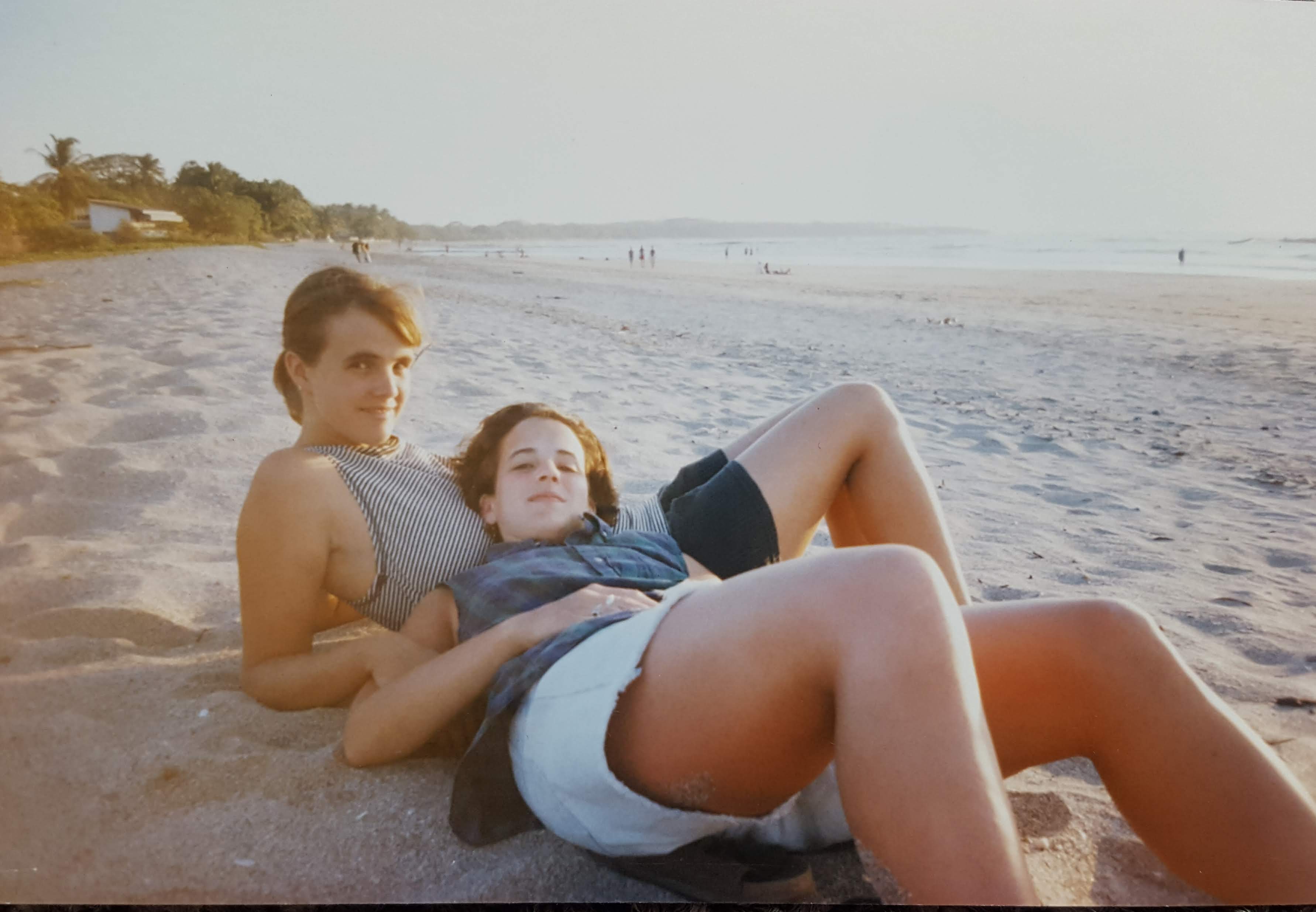
My sister and me at sunset on the beach in Tamarindo in front of my apartment in what is now Witch’s Rock Surf Camp. March, 1996.
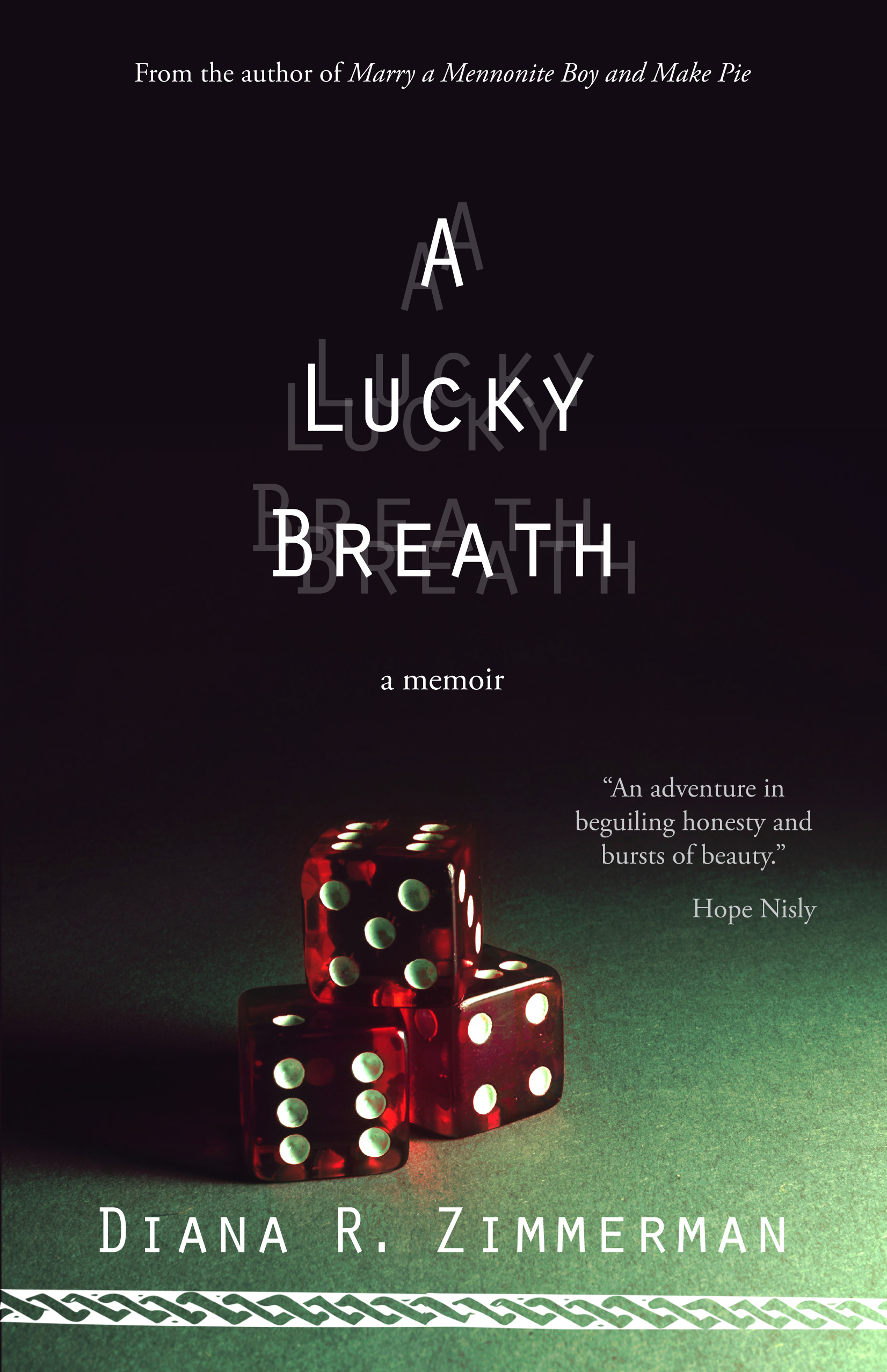
A Lucky Breath is my third memoir. It met the world in December of 2023 after having lived in my notebooks and my computers for over 20 years. When a book exists with you for that long, it becomes a member of the family. Its completion and “departure,” for as much as it is joyous, also unlocks nostalgia. The house feels a little too quiet, afterward. There is a sense of accomplishment and pride. A delicious wave of relief. An odd and unfamiliar sort of loneliness.
A Lucky Breath wasn’t always kind to me in its journey from the universe to the page. It grabbed me by the ear and dragged me, kicking and protesting, to the desk to work on it. When I had time. When I didn’t have time. When I wanted to do nothing or do something else. When I needed rest. A Lucky Breath had a mind of its own from the beginning, and the months following its release have been an adjustment period for me. I couldn’t wait to have such a demanding book finished and out of my hair, but now that it’s gone, I miss it. I’ve found myself with this forgotten commodity called “free time.”
Hard/Impossible
This memoir is not like the previous two that I published. This one rattles my readers. My first memoir, When the Roll is Called a Pyonder, shares my early childhood memories of growing up on a farm in a Mennonite community. It’s charming, funny, sometimes poignant, and easy to identify with even if you didn’t grow up on a farm and are not a Mennonite. The second memoir, Marry a Mennonite Boy and Make Pie, is a coming-of-age story, and deals with the struggles of beginning to make your way in the world. It’s set in a ratty college apartment and, again, is funny, often poignant, and easy to identify with if you grew up to leave the first world that you knew.
A Lucky Breath is a bittersweet memoir of a love affair with a village in Costa Rica and my doomed marriage to an abusive husband there. It’s a divorce story. There is very little to laugh at, and, unless you have also been frightened by your husband and found yourself nearly homeless, it does not give voice to your experiences. I’ve been told it’s both hard to read and impossible to put down.
After the release of both When the Roll is Called a Pyonder and Marry a Mennonite Boy and Make Pie, delighted readers who are also friends, created Zoom chat groups with me to talk about the books, to share their feelings, and their experiences of growing up (first book) and leaving home (second book). Let’s just say that this time nobody jumped up to put together a Zoom call about domestic violence, intercultural marriage challenges, or how we sometimes make the same mistake over and over.
I did, however, privately receive moving responses from readers who found themselves gripped by a tale they were not expecting. Nobody wanted to call me up to talk, though. We love to laugh together but we do not prefer to share our shame face to face.
Riveting and Important
“So, when is the next one coming out?” This is what my readers have wanted to know. As if the fact that I have something else riveting and important to say is a given. I love that. It terrifies me. There’s nothing more fulfilling than hooked readers who want more.
I’m certain that I have something else riveting and important to say. I wonder what it is.
All My Worlds
All of my stories are true. The innocent Mennonite world of the first book, When the Roll is Called a Pyonder, all this time later, is still where I come from. It’s still right where I left it, in Lancaster County, Pennsylvania. You can go visit it. I can go visit it too, and I do. I feel a deep compulsion to protect that world and the people in it from the world of A Lucky Breath. They are all my worlds, but they do not overlap anywhere except inside this head, inside this body. And so, as I have wished and attempted to promote A Lucky Breath and offer it the possibility of success that it deserves, I have also hidden it.
This isn’t normal. But it is real. In this way, I am this book’s own worst enemy, and it is mine. We’re working on our relationship.
Wise and Wonderful
In the stillness left by this book that has left the nest are the voices that urge me to continue. “The Work. You must do The Work,” they say. “Come back to The Work.” The Work is writing, my work. The thing that, to live well and be happy in this world, I must do.
I obey. I’ve begun haphazardly working on another project. I call it a “project” because, at present, it is a pile of mishmash, ideas, and many blanks. I am collecting fragments, writing scenes, and drawing the bones that will give shape to this creature. There will be plenty of time later to overthink everything—this is the time for the jumble of ideas and impressions that roll all over each other like puppies at play. If I am brave, clever, and do not give up, something coherent may materialize though all this. If my other books are any indication, this one may take me until I am 70 to finish, so it ought to be wise and wonderful.
A breath-taking account of a love affair with a place and an escape from a nightmare marriage that is both a female coming of age story and an exploration of the complexities of gender and cultural crossing.
Ann Hostetler Professor of English Goshen College
Opening with a mental map of her Costa Rican community, Zimmerman lays out her journey through a rugged landscape toward a place of home and forgiveness. She navigates her loves and her losses with a brutal, yet beautiful introspection. She does this with a lyricism that “retains the melody that once was losing its tune.”
This is no ordinary memoir of leaving an abusive relationship. It is an adventure in beguiling honesty and bursts of beauty.
Hope Nisly Emeritus Librarian Fresno Pacific University
Diana Zimmerman writes with heart and passion. Her personal reflections on leaving an abusive marriage, her understanding of family life and culture in Costa Rica, and her personal stories make this a rich and captivating read. Zimmerman’s words point to the complicated nature of justice for the vulnerable amid questions of love and loss.
–Amy Gingerich, publisher at Herald Press books
Diana Zimmerman’s lyrical memoir, a tale of walking away and returning, kept me returning each time I attempted to walk away. The short chapters interpose her memories of a foreign culture that privileged Americans can’t imagine with the story of a broken marriage. Zimmerman’s spare prose hides its melancholy behind concrete images like those of chickens roosting in trees and clothes washed by hand in a cement wash sink. A compulsive read about love affairs, despair, lost paths, raw beauty, and the will to try again when you get up in the morning.
Jeremy Garber Methodist Theological Seminary of Ohio



 Talking to Myself