like a planet with
no gravity
all of the deer have
fallen from my forests
and plummeted into
the sky
the eagles and butterflies have
flown free
oceans lift like
thunderheads and
my silent riverbeds
hold no fish
trees cling tight
among clouds of
dry leaves
cacti and sage
remain
Author: dianarenee
...a writer and poet who left the traditional Mennonite community of Lancaster, Pennsylvania and resides in Costa Rica.
First Rain
remember last year how we
watched it rain?
remember how we
ran outside the
first night we heard
drops hit the roof
and stood on the front porch
embraced
watching silver gold rivers
pour in stripes
to the ground?
we knew it was lucky,
that the year’s first rain
deserves recognition
I kissed you
the jungle around us
opened its thirsty mouth and
swallowed deep
remember how you
were tired,
achy in the middle?
I didn’t like the
new pallor under your skin
and I bought you
electrolytes for better
hydration
it was already too late then to
stop the storm
that was coming
remember the thunder
so close
the roof peak cringed and
the cats flicked their ears?
remember the lightning?
we hugged each other
tighter feigning fear
remember how you could
warm me then, when
the dampness made me cold?
water filled your body
and finally
everything stopped
remember me petting
your hair as you
fell asleep?
the rains have come again
the thunder, the lightning
disturbing the cats
we sit together
on the dark porch
in silence
watching little rivers
form at my feet,
trying to understand
this distance
“So What Made You Write The Book?”
Marry a Mennonite Boy and Make Pie is my new memoir that will be released this fall. The most common question that I hear regarding it, other than “What’s it about?” is “So what made you write it?” In this post I will answer both questions, and explain how what the book is about changed over the 20 years it has been with me.
The scene in “Marry A Mennonite Boy and Make Pie” is the summer of 1991—the summer that 3 other college girls and I lived in our first apartment. I’m calling it a memoir because it is more truth than fiction, although there are splashes of imaginary details/events/conversations stirred into the batter. You will learn more about that in a future blog post.
I wrote the first version of this book in 1997, when the summer it describes was only 6 years in the past. The manuscript was about 40 typed pages, completely factual, and I called it “The Summer of the Riotous Walls.” Why I wrote the original story is different than why I “wrote the book” that is going to be published in the fall. Let me explain.
In 1997, I was 26 years old and married to my first husband. I had a job that required me to show up at a small tourist information center and wait for tourists who needed information. It wasn’t exactly a busy place. And what do you do when you have all day to stay put and wait? You think about things. And what do I do when I think about something for a while? Exacatmente.
I wrote “The Summer of the Riotous Walls” for the pure joy of it, for my own entertainment, and so that I wouldn’t forget anything about what I recognized as a pivotal summer in my life. I was still in my 20s, mind you, but even then, I could tell that summer was one of those points of no return. Not because of something cataclysmic that happened, but because underlayers began to melt, laying fault lines for the giant chunks of iceberg that would break free later, reshaping the land and seascapes of what is me. I wanted to remember what we did, the things we said, what mattered, what hurt, how things came together and fell apart. Because that process is important. And necessary. Unless, perhaps, you never “leave home.”
And the title? We painted all over the interior walls. What started out as a fun idea (yes, we got the landlady’s permission) to decorate horribly disgusting walls turned into a disastrous riot of multicolored chaos. It went from cheerful and pretty to ugly and desperate. Or at least that’s the way I remember it.
I wrote that first version of the book for the same reason you take pictures—or for the same reason we took pictures before digital cameras and cell phones. Now, we take pictures to show off. We used to take pictures to remember. I wanted never to forget how I went from being the little girl in my first book, When the Roll is Called a Pyonder, to the adult I am. It didn’t all happen that summer, but that summer was the end of something and the beginning of something else.
And then I put the story away for 17 years. It was too short to be a book, but too long to be a short story. And nothing really happens in it—nothing dramatic like rapes, murders, house fires and terrorist attacks. Which is a shame, because I thought it was pretty good. But not that good. But still, a shame to have it just there on a sheaf of papers in a folder. But hey. It is what it is. Or isn’t.
Then, in 2014, my book When the Roll is Called a Pyonder was accepted for publication. I kind of couldn’t believe it, and I knew that if that book has something to say to the world, this one has more. They each speak more clearly when they speak together. I knew immediately that what I really have is a trilogy (yes, there is another one) that maps how the little girl from When the Roll turns into a woman like me. And that story about that summer in the apartment is the pivot point in the middle.
But it was going to take A LOT of work.
So, I pulled it out, typed those 40 pages into the computer and started working. Between 2014 and 2017 I added scene after scene. The focus of the book changed. It wasn’t about nutty girls painting on walls anymore. I realized that the only way to tell the story right would be to add scenes that are snapshots from my first visit to Costa Rica. Yes, Costa Rica entered the book. I tried to keep it out because it complicated everything for me, but books don’t care how much they complicate your life or how hard they are for you to write.
It turned out that the book wanted to be about a lot more than the amusing antics of girls, although it is still built on them. All along, it wanted to be about the summer after I came back from my first visit to Costa Rica and was turned inside out by it in more ways than I had words to express. I kept waiting, that summer, to feel like the same self I was before and it wasn’t happening. The book wanted to be about breaking apart, connecting, and it wanted to be about expectations. Thus, the new title, Marry a Mennonite Boy and Make Pie, is drawn from a line in the first chapter where I contemplate possibilities for my future.
Marry a Mennonite Boy and Make Pie had to wait a long time for me because it’s not a book a 20-year-old can write. That’s not an insult to 20-year-olds, either. If I hadn’t written the (very entertaining) bones of it when I was 20, how could I have given it the rest of its body at 40? The 20-year-old has the adventures and takes the pictures. The 40-year-old pulls it together and tells what it means.
I needed this book desperately when I was the girl in the story, but I didn’t have it. I needed the permission, the forbearance, and the open ended questions. Now, I have it to give.
* * * * *
Do you have a question about the book? Ask me, and I will answer (or address) it in a future blog post.
April Travels Part II: A Lot of Miles
The Saddle Mountains
The windows of the house face south toward a long row of low desert mountains called the Saddle Mountains, named after a dip in the ridge shaped like the seat of a saddle. It’s a reference point you can see for miles away. When I say miles, I mean A LOT of miles. In the Eastern Washington desert, with no tall trees and no humidity, you can pick out the saddle in the mountain when it’s so far away, you can drive toward it for a full hour.
In 2011 and 2012 when I was working as a traveling case manager for the Maternity Support Services (o yes I did) of a small-town clinic, I could tell where I was in relation to familiar places by keeping one eye on the Saddle Mountains. There were a lot of things I loved about that job, and one of them was driving. For hours. Just to go find some pregnant (usually undocumented immigrant) woman living in a crumbling mobile home the middle of nowhere and ask her to tell me her story. I got paid good money for that. Unbeliveable.
I loved driving home to my own (not crumbling) mobile home, seeing the lights on inside when I pulled up, and looking curiously through my own windows as if I were a stranger. Pio would be inside cooking, with CNN en Espanol talking to him from the living room. There were giant furry cats.
Teenagers
My niece and nephews have turned into teenagers. It took so long to get here, then it happened so fast. Like spring. The noisy little kids who filled their living room floor with toys, never wanted to brush their hair before school, needed their shoes tied, couldn’t reach the orange juice in the back of the refrigerator and had to hear 3 bedtime stories and then prayers… are teenagers. One of them drives them to school. They do things like get their own breakfast and put the dishes in the dishwasher, find both socks all by themselves, lie on the couch reading, get in the mood to play the piano, build a bon fire and produce s’mores with no oversight whatsoever and no injuries. Say things like, “Not right now. I have to do my homework.” It’s amazing.
Blooms
The sour cherry orchards bloomed this week. The orchards that surround the house on all sides went from winter brown to a stunning brilliant bridal white, and now are turning slowly green. Have I seen this before? Not quite like this. I never got to live literally in the middle of it. I went for a walk in the orchard at the peak of the bloom. It was like a fantasy land. Full of bees. Millions. But they could not have cared less about a human with all those acres of delicious white flowers. I thought what a shame that Pio and I never took a walk in the orchard while it bloomed like this. We were always busy working. He would have loved it. Then I thought, well if dead people are still living souls and they don’t have to do things like go to work, then I guess this is as good a time as any for us to take a walk together. We’re both on vacation.
How sometimes you can be right there with another person but you’re really a million miles apart. Or how you can be all by yourself, but you’re really with someone.
In the Basement
In the basement is all of our stuff–or what’s left of it. We pared it down a lot when came back to Costa Rica two years ago. I went down and dug through the boxes. You might think I would be crying or something, but I wasn’t. It’s comforting to find tangible reminders that everything in my head is real. I didn’t make any of it up. Never underestimate the value of being able to prove that to yourself.
Home
Everywhere I go feels like home. Pennsylvania. Washington. Costa Rica. Tomorrow, I’m going back to the home with hammocks, bicycles, and cats. I’m not anxious to leave, but not sad to go. This trip was overwhelming to contemplate from the front side, comforting from the back. It was a good thing to do—make a break at the half-way point in the first year of… This.
How you can walk right out of your life for a month or forever and the world keeps spinning around as if nothing were out of place.
April Travels Part II: Sisters
Ohio
My plans to write a travelogue got a bit derailed by things like socializing with the people I’m visiting and the announcement about my next book. If only all of my problems were so wonderful.
I spent the second week of this April trip in Ohio visiting my sister and her partner. The great thing is that my other sister was able to be there too, so The Three Weird Sisters had a rare and wonderful reunion. The last time we were able to do that, with the exception of a very busy wedding weekend, was 2014. A lot has happened since then. One of us got married; one of us became a widow; one of us has acquired 3 teenagers. Big stuff.
It snowed. I took pictures to prove it. It was also really nice one day (count your blessings) so we went to the world’s most awesome thrift store and an Eddie Bauer factory warehouse outlet. How to save more than you spend. We invented it.
And it was Pio’s birthday. I don’t have anything profound to say about that. It just was, and then the next day it was over. Like Christmas and our anniversary and all those other things that you can’t hide from. I can’t hide from. It was a good day. I made pizza for us and we had a little birthday party, sort of. My sister’s wife had her second round of chemo that day. Yeah. Breast cancer. She’s going to be fine, but still.
There is no way on this planet that you could have convinced me, when I was a kid, that my sisters would one day be my best friends. I don’t think we fought more than normal sisters, but I would always have picked “my friends” over “my little sisters.” Is that normal? I feel a little bad about it now. Now, I pick my sisters, hands down. One is an ethicist/theologian, the other is a dietician who studies spiritual direction, then there’s me. They are both smart as whips, beautiful, and prone to incapacitating fits of laughter. I think it’s genetic—I mean all 3 things. Our mom is the same and so was our grandma.
Washington
Now, I’m in Washington State. Othello, to be exact, approximately 40 minutes from The Middle of Nowhere. Google Map it. You’ll see what I mean. This is where Pio and I lived for 5 years. Made a life out of nothing. We were happy here, then we got restless. I think everything turned out right, considering how everything turned out wrong.
In the basement of my sister’s house where I’m staying, there is a stack of crates and boxes with our things in them. All of our treasures and things we couldn’t take with us back to Costa Rica, and couldn’t part with. Photo albums. Winter clothes. I found a hair on one of Pio’s sweaters. I saved the hair and took the sweater to Goodwill. I took my sweaters to Goodwill too because it made it easier to take his. Plus, I need wool sweaters right now about as much as he does.
Last night I dreamed I was packing up to leave, and Pio was here running all around. It occurred to me that I should buy him a carry-on so he could help me with the luggage. Then I realized that, no, he can’t bring a carry-on–I have to do that myself. But I think I get it.
Marry a Mennonite Boy and Make Pie
GREAT NEWS!
My new book, MARRY A MENNONITE BOY AND MAKE PIE will be coming to you via Workplay Publishing this fall.
What is it about?
Once upon a time, in a mid-west college town, there were 4 girl-women that rented a ramshackle apartment for the summer. They did lots of silly, crazy, and a few potentially-dangerous things as they tried to figure out, like people feeling around a dark room with their hands, how to begin to be adults. They broke rules because they could. They asked questions they were supposed to already know the answers to. The girl-women were Mennonites, or the daughters of Mennonites, or a new generation of Mennonites in full sail toward the edge of what they were told was a flat planet.
This book is written snapshots from that summer, placed together to tell a story. The story is a memoir and it is fiction. Everything is true, some things are false, nothing is impossible.
If you ever had to map your own terrain, if you ever were 20 years old or went to college, if you ever realized that the rules you memorized from the rulebook don’t apply to the game you’re playing, if you ever wondered if you were going mad, you may find snapshots of yourself here. Many of us make the journey. I took pictures.
Marry a Mennonite Boy and Make Pie continues the story begun in my first book, When the Roll is Called a Pyonder, but it is not a direct sequel. It is set 11 years later when that spunky little 9-year-old is just as spunky but not as little. Some of When the Roll is Called a Pyonder‘s audience will also enjoy MARRY A MENNONITE BOY AND MAKE PIE. Some of that audience will be offended. I will do my best to promote this second book in places where it will find appreciation and not create offense. I hope you will join me! Get ready to learn more about it in the coming months as I do my best to give it the promotion it deserves.
April Travels Part 1: Things That Never Change
I got on the plane a week ago in hot, windy Liberia, and flew to Harrisburg, PA. USA. I’ve been here for a week in the farmhouse I grew up in, with my parents and one of my sisters and her family. Tomorrow, my sister and I will fly to Ohio to visit our other sister.
April is supposed to be spring in the northern hemisphere, but in Pennsylvania, this year, it is still winter.
I’ve seen a lot of people I love. A definite highlight was a dinner with friends I haven’t seen in 20 and even 30 years, and another was getting to know a cousin I haven’t really known in my adult life. It’s all good, but it’s not always easy. Falling asleep and waking up are easy. What comes in between is not. Except overeating. Overeating in Pennsylvania Dutch Country is easy. It’s normal. Then you put on your skinny jeans and feel penitent.
The Farmhouse
The farmhouse I grew up in never changes. Part of it is something like 200 years old, which, in the Americas, is old. My parents put a laminate wood floor in the kitchen/living area since Pio and I were here 2 years ago. They got new carpet in the living room. Other than that, everything is the same. When I come home, I sleep in the same bedroom I slept in as a child. The trees are bigger, but since spring is late this year and there are no leaves on the branches, I can look out my windows and over the fields and the pond. Its comforting. Kind of. It’s old. Older than my memory. Older than my loss. I looked out these same windows at the same moon when I was 16 and when I was 2. I remember that.
Does it make me feel better? “Better” might not be the right word. It makes me feel something different—and that can hardly be bad.
Even though it’s April, it’s cold enough outside to keep burning wood in the wood burning stove in the family room. That’s a big plus. There’s a constant cozy spot in the house where my mom and I go to get warm. The floor creaks in all the same spots it did before, and the doors make the same sounds. This is the safest place in the world.

The Farm, March 2011
Cold Wind
It was windy in Guanacaste when I left, and it’s been windy here, but it’s a different wind. A very very cold wind that pushes me back inside every time I stick my head out the door. It comes to my skin with a sensation of pain. The high temperature for today, in degrees Fahrenheit, is predicted to be 43. Low last night of 25. The sun is nothing more than a big light bulb.
Unspoken
I was not—NOT—prepared for almost no one to talk about Pio. That is so weird to me that I can barely get over/around/beyond it. But I have to behave politely and keep it together, so I do.
But I don’t understand. Not mad. Completely confounded. I mean, we all know there’s a very noisy, vivacious and unusual person who is NOT HERE, right? So? I did not expect no one to talk about him. I did not expect to be (almost) the only one to say his name. That is SO WEIRD to me. It leaves me speechless.
I know I am not the only person who notices that Pio isn’t here. Is not speaking of him supposed to be a courtesy to me? Because it only feels upsetting and confusing. Not speaking of him makes me feel worse, not better. As if I am the only one who feels this absence. Of course I am the only one who feels it in this way. But I would actually feel much better if somebody else would bust out with, “Well things sure are different when Pio isn’t here!” I would feel much less like I am about to go insane.
I know. People don’t know what to say. Are afraid of saying the wrong thing, or something silly. Or that I might burst into tears? I might, but probably not. If I do, it won’t be because I became suddenly upset. I burst into tears all the time when no one is looking, so for me it’s not a new or disturbing experience. And the only wrong thing to say is nothing, like he was never even here. THAT is VERY wrong.
I’m guilty of it too. Now I know. Not speaking of the beloved dead because of not knowing what to say or not wanting to upset a friend or a loved one. I’m sorry. I didn’t know. I have done it too.
Those of us who are left are not more upset when someone offers to remember with us. I never for one minute am not thinking of Pio, so there’s no chance you’re going to remind me of something I had momentarily forgotten. To me, honestly, it feels as shockingly inappropriate to address his absence with silence as it would be to ignore him personally if he were sitting at the table. But then again, the PA Dutch are not known for their skill in navigating emotions.
Just thought I’d tell you about it. If I don’t tell you, how will you know? All of us are learning how to do this.
Suitcases
Now, time to stuff everything back into the suitcases and roll on down the road.
Sand
Ashes
I have some things to say about ashes—human ashes, the kind I live with. I thought you might be curious. I was. Pio’s ashes came to me in a rectangular stainless steel box that the Comune di Milano considers appropriate for traveling. The box is sealed shut because in Italy it is illegal to spread human ashes. I didn’t bother to find out why. I don’t actually care why. I will just say that it took a mighty amount of determination for me to get into that box. Having him (“him”) sealed in there by somebody who felt is was not alright for him to come out just about drove me nuts.
I got it. It’s a story for another day—but I got it.
And this is what I want to tell you: cremation ashes look like sand. They do not look like wood ashes, and they’re not flakey like that. They’re heavy like sand. I asked my faithful friend Google about it and s/he explained that the only thing left after a person is cremated, are bones. It makes sense. Everything else is water, and turns into steam or smoke, I suppose. The bones are then ground to tiny pieces and called “ashes.” What they really are is sand.
Does that gross you out? I hope not. There’s nothing yucky about ashes–that’s the whole point of them. Does it scare you? Well. These are the things we need to sit with. Starting now, or you can wait until you have no choice. It makes you sad? Good. You’re supposed to be sad about sad things. Sadness is unsettling when it is a stranger, but when it grows to be familiar, not so much.
Sand
Where I live, the sand is made mostly of tiny pieces of shells. Some coral. Some stones. How long does it take a shell to become sand after the animal that made it dies? I think that should be a unit for measuring time. The beach is made up of bones.
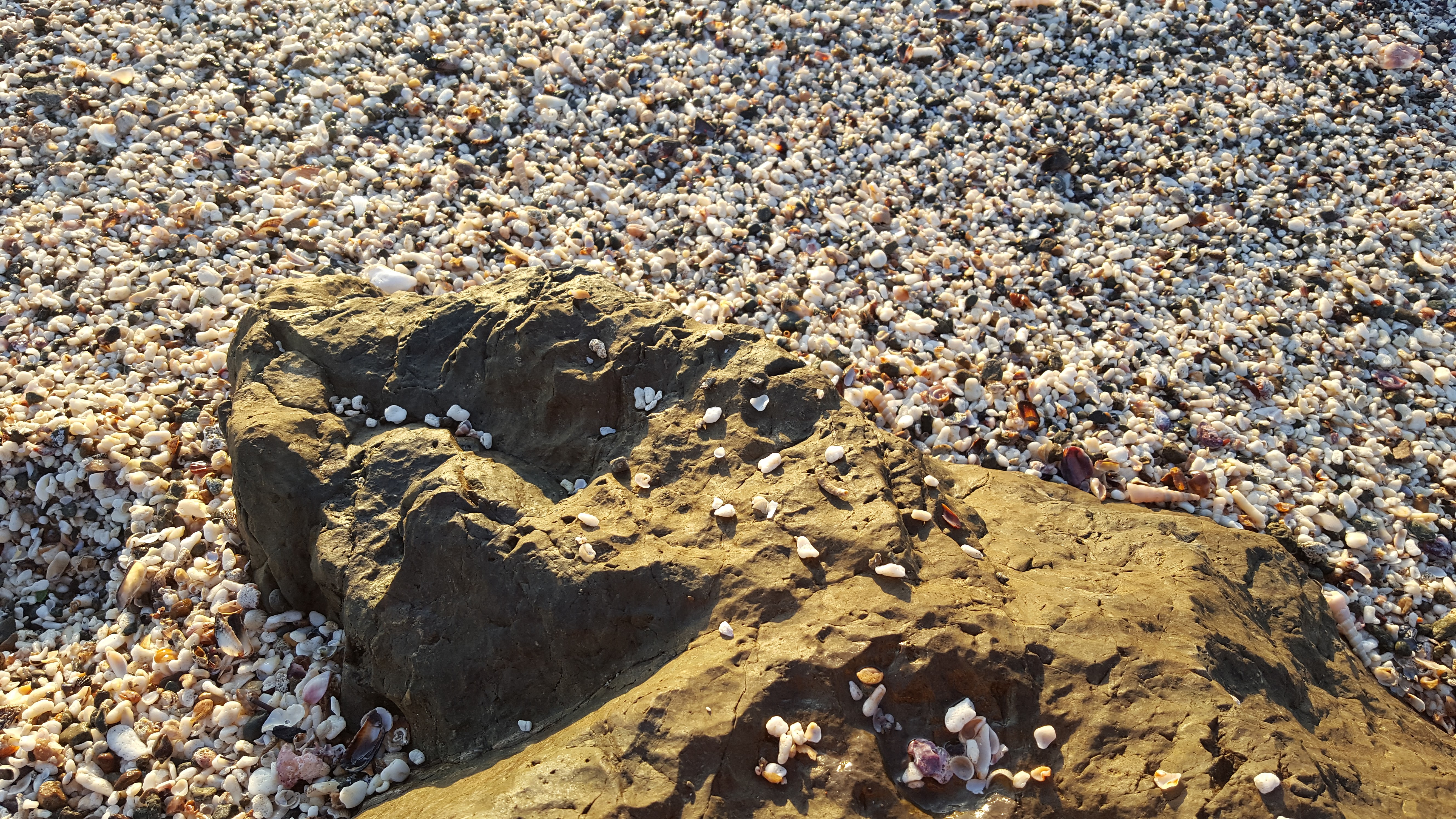
Bones
I sit on the beach and run sand through my fingers. Push my toes into it. Look at the little bones of all of the things that ever lived. Think about how everything together equals una sola cosa. I tell myself it’s ok.
How long does it take for water molecules that rise to the sky from a crematorium in Milan to become a cloud above Costa Rica? I lie in the sand when the wind is whipping and let it pelt me. Get in my ears and bury itself in my hair. Everything that is, is made of everything that was. I tell myself it’s ok.
Sometimes it is, sometimes it isn’t.
But you have to find a way to open yourself up wide enough to let it inside you. You’ll suffocate, otherwise. The more you’re afraid or the more you fight, the worse. You have to put your fingers in the ashes and the sand and you have to let all the little bones pour through your fingers. You just do. There’s nothing to be afraid of.
Put your ear to the ground, to the sand, and listen to the bones of everything.
All You Have
time is nothing
time is
all you have
mark its passage
keep it
let it go
can wind be a
measure of it, or
is time a measure of
how much wind
has slid through
your branches?
where are your leaves?
they have fallen and
wind has
taken them away
don’t look
wait with
eyes closed
hear how much time
fills the universe
catch it
hold it tight
all you have is
nothing
The Illuminated Half
You start getting used to being just you again. Even if you don’t want to—you do. It’s not like everything is always a surprise every day like it was at first. It starts out like “50 First Dates,” with you having to tell yourself the whole story from beginning to end every single morning, but eventually when you wake up, you remember. And your life slowly starts to resemble what it was a long time ago, before everything. You liked it, then. You like it now, sometimes.
You get better at not buying too much food at the grocery store. You realize that you don’t need the car you don’t have, because a backpack full of food lasts for a week, anyway. You stop expecting to relax on the weekends, because by the time you run all the errands on your list and do all the things that need to be done, it’s over. Because you have to do each and every single thing yourself, one at a time.
It’s what happens. In case you wondered.
Even though you have a good job and spend almost nothing, you are still always running short of money. Because rent is rent and the bills are the bills. One person or two don’t change the rent, the electricity, the cost of wi-fi. But only half as much comes in. You try not to stress out about it. Anyway, you have a Jenga towers of tiny containers of leftovers piling up in the freezer. You make a mental note to that you need more tiny containers.
You’re surprised to discover that even though you want to go out and see people, when you get there and see them, you soon want to leave and go home. What’s there to talk about anyway? And people seem possessed by this inexplicable need to talk all the time. You wonder if there is anyone else on the planet who comprehends the phrase “comfortable silence.” You realize that if there is, you don’t know them. You wish you did. You wish other people had more in common with cats.
You look up at the half moon one evening and suddenly you get it. It’s the perfect analogy. The half moon. That’s what you are. Half of a thing. The illuminated half. The half that reflects light. The other half is there, but you can’t see it because it can’t reflect light. Exactly. But it’s still there. It’s still the other half.
Then you feel a little bit better.
Four
this is the poem
about 4 months
of silence
you think that is a
long time but
the poem reminds you
it is only the beginning
in it, you can hear
clocks tick
wind
an almond leaf scuttles
through the yard
it is a short poem
but the 4 months
are long
moonlight
drums on the roof
like rain
The Good Book That is “Too Quiet”
I thought you might be ready for a change in subject matter. And I have been talking to myself about something new lately, so I’m not forcing a different conversation. I need your input. I want your opinion, maybe your permission, perhaps your forgiveness. This conversation that I’ve been having with myself is not unrelated to the events in the last year of my life, which I think will be obvious. But it is also not about sickness or death.
Whew.
I have a book. It’s not a new book; it’s one I’ve been working on (off and on) for 20 years. I’ve mentioned it before, although not recently. It’s the memoir, with some fiction stirred in, of a certain summer in the middle of college. It’s a damn good book. I mean, really. There is not a shadow of a doubt in my mind. And it’s as finished as it’s going to get. Not perfect, but good enough, and done.
After “When the Roll Is Called a Pyonder” was published in 2014, I pulled this one out of the vault, and worked on it as hard as I could for …about 2 years. I poured my heart and soul into it. I paid real money for a writing to coach to help me. And then I started sending it to publishers.
Through 2015 and 2016, I sent this book to every small publisher that (a) publishes either fiction or memoir and (b) doesn’t charge a reading fee of more than 20$. I even pitched it to a bunch of literary agents. I have the loveliest collection of complimentary rejection letters you ever saw. Like I said, it’s a good book. But nobody wants to publish it. Nobody is convinced it will make them boatloads of money, which is what “the business” is about. What can I say? These people know their business. They’re probably right.
Then in January 2017, something amazing happened. A real literary agent in New York City wrote me back and said he loves my book, he thinks he can sell it to a big NYC publisher, and would I sign a contract? I was so happy I practically cried, and Pio was so proud of me. I almost splattered the great news all over Facebook, but then I didn’t. Because a contract with an agent does not equal a book deal. And how embarrassed would I be if he couldn’t sell it either?
Which is exactly what happened.
The feedback from The Big Boys is that I don’t have a big enough “platform”—meaning followers on my blog and on social media. In other words, it’s a good book, but I’m Nobody. And that my book is “too quiet.” I interpret that to mean there’s not enough, sex, drugs and violence. Well. Guilty as charged. First, I don’t really write about sex, drugs and violence. Why would I? After “Pulp Fiction,” what could I possibly add? Second, it’s a book about Mennonite kids, for the love of God! A little imagination? Anyone?
So, I can think of 3 possibilities for this book:
1. Give up.
2. Spend more years of my life sending this book to publishers and agents.
3. Self-publish.
The problem with #1 is that I can’t do it. I’ve even tried, but I can’t.
The problem with #2 is that I have a limited number of free hours to spend on surfing/reading/writing/lying in my hammock looking at the stars/pestering the cats/drinking wine… doing anything that isn’t sleeping or working. And honestly? I have other things to write. I can either spend my free time on cover letters (like I did for 2 of the last 3 years) or I can get on with life and write something else. I would love that.
The problem with #3? It has 2 problems. On one hand, even though this may be bogus, self-publishing a really good book feels like a cop-out, like giving up. And maybe there are ways in which I am ready to do that. What the hell? Who am I kidding? What am I doing? Hold out for an imaginary audience of people I don’t know, when I have you and me to write for? Why? Are they better people or more worthy? I think not.
The other problem with self-publishing is a very deep very personal can of worms that I would rather not open. But if I self-publish this book, the worms are going to be all over the place, let me tell you. All over. And I might need a whole lot of moral support.
I would rather have introduced this book to the world with the support of a traditional publisher (no matter how small) behind me because this “too quiet” book is going to deeply upset/offend/dismay every single person in the state of Pennsylvania (and a few in upstate New York) who is a blood relative of mine. Each and every single one. I am choosing my words carefully as I write this. If you don’t get what I am saying, go back and read that again. Unless I somehow publish this book “in secret” (oxymoron?!), there are going to be painful personal conversations as a result. That I am not looking forward to. And I would just rather have had a publisher who thinks I’m awesome holding my hand, instead of having to stand here spitting into the wind all by myself. But I’m not sure I’m going to get my way this time. Sometimes, being a big girl sucks.
I’m 47 years old. It shouldn’t matter. I didn’t think it would at this point in my life. If I had known, at 17 and 27 and 37, that it would still matter this much, I would have been devastated. So now I know: it’s never going to go away. Never. Which ties directly, for me, to the reason you have to read this book—the reason it must get out of my computer. Because if I have a heart attack in my bed tonight and this book NEVER gets read by anyone, THAT will be the real and true failure. I will have failed to face something that has been waiting for me my whole life.
I actually believe this. It makes me shake in my shoes in the way that happens when you know a thing is true. …And it’s kind of also what the book is about.
So. What do you think? I’m asking.
P.S.
Please know: There is nothing even remotely scandalous in this book for anyone who was born anywhere other than where/when I was.
(O, the ironies of knowing your “too quiet” book will shock the covering pins out of some people’s hair…)

