Dawning

Something is going on with me. After a year of what may have looked not-so-bad on the outside but was really deep mourning on the inside, something is happening. It is not something I am doing. I have done many things, but this one is not starting inside me and moving out. This one is coming to me from the outside in, and I am observing it, witnessing it.

To tell you you about it, here are 3 things as they were born from my pen into my journal on 3 separate days, all in the month of November. Turn off Grammar Correct. It’s choppy, but if you hold on, it will get you there.


ONE

I feel Pio. Calling me to be alright already. To be happy. To knock it off. To open and close and hold on and let go and be ok. To live. To open my closed hands. To honor him by being joyful and free and engaged with/in my life. With Life.

That is not coming from me. I want to hide and pine and ponder and pontificate and gestate and all. He says no. I am in between these two things, both pulling.


TWO

I went to an intense yoga class and then I laid on the floor and understood Everything.

Thankfulness. For Pio. For what we had. For what he was.

For Life that we have while we have it. And we all move into it and out of it, all of us. All. And it isn’t fair to sulk or to be bitter that someone moved out of it before we wanted, because we didn’t will them into it in the first place, and none of us belong to anything but Life.

Pio didn’t belong to me. He belonged to Life.

And when he is gone the world, the planet, cannot keep him. I cannot keep any more of him than what he has planted in me. When we are gone no one can keep us.

There is so much beauty moving in and out of our lives all the time. Pio wants me to experience the beautiful things and people that are with me now today in life, and not hate the space he isn’t filling.

It is inconceivable that he left his life and I am here, but I am because there are things I must do and be. In the end, no one remains unforgotten except Jesus and Shakespeare and Genghis Khan. So all of us–all of us–are like flowers and grass. We have to be beautiful while we can and that is our calling and our blessing.

And we must be open-hearted and open-handed and grateful for everything we have, and not expect not to lose things. Because everything is coming and going and only mountains remain to see it all.

I will never “find anyone like him” again because no one else is supposed to be like him. My beauty and happiness is mine, not created by him or by anyone else. It is mine and comes from me.

Things and people that I love and want may come to me. And go from me. Because my life is not The Main Storyline. The Main Storyline is so big and so long I cannot know it all.


THREE

I don’t want to call it a “rebirth” or “moving on” or any of the other words or phrases other people use. What is it? It’s like a fog lifting? No. The fog is there. It’s like developing a 7th sense to see/perceive through the fog.

Yes. Like developing a 7th sense. I guess that’s supposed to be 6th sense, ha ha!, but I think I already have #6. The 6th Sense is knowing on this plane, across time/space barriers. Maybe this really is Sense #7: a sense that can “see” through the fog and perceive the depth of time and space where you and the Lost One both are, but in different forms.

And this form is/was only temporary, anyway.

And no one ever really belongs to anyone else. All of us are Life’s gifts to itself. And where we came from and where we are going, who knows? But before our lives was Forever, and after is even longer, and this life was only ever going to be a flash in the pan for any of us. Whether it’s 100 days or 100 years.

This is dawning on me. That is all I can say. It is coming upon me slowly and silently out of out of deep night like a dawn. That none of us knew would come. Much less how or when.

But you have to Do All the Things during the night. You have to listen to the voice of the deep space and wait for the echo to tell you where the bottom of it is. The echo never comes, but you must wait. And while you wait comes the dawn.

I have a peace now and an understanding. It doesn’t wash away loneliness; it sits with it. This peace and this loneliness sit together. They form together in the dark like twins. There is no way to explain these things. The only thing to do is wait for them and when they come, take them in.

Walk. Stop eating. Watch the stars. Sleep with them. Pay attention. Do not stop crying.  Because you have to let go. Not of love or of pain. Of the illusion of belonging. You have to let go. Of ownership.  Nothing is yours. Nothing ever was. Even you are only being lent to your life for now.

He was never really mine. That much has always been clear if you dare to see it. He came to me to give me pizza and laughter and self-confidence and olive oil and the Italian language and 2 step-kids, a trip through the dark side and into the light, 5 years in Washington with my sister, and a motorcycle. But he would freaking kick my ass if he saw me sitting around crying for him now.

He would want me to have become more beautiful, stronger, more self-confident than ever before for having spent 14 years with him. That is what he would want. That’s what Life would want.

All of this is dawning on me. I am not doing this. I am passive; it is active. It is coming on its own over me. In the dark, I did The Work. Now it is dawning.

Yes I watched the tragedy of how he died. But if he was not angry and did not hold back from it, why should I? He told me he knew I would be alright. And I am. I feel in some ways ashamed to say it because I fear it might sound like I am falling out of love with him. I am not. But peace is coming to me like a slow dawn.

And we aren’t so far away from each other after all, are we, amore mio? Not really.


AFTERWARD

I stopped and cried a few times while I was writing that last one just the other day. They weren’t exactly sad tears, just the manifestation of tremendous amounts of emotion in the absence of adequate words.

The only reason I can think of that I should have been chosen for these things is because I am the one who will always bear witness, who will do The Work, tell the stories, carve the totem poles. For you. For the day a story will save your life.

Look, now. You see? The sky is beginning to lighten.


Pio in Mexico, on top of the world. Late 1990s.

Radar

It’s generally safe to assume that when I’m not posting much it’s because there’s a lot going on.  When I pick up the talking stick, it’s because I’ve had time to think—to transpose everything that’s happened into words.  It takes me a while but you know I get there.  There’s been a lot going on.  I don’t know if I’m there.

THE LIST

For one, there’s my book.

Then, I had to move.

And the 2nd of October marked the one year anniversary of the last day I sat beside Pio and held his hand.

I took his ashes into the ocean on that day.

Also, not specifically related to any of this but happening simultaneously, I’ve started experimenting with intermittent fasting.

So there’s a lot going on inside of me, but I don’t know what to say about most of it yet.  Here’s a feeble attempt to start:

UNSOLICITED ADVICE

I guess I can begin with an unsolicited piece of advice about what to say/not to say to your friend who has lost someone as significant as air.  Do that person a favor and don’t make comments about how fast time has gone.  Have I said this before?  I’m sorry.  I’m saying it again.  Like, for example, “Wow!  Time is flying, isn’t it?  I can’t believe it’s already been one year!”  Please don’t say that.  Because to the person who lost someone, the first week took a year.  I guarantee you that friend of yours feels like they have already lived without their person for 100 years and I promise you they don’t think it’s a nice feeling.  Just so you know.  There’s that.

LUCKY AND UNLUCKY

AMAZING reviews have been coming in about Marry a Mennonite Boy and Make Pie.  I’ve also had touching private conversations with friends who have experienced journeys that are similar to mine in one way or another.  I can see now that I was right:  this book did need to be written.  And it did need to get out of my computer and into other hands.  I’m so proud of it.

And, yeah, I moved.  My landlord suddenly needed his extra house back, so I had to make other plans.  I was SO SAD to get the news that I needed to move, but then something happened that you kind of won’t believe.  I almost immediately (2 days?) found another house.  It’s about the same price and it’s so close to the beach I can hear the waves all night long.  If there is ever a tsunami, I will never know what hit me.  But the best part is that back before I even knew him, Pio built this house.  Can you believe it?  It feels exactly like home.  It is home.  Caramelo and Ambrogio like it as much as cats can like a new house.  Is all of this some random coincidence?  I have no idea.

So again, I’m lucky.  And unlucky.

I’m not ready to tell you about the ashes yet.  I might have to write it as a poem because I don’t know now you make a thing like that fit into sentences.

And the book deserves more focus than what I’ve been giving it.  You’re supposed to blog mercilessly about your new book and drive everyone who knows you insane with shameless self-promotion when it comes out.  I don’t think I’ve been doing that.  That would have been hard for me to do even if this was the only thing on my plate.  It isn’t.

I have a good friend who does intermittent fasting and got me curious.  I didn’t think I could do it.  It sounded horrible. I  thought I would be miserable or dizzy or grumpy or…  I just thought it would be too hard or somehow unbearable.  It isn’t.  It isn’t easy, but what’s easy?  Pretty much nothing worth doing is easy.   And there’s the spiritual/emotional side of it too.  I’m not sure I have words that give this any meaning, either, but I’m acknowledging it.  Either fasting is a spiritual practice that turns out to be good for your body, or it is a health practice that turns out to be good for your spirit.  I don’t really feel the need to differentiate.  If you get curious, you can read about it on line.  If it was anywhere near as bad as you think, I would not be doing it.  I always say I’ll try anything once, and I didn’t think I could live with something as lame-sounding as “intermittent fasting” being the one thing I wimped out on and wouldn’t try.  I’ll save that for something actually dangerous.

I didn’t take all the ashes.  I saved some.  That’s cheating, but whoever does the surviving gets to make at least a few of the decisions.  I made up that rule.

BATS

I’ve been thinking a lot about bats.  How they fly around in dark caves and no, they can’t see, but they “see” with other senses.  Radar.  They turn on their radar and they can tell where they are, where other things are, where they should go.  I’ve been trying to navigate by radar.  Because I can’t see shit.  It’s all fog.  But I try to see and listen with other senses.  Sometimes when I walk or run on the deserted beach, I close my eyes and try to keep going in a straight line by listening to the sound of the ocean to the side of me, feeling the wind in my face, feeling the sun on my back.  It isn’t easy but I can do it.  I keep trying.  I follow my gut, hoping that will teach it to give good advice.

I spent a whole year of evenings, essentially, lying in a hammock on a dark porch in silence trying to take it all in.  Not unlike a bat in a cave, except I wasn’t hanging upside down.  I was hanging though, in the hammock.  Most people are afraid of or dislike bats and dark places and sadness.  Most people run away from the cave.  Not me.  I am trying to see my way around in it like a bat.

I told you, there’s a lot going on and I’m not sure I’ve arrived at the words for it yet.  But I’m trying.  I never stop trying.  I’ll get there.


Those Dreams About Having Forgotten Your Clothes

It’s no accident that Marry a Mennonite Boy and Make Pie came out two days before the date when, last year, Pio went into the hospital and never came home. I picked the release date—it wasn’t assigned to me. I had a premonition that this would be a good time to have something to be happy about, something else to talk about. Not hiding from it—I don’t hide—just adding other ingredients into the mix. It gives you something to say when you see me other than a weighty, “How are you?” and we both know what you mean.

How am I? Somehow or other I’m still alive. Most days, mostly alright. Who knew? Anyway, what are my choices? That pragmatic little rascal you just read a book about hasn’t changed all that much. I can go around being alright and not-alright at the same time.

You ask me how it feels to have Marry a Mennonite Boy and Make Pie out there? Partly like a huge sigh of relief. That’s a lot to carry around for 20 years, KNOWING day and night, you MUST say it all and feeling, simultaneously, that you CANNOT. Well, I just did. The rest of it feels like one of those dreams about having forgotten your clothes.  Except I’m not sleeping.  Lucky me, I’m used to running around in public in my underwear (as in, a bikini) so I’m kind of over it. It is what it is. In the end, 98% of us look better dressed, not just me. My parents are going to read it. They haven’t yet, but they are going to. That’s a whole other subject.

Let me tell you about the 1st three people I heard back from about the book, and how they surprised me. All of them are friends from college days; none of them are “in” the book or were my very closest friends. The first thing that surprised me is that two of the people are men. I greatly feared that this would be more of a “chick flick” than what the story deserves to be. Because on the subject of growing up Mennonite, carrying an immense baggage of expectations, running smack into the world, and having to figure out what the sam hill to do about everything is NOT a girl story, specifically. So I was pleasantly surprised that two of the first people to contact me, who found meaning in the pages, were men. The other thing that surprised me is that nobody wrote me to tell me how funny it was—they wrote me to tell me how meaningful. I could, again, not be more delighted. Because many stories are funny (I hope), I feared that it would come off as a bunch of silliness with some complaining mixed in, and that I would somehow not convey the gut-twisting agony underlying what may seem like silly questions if you weren’t there. If they weren’t the ones your life depends upon. I am happily humbled to begin to believe that the book may do, at least in some ways, what I hoped it would: tell not only “my” story, but a personalized version of “our” story. The details are different for all of us. The underlying dilemmas, it is my best guess, are the same.

There is so much more in my head to write about. I will never have to make anything up, ever, because there are so many stories to tell. I didn’t start keeping a journal at 9 years old for the purpose of being able to look up almost any day (for sure any week) of my life, but that is the result. I have the bones of 3 more books in my computer right now. Will I live long enough to write them all? At 20 years a piece, that would make me 107 when the last one is finished, so something is going to have to change here if I’m going to make it through them all. I’m doing my best. What I really need is for a millionaire to fall in love with me so that I don’t have to scratch around for pennies in the dust during most of my waking hours instead of concentrating on The Real Work. I don’t want to rule that out, but in morning I will be up and scratching.

Write me, after you’ve read Marry a Mennonite Boy and Make Pie. Reflect it back to me. Tell me what it says to you. Tell me what made you laugh. Tell me what stabbed you. Ask me a question—I might answer it. Tell me if you think I’ve been unfair. Tell me, even if you didn’t end up as far away as Costa Rica, if you know what I’m talking about.

The first 15 people to receive “Marry A Mennonite Boy and Make Pie.”


What the Improv Instructor Said

Rewind about 28 years It’s my first year of college.
Where are we?  We’re in Fort Wayne, Indiana at a small college theatre convention.
What am I doing?  I’m sitting in an auditorium with the other Goshen College theatre students, and we are listening to a woman discuss Improvisation.

Improv always terrified me and I was never any good at it, but this woman is about to say something that I will never forget. It’s not particularly deep, and it didn’t make me any better at improv, but I will not ever forget it—ever.

It’s a statement about God, and it came to me at the dawn of my awareness that you can talk about God without necessarily making religious statements. Not God as in Yahweh or some such grouchy guy with a thing for blood, but God as in Everything. That in itself was memorable for Little Diana and maybe what the improv instructor said stayed with me simply because of what it revealed to me about ways to think about God. I don’t know. It was a long time ago.

Context:  You’re standing on stage doing improv. You don’t know what is going to happen next and you’re going to have to come up with something to make it work. (O yes. Life lesson in the making is written all over this one!)

The woman’s words were simply this: “God will visit you.”

When you don’t know what to say? God will visit you.
When you don’t know what to do? God will visit you.
When everything is wrong but you still need to do something right?  God will visit you.
When you’ve made a mess of it and now you have to find your way out? God will visit you.
Open your heart. Begin to speak. God will visit you.

Somehow or other that sunk straight into the core of that 19 year old girl who had heard SO MUCH about God all her life. Heard so much about saying and doing the right thing so that God would be pleased—not that we should leap and that while in the air God would visit us.

I have come back to that seat in that auditorium to listen to that woman’s comforting words over and over and over in my life. I am there now.

What’s going to become of me in my life? God will visit you.
Am I doing this right? God will visit you.
How will I know if I am supposed to do something different? God will visit you.
Help. God will visit you.
What should I say? God will visit you.
What should I do? God will visit you.
What if I can’t stand it anymore? God will visit you.
What if I make an ass of myself? God will visit you.
How will I live my life? God will visit you.
What if I want to be left alone? God will visit you.
What if I don’t want to be left alone? God will visit you.

But you won’t know what will happen until it happens.
You won’t know what to do until you do it.
You won’t know what to say until you hear yourself say it.
That’s improv.
That’s life.
God can only visit you when you have leapt off the edge and are in the air, when you have opened your mouth to speak.

It’s terrifying. I hate improve. I hate life.
I don’t hate life, but life is cruel. Fear is cruel. Fear of the unknown is paralyzing.
Do not be paralyzed. God will visit you.

God has visited me. Often. Look where I am. Could I be anything other than living proof that God will visit you? I promise myself God will visit me, still.  My God, I hope I am right.

I would like God to visit me before I get on stage, before I have to stand there, take a deep breath, and open my mouth.  I would like a script–to know what will happen and what my lines will be. But that isn’t improv and that isn’t life.  Or, it isn’t my life.  It isn’t anyone’s life.

Take heart.
I say this to me.
I say this to you.
The story is written as it unfolds.
Take a breath and the words will come.

God will visit you.

Open Letter to my Characters: MARRY A MENNONITE BOY AND MAKE PIE

This is an open letter to the people who gave shape to my “characters” in MARRY A MENNONITE BOY AND MAKE PIE, no matter how large or how small your role. From Beth to Professor Williams. Nina. Mean Tabitha. Colin. Tom.


Dear you,

You are about to find a character very similar to yourself personified in my book.

You may like the character you see, or you may not. You may believe that I have finally revealed my true feelings about you, and this is so, but not in the way you imagine. You may feel that I have misrepresented you, and this is certainly true as well. None of us are, today, who we were almost 30 years ago. Hallelujah. You may feel that I misrepresented who you were then, and I provide no argument. The book perhaps contains a literary rendition of how the 20-year-old version of me experienced the 20-year-old version of you. Real and invented stories in this book create a picture that is true when seen from a step back, as a whole.

Please know that if you find a blurry photograph of yourself in these pages, even if you feel it is unflattering, that a writer experiences this process as a profound act of love. And the process has been going on for 25 years. If I didn’t love you then, I do now. If I loved you then, I love you more. You have lived with me for 25 years, grown into me. You have been here with me all along when I slept and when I woke. You were there with me as I scratched the first draft of this book onto white notebook paper in the shade of a windy porch in 1997. You were there with me through marriages, a divorce, you were there when I learned to surf, as I learned new languages, as I wrote other books, a thousand poems, on cold dark mornings in Moses Lake where I sat at my computer breathing life into you, feeding you, laughing, crying, throwing pens across the room. You have been with me through my entire adult life, and you have been with me through death. You are with me now.

That’s what I want to say to you. I may have had to forgive you. I have had to forgive myself 1,000 times for my stupidities. Now perhaps you will have to forgive me.

I think we can do it. I think we can do the work.

This book maybe be classifiable as a “coming of age” story, but it is not about how to leap out of the nest and fly. It’s about realizing you have tumbled out and your points of reference are not where they belong. We were there together at this elemental moment. I have kept it safe and I am giving it back to all of us with a deep sense of reverence and love.

Namaste.

Diana


me, then

Purple is Like That

I’m supposed to be shamelessly promoting my book that’s soon coming out, but this week it’s not going to happen.

Instead, it’s time for another letter from the road nobody wants to travel on. Nine months in. Yeah.  You say, “Oh that’s so fast. How can it be 9 months? It seems like yesterday!”  I say, “Lucky you.” It must be nice.

I don’t really like the word “Grief” because I don’t understand it.  Just the word sounds like throwing up.  It makes me picture someone crying so much they can’t move.  Which, for me, is not one of my choices.  It’s spoken of as if it were a sickness you come down with then get over, yet often referred to as a “journey.” Maybe it is like a sickness—I don’t know. I’ll let you know if I get over it. But it’s the only word we have for being really sad for a long time about something big, so I guess I’ll have to break down and use it.

This is what I want to tell you about Grief, in case you come down with it too, someday, or you have another, less-vocal, friend who gets bitten by the bug:

1. The “journey” metaphor does not work for me AT ALL.  At least not so far.

I love all trips categorically–heck, I even like getting on the bus–but I do not like this one bit.  Geez. If this reveals itself later to have been a journey, I’ll let you know, but for right now can we not refer to this as some type of trip or pilgrimage I have decided to take?  Pretty please?  It’s more like a case of malaria.  If this is a journey, it is The Trail of Tears.  It is a forced exodus from a war-torn country.  It does not feel like being on a journey. It feels like being suspended in time.

2. You get used to things.

I’ve said this already, but here it is again. You get used to things you cannot imagine you could get used to. You just do. Walking in the door and talking to an empty house. Doing absolutely everything for yourself. Eating by yourself. Taking up the whole bed. You get used to the person who’s not there being not-there. You get used to trying to remember what it was like when they were.

You also get used to doing whatever the hell you feel like whenever you feel like with or without a good reason. It’s very selfish. It might be the only perk. You never have to share anything or explain yourself. You just leave when you want to go home, buy something because you feel like it, pour another glass of wine or skip it entirely. Nobody asks you anything. You can go to bed ridiculously early if you haven’t got anything better to do.

3. Being around the wrong people is worse than not being around the right person.

Make no mistake: People in the middle of Grief are not necessarily desperate for company. Or maybe that’s just me being a Scorpio. I wouldn’t know. I’m just saying: being alone is not the worst thing. Not just any human being is a suitable replacement for the one who’s gone. A person experiencing grief may not want to be alone. Or they may prefer it to any other option they can think of. Don’t take it personally. If you propose something and your grieving friend gives a weird answer that sounds a little like they might be putting you off, they probably are. Maybe this is because we get used to being selfish.

You might need way more down time than before.  I can become thoroughly miserable if I give myself something to do every night of the week.  It’s too much.  I just need more space between things.  And at 9 months, I am WAY better at this than at first!  Oh man.  Way better.  At first, I needed a day of hibernation for every hour out of the house.  Emotional overload is like dengue fever–it takes a long time to get your strength back and it doesn’t come all at once.

4. You don’t want people to pity you.

I will say that I make/have made a concerted effort not to seem pathetic. Sometimes I feel pathetic, but It’s not ok with me to show it. I save pathetic moments for when it’s just me and the cats. I don’t mind appearing to be sad, but I don’t want to inspire pity for any reason. That bothers me.

5. You never mind talking about it.

I’m checking back in on this subject. I remember writing before that it doesn’t bother me to talk about Pio. I expect it never will. I don’t mind talking about him when he was healthy or telling you about when was sick. It’s not like I forget about it when I’m talking about something else, right?  And no, I’m not going to lose it on you.  I don’t want you to pity me, remember?

6. Your life does not go on. It stops and starts over.

Lots of people, when they want to be encouraging, say things like, “Life goes on,” or talk about “Getting on with life.” This, in the literal sense is true. Life on the planet does indeed go on no matter what happens to any of us—there’s no arguing that. But YOUR life–when your husband dies or some such thing–your life as you know it? It’s as over has his is. And it would be nice if somebody would warn you about this, that way you will know you’re not going crazy when that’s the way you feel. It doesn’t mean you’re going to die now, too. It means that life is over and whatever happens next is going to be part of a different one. How you feel about that—whether you like it or not—is irrelevant. It just is. You’re welcome.

7. It’s very hard to reach out, so you hope other people will.

This is another one I’m better at now than I was at first, but I’m including it in the list because it belongs here.  It takes more nerve to reach out to people than it did before, even for a extrovert like me.  A person in my shoes is probably not going to call you, ask you how you are, and see if you want to go out to lunch. Because you have a life, and what if you’re busy? I don’t want you to have to tell me no. Or say you’ll call me back and then you don’t. I would rather eat my sandwich in peace and not set myself up for disappointment. I’m not going to ask, and then ask again.

When your friend is having a time of Grief, it’s your turn, and it might be for a long time.  And if they make some lame-sounding excuse, it’s ok.  Try again later.  It might just not be the right day.  Or the right week.

8.  You get pretty good at the art of being happy and sad at the same time.

Maybe they’re opposites on the vocab test, but in real life, they’re not.  In real life, they’re like red and blue:  when you mix them, they make new color.   That’s the color of your new life.  Just because one day you’re happy doesn’t mean you’re “over it.”  And because two days later you’re having a complete and unexpected meltdown doesn’t mean you weren’t really happy, then.  Happy things can make you very sad.  Sad things can be very comforting.  It’s ok.  Purple is like that.


That’s what I can tell you from here, 9 months after my life stopped and started over.  And I have one last piece of advise for you when talking to your friend who has lost something immense:

Do not say “If you need anything let me know.” Have I mentioned this? Either offer something concrete, or say, “Have a nice day.” This invitation to “anything,” certainly stated with all benevolent intent, is SO ANNOYING. What exactly is it supposed to mean? It’s so open, it means nothing. Is it an offer of money? I don’t think so. You’ll drive me to the hospital if I get bitten by a snake? If I run out of milk or eggs you’ll be right over?  I should call you instead of the fire department if my house catches on fire? I don’t get it.

Try again.  You want to offer something? Offer it. Hey, do you need a ride to the grocery store? Wow, my lemon tree is loaded to the ground—want some? Want to have breakfast tomorrow morning? Need anything from the hardware store? Those offers I can manage. But that “ask me for anything” thing—it doesn’t work. At all. I will probably not ask you for anything, even when I need something. And you probably know that.  I will probably just figure it out on my own.  Which, unavoidably, is the New Normal.


Watch the Horizon (A Picture of Time)

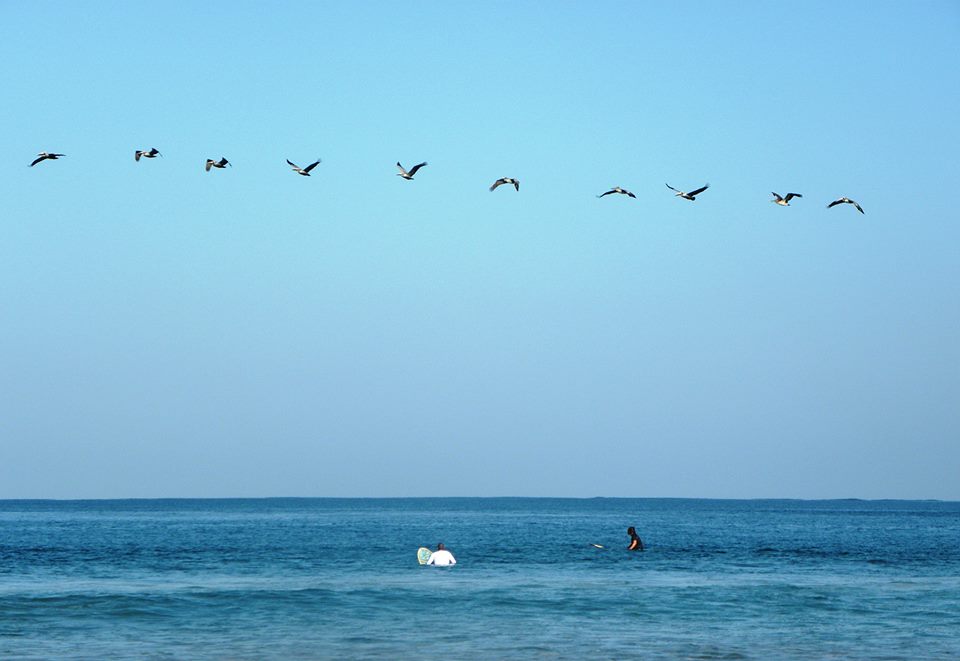
I go out surfing in the morning. The ocean is warm and crystal clear–so clear I can see the ripples in the sand two or three meters below my feet as I sit on my board. Waiting. All I do is wait. I wait and wait and wait. I had no idea you could wait so long and still have so much time left. To wait.

The sun climbs. Sets of waves come. When I’m surfing I’m thinking about surfing. That’s all. Watching the horizon for a movement or a slight change in color that means the next set it coming. No more, no less. Most of surfing is waiting. For waves. For the right wave. For the right moment to paddle and stand. At least when I’m surfing, I know what I’m waiting for. Maybe that’s why it’s so much of a relief. Sometimes I surf well, sometimes I don’t. Sooner or later I’m thinking about breakfast.

I ride back to the shore and lay on the sand. Above me in the blue are clouds. I think about water. So much water. In me, around me, above me. I think about Pio and how he filled up with water. I think about how ashes are what’s left of a person when all of the water is gone. I wish it would rain on me right now and the water would be him. The same molecules. I supposed it’s not impossible.

Everything aches. Sometimes a lot, sometimes a little.

Eight months have gone by. Compared to the whole rest of my life, it’s nothing. It’s already been an eternity. I wait and wait and wait. As if, if I wait long enough… What? He will come back? I don’t think so. He’ll send me some kind of sign? For what? I’ll die too? Well there’s hardly any debating that. But is that what I’m waiting for? I don’t know. I’m waiting to find out what I’m waiting for. It’s taking such a long time.

I look at pictures of us and we have the same eyes. We have the same hair. I look at us and now I see why some said we looked like siblings. At the hospital in the last days, Pio’s roommate thought he was my father.

Time is not obeying the rules. Or maybe I’m finally learning to understand it. It doesn’t just go, it stands still, thick as giant waves of salt water. A friend tells me I seem to be moving forward. I say I don’t know about that, but thanks. I say thanks because I can tell it was a compliment. I don’t want to move forward. I want to move backward and I can’t. I don’t want to do anything. So I wait. It doesn’t feel to me like I’m moving any direction. It’s the same day over and over and over. I wait for a different day, but every day when I wake up, it’s the same one. So I wait.

Waiting is hard work. When you don’t know how long you will have to do it. How hard it will rain, how much the wind will blow. When you don’t know what you are waiting for. But it’s the only thing that seems possible, so you do it.

I don’t know what “grief” means, how it’s different than just being sad. What it looks like. How you do it. I don’t know what “healing” means either, how it’s different than “feeling better.” I don’t want to feel better. Except when I’m surfing. It doesn’t go away, but you learn to live with it, another friend says. Wise words. I don’t want it to go away. I want to live with it. If my sadness goes away from me, there will be nothing left of me. I will be water vapor like Pio. Clouds and ashes.

I sleep deeply. On cool or rainy nights, the cats cry to be let under the mosquito net with me. We have the whole bed. I eat. Don’t worry about that. Then the morning comes and it’s the same day again. I don’t mean to say that I am bored or depressed. I don’t think I am either one. I’m drawing you a picture of time. Eight months. Is that a long time? I don’t know. It’s the same as 10 years. Is ten years a long time? Not really. Eight months is much longer. There’s no use asking how long I have to wait. Waiting is just waiting. Watching the horizon for a movement or a slight change in color.

    Pio and a friend waiting for waves on a flat day in 2009.

“So What Made You Write The Book?”

Marry a Mennonite Boy and Make Pie is my new memoir that will be released this fall.  The most common question that I hear regarding it, other than “What’s it about?” is “So what made you write it?”  In this post I will answer both questions, and explain how what the book is about changed over the 20 years it has been with me.

The scene in “Marry A Mennonite Boy and Make Pie” is the summer of 1991—the summer that 3 other college girls and I lived in our first apartment. I’m calling it a memoir because it is more truth than fiction, although there are splashes of imaginary details/events/conversations stirred into the batter. You will learn more about that in a future blog post.

I wrote the first version of this book in 1997, when the summer it describes was only 6 years in the past. The manuscript was about 40 typed pages, completely factual, and I called it “The Summer of the Riotous Walls.”  Why I wrote the original story is different than why I “wrote the book” that is going to be published in the fall.  Let me explain.

In 1997, I was 26 years old and married to my first husband. I had a job that required me to show up at a small tourist information center and wait for tourists who needed information. It wasn’t exactly a busy place. And what do you do when you have all day to stay put and wait? You think about things. And what do I do when I think about something for a while? Exacatmente.

I wrote “The Summer of the Riotous Walls” for the pure joy of it, for my own entertainment, and so that I wouldn’t forget anything about what I recognized as a pivotal summer in my life.  I was still in my 20s, mind you, but even then, I could tell that summer was one of those points of no return. Not because of something cataclysmic that happened, but because underlayers began to melt, laying fault lines for the giant chunks of iceberg that would break free later, reshaping the land and seascapes of what is me. I wanted to remember what we did, the things we said, what mattered, what hurt, how things came together and fell apart. Because that process is important. And necessary. Unless, perhaps, you never “leave home.”

And the title? We painted all over the interior walls. What started out as a fun idea (yes, we got the landlady’s permission) to decorate horribly disgusting walls turned into a disastrous riot of multicolored chaos. It went from cheerful and pretty to ugly and desperate. Or at least that’s the way I remember it.

I wrote that first version of the book for the same reason you take pictures—or for the same reason we took pictures before digital cameras and cell phones. Now, we take pictures to show off. We used to take pictures to remember. I wanted never to forget how I went from being the little girl in my first book, When the Roll is Called a Pyonder, to the adult I am. It didn’t all happen that summer, but that summer was the end of something and the beginning of something else.

And then I put the story away for 17 years. It was too short to be a book, but too long to be a short story. And nothing really happens in it—nothing dramatic like rapes, murders, house fires and terrorist attacks. Which is a shame, because I thought it was pretty good. But not that good. But still, a shame to have it just there on a sheaf of papers in a folder. But hey. It is what it is. Or isn’t.

Then, in 2014, my book When the Roll is Called a Pyonder was accepted for publication. I kind of couldn’t believe it, and I knew that if that book has something to say to the world, this one has more. They each speak more clearly when they speak together. I knew immediately that what I really have is a trilogy (yes, there is another one) that maps how the little girl from When the Roll turns into a woman like me. And that story about that summer in the apartment is the pivot point in the middle.

But it was going to take A LOT of work.

So, I pulled it out, typed those 40 pages into the computer and started working. Between 2014 and 2017 I added scene after scene. The focus of the book changed. It wasn’t about nutty girls painting on walls anymore. I realized that the only way to tell the story right would be to add scenes that are snapshots from my first visit to Costa Rica. Yes, Costa Rica entered the book. I tried to keep it out because it complicated everything for me, but books don’t care how much they complicate your life or how hard they are for you to write.

It turned out that the book wanted to be about a lot more than the amusing antics of girls, although it is still built on them. All along, it wanted to be about the summer after I came back from my first visit to Costa Rica and was turned inside out by it in more ways than I had words to express. I kept waiting, that summer, to feel like the same self I was before and it wasn’t happening. The book wanted to be about breaking apart, connecting, and it wanted to be about expectations. Thus, the new title, Marry a Mennonite Boy and Make Pie, is drawn from a line in the first chapter where I contemplate possibilities for my future.

Marry a Mennonite Boy and Make Pie had to wait a long time for me because it’s not a book a 20-year-old can write. That’s not an insult to 20-year-olds, either. If I hadn’t written the (very entertaining) bones of it when I was 20, how could I have given it the rest of its body at 40? The 20-year-old has the adventures and takes the pictures. The 40-year-old pulls it together and tells what it means.

I needed this book desperately when I was the girl in the story, but I didn’t have it. I needed the permission, the forbearance, and the open ended questions.  Now, I have it to give.


*  * * * *

Do you have a question about the book?  Ask me, and I will answer (or address) it in a future blog post.

April Travels Part II: A Lot of Miles

The Saddle Mountains

The windows of the house face south toward a long row of low desert mountains called the Saddle Mountains, named after a dip in the ridge shaped like the seat of a saddle.  It’s a reference point you can see for miles away.  When I say miles, I mean A LOT of miles.  In the Eastern Washington desert, with no tall trees and no humidity, you can pick out the saddle in the mountain when it’s so far away, you can drive toward it for a full hour.

In 2011 and 2012 when I was working as a traveling case manager for the Maternity Support Services (o yes I did) of a small-town clinic, I could tell where I was in relation to familiar places by keeping one eye on the Saddle Mountains.  There were a lot of things I loved about that job, and one of them was driving.  For hours.  Just to go find some pregnant (usually undocumented immigrant) woman living in a crumbling mobile home the middle of nowhere and ask her to tell me her story.  I got paid good money for that.  Unbeliveable.

I loved driving home to my own (not crumbling) mobile home, seeing the lights on inside when I pulled up, and looking curiously through my own windows as if I were a stranger.  Pio would be inside cooking, with CNN en Espanol talking to him from the living room.  There were giant furry cats.


Teenagers

My niece and nephews have turned into teenagers.  It took so long to get here, then it happened so fast.  Like spring.  The noisy little kids who filled their living room floor with toys, never wanted to brush their hair before school, needed their shoes tied, couldn’t reach the orange juice in the back of the refrigerator and had to hear 3 bedtime stories and then prayers… are teenagers.  One of them drives them to school.  They do things like get their own breakfast and put the dishes in the dishwasher, find both socks all by themselves, lie on the couch reading, get in the mood to play the piano, build a bon fire and produce s’mores with no oversight whatsoever and no injuries.  Say things like, “Not right now.  I have to do my homework.”  It’s amazing.


Blooms

The sour cherry orchards bloomed this week.  The orchards that surround the house on all sides went from winter brown to a stunning brilliant bridal white, and now are turning slowly green.  Have I seen this before?  Not quite like this.  I never got to live literally in the middle of it.  I went for a walk in the orchard at the peak of the bloom.  It was like a fantasy land.  Full of bees.  Millions.  But they could not have cared less about a human with all those acres of delicious white flowers.  I thought what a shame that Pio and I never took a walk in the orchard while it bloomed like this.  We were always busy working.  He would have loved it.  Then I thought, well if dead people are still living souls and they don’t have to do things like go to work, then I guess this is as good a time as any for us to take a walk together.  We’re both on vacation.

How sometimes you can be right there with another person but you’re really a million miles apart.  Or how you can be all by yourself, but you’re really with someone.


In the Basement

In the basement is all of our stuff–or what’s left of it.  We pared it down a lot when came back to Costa Rica two years ago.  I went down and dug through the boxes.  You might think I would be crying or something, but I wasn’t.  It’s comforting to find tangible reminders that everything in my head is real.  I didn’t make any of it up.  Never underestimate the value of being able to prove that to yourself.


Home

Everywhere I go feels like home.  Pennsylvania.  Washington.  Costa Rica.  Tomorrow, I’m going back to the home with hammocks, bicycles, and cats.  I’m not anxious to leave, but not sad to go.  This trip was overwhelming to contemplate from the front side, comforting from the back.  It was a good thing to do—make a break at the half-way point in the first year of…  This.

How you can walk right out of your life for a month or forever and the world keeps spinning around as if nothing were out of place.

April Travels Part II: Sisters

Ohio

My plans to write a travelogue got a bit derailed by things like socializing with the people I’m visiting and the announcement about my next book. If only all of my problems were so wonderful.

I spent the second week of this April trip in Ohio visiting my sister and her partner. The great thing is that my other sister was able to be there too, so The Three Weird Sisters had a rare and wonderful reunion. The last time we were able to do that, with the exception of a very busy wedding weekend, was 2014. A lot has happened since then. One of us got married; one of us became a widow; one of us has acquired 3 teenagers. Big stuff.

It snowed. I took pictures to prove it. It was also really nice one day (count your blessings) so we went to the world’s most awesome thrift store and an Eddie Bauer factory warehouse outlet. How to save more than you spend. We invented it.

And it was Pio’s birthday. I don’t have anything profound to say about that. It just was, and then the next day it was over. Like Christmas and our anniversary and all those other things that you can’t hide from. I can’t hide from. It was a good day. I made pizza for us and we had a little birthday party, sort of. My sister’s wife had her second round of chemo that day. Yeah. Breast cancer. She’s going to be fine, but still.

There is no way on this planet that you could have convinced me, when I was a kid, that my sisters would one day be my best friends. I don’t think we fought more than normal sisters, but I would always have picked “my friends” over “my little sisters.” Is that normal? I feel a little bad about it now. Now, I pick my sisters, hands down. One is an ethicist/theologian, the other is a dietician who studies spiritual direction, then there’s me. They are both smart as whips, beautiful, and prone to incapacitating fits of laughter. I think it’s genetic—I mean all 3 things. Our mom is the same and so was our grandma.

Washington

Now, I’m in Washington State. Othello, to be exact, approximately 40 minutes from The Middle of Nowhere. Google Map it. You’ll see what I mean. This is where Pio and I lived for 5 years. Made a life out of nothing. We were happy here, then we got restless. I think everything turned out right, considering how everything turned out wrong.

In the basement of my sister’s house where I’m staying, there is a stack of crates and boxes with our things in them. All of our treasures and things we couldn’t take with us back to Costa Rica, and couldn’t part with. Photo albums. Winter clothes. I found a hair on one of Pio’s sweaters. I saved the hair and took the sweater to Goodwill. I took my sweaters to Goodwill too because it made it easier to take his. Plus, I need wool sweaters right now about as much as he does.

Last night I dreamed I was packing up to leave, and Pio was here running all around. It occurred to me that I should  buy him a carry-on so he could help me with the luggage. Then I realized that, no, he can’t bring a carry-on–I have to do that myself. But I think I get it.

April Travels Part 1: Things That Never Change

I got on the plane a week ago in hot, windy Liberia, and flew to Harrisburg, PA. USA. I’ve been here for a week in the farmhouse I grew up in, with my parents and one of my sisters and her family. Tomorrow, my sister and I will fly to Ohio to visit our other sister.

April is supposed to be spring in the northern hemisphere, but in Pennsylvania, this year, it is still winter.

I’ve seen a lot of people I love.  A definite highlight was a dinner with friends I haven’t seen in 20 and even 30 years, and another was getting to know a cousin I haven’t really known in my adult life.  It’s all good, but it’s not always easy. Falling asleep and waking up are easy. What comes in between is not. Except overeating. Overeating in Pennsylvania Dutch Country is easy. It’s normal. Then you put on your skinny jeans and feel penitent.


The Farmhouse

The farmhouse I grew up in never changes. Part of it is something like 200 years old, which, in the Americas, is old. My parents put a laminate wood floor in the kitchen/living area since Pio and I were here 2 years ago. They got new carpet in the living room. Other than that, everything is the same. When I come home, I sleep in the same bedroom I slept in as a child. The trees are bigger, but since spring is late this year and there are no leaves on the branches, I can look out my windows and over the fields and the pond. Its comforting. Kind of. It’s old. Older than my memory. Older than my loss. I looked out these same windows at the same moon when I was 16 and when I was 2.  I remember that.

Does it make me feel better? “Better” might not be the right word. It makes me feel something different—and that can hardly be bad.

Even though it’s April, it’s cold enough outside to keep burning wood in the wood burning stove in the family room. That’s a big plus. There’s a constant cozy spot in the house where my mom and I go to get warm. The floor creaks in all the same spots it did before, and the doors make the same sounds. This is the safest place in the world.

The Farm, March 2011

Cold Wind

It was windy in Guanacaste when I left, and it’s been windy here, but it’s a different wind. A very very cold wind that pushes me back inside every time I stick my head out the door.  It comes to my skin with a sensation of pain.  The high temperature for today, in degrees Fahrenheit, is predicted to be 43.  Low last night of 25.  The sun is nothing more than a big light bulb.


Unspoken

I was not—NOT—prepared for almost no one to talk about Pio. That is so weird to me that I can barely get over/around/beyond it. But I have to behave politely and keep it together, so I do.

But I don’t understand. Not mad. Completely confounded.  I mean, we all know there’s a very noisy, vivacious and unusual person who is NOT HERE, right? So? I did not expect no one to talk about him. I did not expect to be (almost) the only one to say his name. That is SO WEIRD to me. It leaves me speechless.

I know I am not the only person who notices that Pio isn’t here. Is not speaking of him supposed to be a courtesy to me? Because it only feels upsetting and confusing. Not speaking of him makes me feel worse, not better. As if I am the only one who feels this absence. Of course I am the only one who feels it in this way. But I would actually feel much better if somebody else would bust out with, “Well things sure are different when Pio isn’t here!” I would feel much less like I am about to go insane.

I know. People don’t know what to say.  Are afraid of saying the wrong thing, or something silly. Or that I might burst into tears? I might, but probably not. If I do, it won’t be because I became suddenly upset.  I burst into tears all the time when no one is looking, so for me it’s not a new or disturbing experience. And the only wrong thing to say is nothing, like he was never even here. THAT is VERY wrong.

I’m guilty of it too. Now I know. Not speaking of the beloved dead because of not knowing what to say or not wanting to upset a friend or a loved one. I’m sorry. I didn’t know. I have done it too.

Those of us who are left are not more upset when someone offers to remember with us. I never for one minute am not thinking of Pio, so there’s no chance you’re going to remind me of something I had momentarily forgotten.  To me, honestly, it feels as shockingly inappropriate to address his absence with silence as it would be to ignore him personally if he were sitting at the table.  But then again, the PA Dutch are not known for their skill in navigating emotions.

Just thought I’d tell you about it.  If I don’t tell you, how will you know?  All of us are learning how to do this.


Suitcases

Now, time to stuff everything back into the suitcases and roll on down the road.


Sand

Ashes

I have some things to say about ashes—human ashes, the kind I live with.  I thought you might be curious.  I was.  Pio’s ashes came to me in a rectangular stainless steel box that the Comune di Milano considers appropriate for traveling.  The box is sealed shut because in Italy it is illegal to spread human ashes. I didn’t bother to find out why.  I don’t actually care why.  I will just say that it took a mighty amount of determination for me to get into that box.   Having him (“him”) sealed in there by somebody who felt is was not alright for him to come out just about drove me nuts.

I got it.   It’s a story for another day—but I got it.

And this is what I want to tell you:  cremation ashes look like sand.  They do not look like wood ashes, and they’re not flakey like that.  They’re heavy like sand.  I asked my faithful friend Google about it and s/he explained that the only thing left after a person is cremated, are bones.  It makes sense.  Everything else is water, and turns into steam or smoke, I suppose.  The bones are then ground to tiny pieces and called “ashes.”  What they really are is sand.

Does that gross you out?  I hope not.  There’s nothing yucky about ashes–that’s the whole point of them.  Does it scare you?  Well.  These are the things we need to sit with.  Starting now, or you can wait until you have no choice.  It makes you sad?  Good.  You’re supposed to be sad about sad things.  Sadness is unsettling when it is a stranger, but when it grows to be familiar, not so much.

Sand

Where I live, the sand is made mostly of tiny pieces of shells.  Some coral.  Some stones.  How long does it take a shell to become sand after the animal that made it dies?  I think that should be a unit for measuring time.  The beach is made up of bones.

Bones

I sit on the beach and run sand through my fingers.  Push my toes into it.  Look at the little bones of all of the things that ever lived.  Think about how everything together equals una sola cosa.  I tell myself it’s ok.

How long does it take for water molecules that rise to the sky from a crematorium in Milan to become a cloud above Costa Rica?  I lie in the sand when the wind is whipping and let it pelt me.  Get in my ears and bury itself in my hair.  Everything that is, is made of everything that was.  I tell myself it’s ok.

Sometimes it is, sometimes it isn’t.

But you have to find a way to open yourself up wide enough to let it inside you.  You’ll suffocate, otherwise.  The more you’re afraid or the more you fight, the worse.  You have to put your fingers in the ashes and the sand and you have to let all the little bones pour through your fingers.  You just do.  There’s nothing to be afraid of.

Put your ear to the ground, to the sand, and listen to the bones of everything.