The Illuminated Half

You start getting used to being just you again.  Even if you don’t want to—you do.  It’s not like everything is always a surprise every day like it was at first.  It starts out like “50 First Dates,” with you having to tell yourself the whole story from beginning to end every single morning, but eventually when you wake up, you remember.  And your life slowly starts to resemble what it was a long time ago, before everything.  You liked it, then.  You like it now, sometimes.

You get better at not buying too much food at the grocery store.  You realize that you don’t need the car you don’t have, because a backpack full of food lasts for a week, anyway.  You stop expecting to relax on the weekends, because by the time you run all the errands on your list and do all the things that need to be done, it’s over.  Because you have to do each and every single thing yourself, one at a time.

It’s what happens.  In case you wondered.

Even though you have a good job and spend almost nothing, you are still always running short of money.  Because rent is rent and the bills are the bills.  One person or two don’t change the rent, the electricity, the cost of wi-fi.  But only half as much comes in.  You try not to stress out about it.  Anyway, you have a Jenga towers of tiny containers of leftovers piling up in the freezer.  You make a mental note to that you need more tiny containers.

You’re surprised to discover that even though you want to go out and see people, when you get there and see them, you soon want to leave and go home.  What’s there to talk about anyway?  And people seem possessed by this inexplicable need to talk all the time.  You wonder if there is anyone else on the planet who comprehends the phrase “comfortable silence.”  You realize that if there is, you don’t know them.  You wish you did.  You wish other people had more in common with cats.

You look up at the half moon one evening and suddenly you get it.  It’s the perfect analogy.  The half moon.  That’s what you are.  Half of a thing.  The illuminated half.  The half that reflects light.  The other half is there, but you can’t see it because it can’t reflect light.  Exactly.  But it’s still there.  It’s still the other half.

Then you feel a little bit better.

The Good Book That is “Too Quiet”

I thought you might be ready for a change in subject matter. And I have been talking to myself about something new lately, so I’m not forcing a different conversation. I need your input. I want your opinion, maybe your permission, perhaps your forgiveness. This conversation that I’ve been having with myself is not unrelated to the events in the last year of my life, which I think will be obvious. But it is also not about sickness or death.

Whew.

I have a book. It’s not a new book; it’s one I’ve been working on (off and on) for 20 years. I’ve mentioned it before, although not recently. It’s the memoir, with some fiction stirred in, of a certain summer in the middle of college.  It’s a damn good book. I mean, really. There is not a shadow of a doubt in my mind. And it’s as finished as it’s going to get. Not perfect, but good enough, and done.

After “When the Roll Is Called a Pyonder” was published in 2014, I pulled this one out of the vault, and worked on it as hard as I could for …about 2 years. I poured my heart and soul into it. I paid real money for a writing to coach to help me. And then I started sending it to publishers.

Through 2015 and 2016, I sent this book to every small publisher that (a) publishes either fiction or memoir and (b) doesn’t charge a reading fee of more than 20$. I even pitched it to a bunch of literary agents. I have the loveliest collection of complimentary rejection letters you ever saw. Like I said, it’s a good book. But nobody wants to publish it. Nobody is convinced it will make them boatloads of money, which is what “the business” is about. What can I say? These people know their business. They’re probably right.

Then in January 2017, something amazing happened. A real literary agent in New York City wrote me back and said he loves my book, he thinks he can sell it to a big NYC publisher, and would I sign a contract? I was so happy I practically cried, and Pio was so proud of me. I almost splattered the great news all over Facebook, but then I didn’t. Because a contract with an agent does not equal a book deal. And how embarrassed would I be if he couldn’t sell it either?

Which is exactly what happened.

The feedback from The Big Boys is that I don’t have a big enough “platform”—meaning followers on my blog and on social media. In other words, it’s a good book, but I’m Nobody. And that my book is “too quiet.” I interpret that to mean there’s not enough, sex, drugs and violence. Well.  Guilty as charged. First, I don’t really write about sex, drugs and violence. Why would I? After “Pulp Fiction,” what could I possibly add?  Second, it’s a book about Mennonite kids, for the love of God! A little imagination? Anyone?

So, I can think of 3 possibilities for this book:
1. Give up.
2. Spend more years of my life sending this book to publishers and agents.
3. Self-publish.

The problem with #1 is that I can’t do it. I’ve even tried, but I can’t.

The problem with #2 is that I have a limited number of free hours to spend on surfing/reading/writing/lying in my hammock looking at the stars/pestering the cats/drinking wine… doing anything that isn’t sleeping or working. And honestly? I have other things to write. I can either spend my free time on cover letters (like I did for 2 of the last 3 years) or I can get on with life and write something else. I would love that.

The problem with #3? It has 2 problems. On one hand, even though this may be bogus, self-publishing a really good book feels like a cop-out, like giving up. And maybe there are ways in which I am ready to do that. What the hell? Who am I kidding?  What am I doing?  Hold out for an imaginary audience of people I don’t know, when I have you and me to write for?  Why?  Are they better people or more worthy?  I think not.

The other problem with self-publishing is a very deep very personal can of worms that I would rather not open. But if I self-publish this book, the worms are going to be all over the place, let me tell you. All over. And I might need a whole lot of moral support.

I would rather have introduced this book to the world with the support of a traditional publisher (no matter how small) behind me because this “too quiet” book is going to deeply upset/offend/dismay every single person in the state of Pennsylvania (and a few in upstate New York) who is a blood relative of mine. Each and every single one. I am choosing my words carefully as I write this. If you don’t get what I am saying, go back and read that again. Unless I somehow publish this book “in secret” (oxymoron?!), there are going to be painful personal conversations as a result. That I am not looking forward to. And I would just rather have had a publisher who thinks I’m awesome holding my hand, instead of having to stand here spitting into the wind all by myself. But I’m not sure I’m going to get my way this time. Sometimes, being a big girl sucks.

I’m 47 years old. It shouldn’t matter. I didn’t think it would at this point in my life. If I had known, at 17 and 27 and 37, that it would still matter this much, I would have been devastated. So now I know: it’s never going to go away. Never. Which ties directly, for me, to the reason you have to read this book—the reason it must get out of my computer. Because if I have a heart attack in my bed tonight and this book NEVER gets read by anyone, THAT will be the real and true failure. I will have failed to face something that has been waiting for me my whole life.

I actually believe this. It makes me shake in my shoes in the way that happens when you know a thing is true. …And it’s kind of also what the book is about.

So.  What do you think?  I’m asking.


P.S.

Please know: There is nothing even remotely scandalous in this book for anyone who was born anywhere other than where/when I was.

(O, the ironies of knowing your “too quiet” book will shock the covering pins out of some people’s hair…)

My Window

You all so kindly and generously held onto me through the last unbelievable months.  It seems right to me that I should tell you what comes next, what comes now.   I don’t have a lot of eloquent words, but I can pull back the curtain and let you look out my window.

You wonder how I am.

What can I say? Alright, I think, all things considered. Glad to be back in Costa Rica. Glad to be “home.” I put the quotation marks around the word, because nowhere without Pio feels like home. But Costa Rica is my home and I am glad I am here. I’m better, here, than anywhere else.

I got of the plane from Italy about 2 ½ weeks ago. I moved into a lovely house with lots of pretty wood, an extra bedroom, a huge porch, and my cats. Those things are all good. I got my washer hooked up yesterday, so that took things up a notch. I have a hammock on my porch. My bike works and my legs are catching up to the job of pedaling.

This is the beginning of my second week of work. Work is good. It’s weird, because I hear the truck Pio drove pull up to the office 100 times a day, and it’s never him. Maybe, eventually, I’ll get used to it and stop looking up every time I hear it. His workshop is dark and quiet. Exactly what he feared most. He was so proud of that workshop. I’m doing some accounting clean-up right now, not trying to run the maintenance department anymore. I didn’t love being in charge of maintenance before, and I have no interest at all in doing it without Pio. I’d rather play matching games with numbers. I’d rather sell coconuts on the beach.

You wonder what you should say if you see me.

Don’t worry about it. “Hi, how are you?” works. What are you supposed to say? Unless you say something like “Good riddance,” or “You were never a very good wife anyway,” you are not going to say the wrong thing. And no, I am probably not going to come unglued and bawl all over you if you hug me and tell me how sorry you are. I’ve only done that twice: once with my parents, and once with the closest thing I will ever have to children. So if you’re not my mom and you’ve never called me “mom,” you’re fine.

No, I don’t dread running into you or anyone else. If I didn’t want to see people I know, I wouldn’t have come back to Tamarindo. I would have gone to another province or another country. The only people I actually don’t want to see are the ones that didn’t like Pio–and as you can imagine, it’s slim company.  So, again—you’re fine.

Talking about Pio and receiving the pictures you have of him does not upset me. They make me smile and laugh. They’re like little visits.

But don’t

Don’t talk about “starting over” or “getting on” with life.” Ok? Those are the wrong words. I realize they are the ONLY words our language has for this, but they are the WRONG ones. Don’t say them. I know what my job is now even if I don’t have the right way to say it. I won’t be mad at you if it pops out, I’ll just feel a little sadder and a little more lost.

And don’t say “Everything happens for a reason.” It sounds mean. I’m not telling you what to believe, I’m telling you what not to say. I am at peace with as much of that concept as humanly possible, but I was never a fan of that snooty saying before, and I’m sure not about to convert now. I’m good with, “Everything happens.” Put the period right there. Less is more.

Ashes

Yes, I have them in the house with me.
No, that is not weird.
Yes, I intend to put them in the ocean as Pio always asked me to, but not yet.
No, I don’t know when.
Yes, I tried to open the box.
No, I couldn’t.
Yes, it is sealed.
No, I am probably not going to hold some kind of event where I invite other people when I take his ashes to the ocean.
No, not even you.
Oh, that’s selfish? Ok.
Yes, I will tell you about it afterward.


I sleep really well. I’m tired. Everything takes twice the effort. I don’t mean to complain—I’m trying to explain why I sleep like a log when you’d think I should be tossing and turning. Also, it’s warm, and I sleep much better when I’m warm than when I’m cold. I sleep better when I can hear what time it is by listening through my window.  If you live in Guanacaste, you know what I mean: tree frogs and crickets, owls, roosters, monkeys, dawn.

Tamarindo Bay is like a lake right now, but when we get some waves, I’m ready to go surfing.  And then I will be better than I am.  The ocean is big enough for everything.

Deep Space

I didn’t write this; I came across it this summer in an article about Lady Diana’s death, and I copied and pasted it into a Word document on my computer so that I could come back to it later:

“Grief is exhausting, as we all know. The bereaved are muddled and tense, they need allowances made. But who knows you are mourning, if there is nothing but a long face to set you apart? No one wants to go back to the elaborate conventions of the Victorians, but they had the merit of tagging the bereaved, marking them out for tenderness. And if your secret was that you felt no sorrow, your clothes did the right thing on your behalf. Now funeral notices specify “colourful clothing”. The grief-stricken are described as “depressed”, as if sorrow were a pathology. We pour every effort into cheering ourselves up and releasing balloons. When someone dies, “he wouldn’t have wanted to see long faces”, we assure ourselves – but we cross our fingers as we say it. What if he did? What if the dead person hoped for us to rend our garments and wail?”

There’s so much there, I don’t really even know where to start.  I’ve been thinking about this a lot—all of it.  I’ve been thinking about Sadness and how well/poorly-prepared we are for its arrival.  Because it comes.

I think maybe the Victorian’s were onto something.  And I think we modern folk are stupid, trying to convince ourselves that some type of forced cheerfulness in the face of loss has any spiritual merit whatsoever. It perhaps provides some relief to the audience, but it is of no help to the person performing it.  If you ask me how I am, and I tell you I’m fine, does that make you feel better?  Do you believe me?  Why would you?

And we are wise not to confuse Sadness, sorrow, even, with depression.  They are not the same.

I’m terribly sad right now.  I’m not depressed.  How do I know that?  I do, and it is your job to believe me.  No, I’m not happy.  Yes, I cry sometimes.  No, I often do not want to talk to anyone.  Yes, sometimes my favorite activity is looking out the window for a good long while.  And no, I repeat, I am not depressed.  If it disturbs you to hear about my sadness, I don’t have to tell you.  But if Sadness frightens you or makes you uncomfortable, well, what can I say?  That one’s on your plate.

If we feel fine about being happy over happy things, why should we be concerned about feeling sad over sad things?

Yes, I can laugh and enjoy things.  Yes, I have been accepting dinner invitations from Pio’s family, not crying over my pizza at them, and having a perfectly good time.  Yes, I still try to like something about every day.  Maybe walking.  Maybe shopping.  Persimmons.  (OMG, persimmons!)  Maybe looking at pictures of Pio and me.  Maybe packing my suitcases.  I love packing suitcases.  If all else fails, I can fill the bathtub up with water so hot it makes me dizzy, and just feel warm.

I never thought I would say this, but I would love it if social custom required me to wear black (or specific in some other way) clothing right now.  It would be a relief.  It would speak for me.  Then I wouldn’t sometimes think, when I find myself having a good time, that perhaps I have for one moment forgotten to feel appropriately sad.  Then, when I am crying into the telephone at the train station, no one will wonder if I need them to phone the police.  The haunted look I sometimes catch on my face in the mirror would make sense to other people who see it.  No explanation needed.

I have no intention of being sad for the rest of my life.  I know Pio would not want me to be sad for the rest of my life.  But I think he would be alright with me being sad right now.  He did not want to leave me—he told me he didn’t—and if dead people can have terrestrial emotions, I think he’s sad too.  Or he was at first.  If dead people have terrestrial emotions, for how long do they have them?  So please don’t try to cheer me up.  We can have fun together.  We can talk about something else.  You can distract me.  You can make me laugh.  But it is breaking the rules to try to make me feel any particular way.

You want to know what it feels like?  Don’t be scared.  I will tell you.  Because this could be you someday.  Death is normal.  It feels like instead of being full of blood and bone, inside my skin, I am full of deep space.  Light years.  Deep, deep, deep silence.  Complete stillness where nothing moves or makes a sound.  And it’s not frightening.  It’s just very deep, and very quiet.  Still.  And infinite.  And now you’re thinking, “Oh—dark cold nothingness!  See! She’s depressed!”  Shut up.  I didn’t say dark or cold or nothing.  All of that is beside the point.  Besides, the less you say, the closer you are to being right.

Shhhh.

Yes.

Rilke’s “Letters To A Young Poet,” the only book you ever need to read, has an entire letter devoted to Sadness.  It’s Letter #8.  You should read it.  I would paste the whole thing right here if I thought you would read it all, but I think you might not, so I will only paste  one paragraph:

“So you mustn’t be frightened if a sadness rises in front of you, larger than any you have ever seen; if an anxiety, like light and cloud-shadows, moves over your hands and over everything you do. You must realize that something is happening to you, that life has not forgotten you, that it holds you in its hand and will not let you fall. Why do you want to shut out of your life any uneasiness, any misery, any depression, since after all you don’t know what work these conditions are doing inside you? Why do you want to persecute yourself with the question of where all this is coming from and where it is going? Since you know, after all, that you are in the midst of transitions and you wished for nothing so much as to change. If there is anything unhealthy in your reactions, just bear in mind that sickness is the means by which an organism frees itself from what is alien; so one must simply help it to be sick, to have its whole sickness and to break out with it, since that is the way it gets better. In you, so much is happening now; you must be patient like someone who is sick, and confident like some one who is recovering; for perhaps you are both. And more: you are also the doctor, who has to watch over himself. But in every sickness there are many days when the doctor can do nothing but wait. And that is what you, insofar as you are your own doctor, must now do, more than anything else.”

So anyway.   That’s where I am.  That’s what I’m thinking about.

Four weeks and about 1 hour ago, Pio left me here with you.  Tomorrow, I will pick up his ashes.  In 10 days, I will take him home.

Deep space is where everything ends and begins.
Positive

I walk a lot. I usually have an actual or imaginary purpose for my walks other than just wandering around. I walk to the grocery store, the pharmacy, a street market, or I explore a new street. There’s something I’ve been thinking about while I walk. Hablando sola. I’ve been talking to myself about it for a long time and I haven’t known how to break it to you. I think a lot of things I can’t say, because there are things you say when your husband has a late-stage metastatic cancer, and things you don’t. Trust me.

This one, I think I’ve got broken down into bite-sized pieces.

So when you find out that a loved one has something bad that isn’t going to go away, people reassure you with things like, “Be positive. You never know,” and, “I’m going to pray for a miracle,” and, “Ten years ago my uncle had stage 4 brain cancer and how he’s running marathons and writing computer software,” or some such thing. And when you first find out there have been monsters lurking in the shadows all this time, those things are very reassuring. Obviously, Hope is essential for Life and Survival, and the last thing a sick person should do is give up hope. Same for his wife.

I’m just going to say that personally, three months in, I’m a little bit beyond the everything-might-be-alright stage. Nothing is alright. And when you tell me to “be positive,” I feel like you don’t get it. I’m not mad. And I’m not going to leap off the balcony. I’m just saying.

Before I go on, let me state that gigantic, cataclysmic miracles are always invited. I know they happen, and they are welcome any time. But if they were normal, or something you should hold your breath for, then they wouldn’t be called Miracles now would they? They would be called Normal. So forgive me if I’m not counting on one. I would love one. You can keep praying for one. But please don’t frown sideways at me if this is all I have to say about miracles. Thanks.

Pio is a really positive guy. He always has been. Me too. I think we’re both about as positive as they come. So don’t tell me to be positive. I was born positive. Pio was born ridiculously positive. Nobody is sitting around the house moping, and all things considered, I think that should serve as evidence that we both ARE positive. Even our blood types are positive.

But I’ve been talking to myself a lot about what “positive” looks like when you have metastatic stomach cancer. Or your husband does. Two months ago, the doctor told us that this isn’t going to go away. So where’s the line between being “positive” and sticking your head in the sand? Hm? A month ago the oncologist told us that she didn’t even want to agree to give him chemo at all, and here he is 3 treatments in and still fighting like a badger. They told us the chemo, if it is successful, could slow down or stop the progress of the disease. Did they actually use the word “stop” or did Pio add that in? I don’t remember anymore. At any rate, let’s not pretend we think they meant “stop indefinitely,” if they even used that word at all. Or, oops. Would that be not-being positive? Is there any value in being realistic? How about reasonable? They very specifically stated that this does not have a cure.

I can’t tell you what’s going on inside anyone else’s head; I can only tell you what’s going on inside mine. And in some ways it isn’t fair, because I’m not the one with anything wrong with me. I feel a guilty doing all the talking, and fear that I may be misunderstood as trying to make this all about me. So, read on at your own risk. Yes, this is about me. It isn’t about cancer. It’s about holding on and letting go.

To me, today, being “positive” means putting my big-girl pants on every single morning when I get out of bed.  It means finding the courage to be a cheerful presence in the house–not too much; just enough.  It means finding a reason to go out for a walk in the fresh air, and going. Being positive means looking right at all the ugly things that are happening and taking a deep breath. And naming them. It doesn’t mean pretending they aren’t ugly. Or pretending tomorrow they might wake up suddenly pretty. Or pretending that any day is going to be better than today for a long, long time. Being positive right now, means acknowledging that it’s going to get worse before it gets better, because I’m sorry but it is, and it doesn’t help you or me to pretend it’s not. And it means believing that someday things are not going to be like they are today.

Being positive means that I find the good things about each day and deeply enjoy them. The red ball of the sun rising quietly over the Duomo at 7 AM. Whatever crazy neighbor that is who has a ROOSTER in Milan that I can hear crowing before traffic noise starts. Giggling with Pio at breakfast about his crazy hair. Peaches. Proscuitto cotto. Homemade chocolate pudding. A visit from Kiara. A silly tv commercial that makes us laugh. The bread Pio suddenly got up from the couch and made on Saturday. Thunder. A rainbow. A long walk during which I talk to myself like a crazy lady, sneak out a few tears, hum a song, buy an ice cream cone. Checking the surf on the surf cam in Tamarindo. Watching the evening news with Pio as night falls. Getting up to click the light on so I can keep crocheting while he snoozes. Drinking chamomile tea together. Listening to him breathe while he sleeps.

Send love. Send light. Send good vibes. Send thoughts. Send prayers. Pray for a miracle if you dare, but pray for an atomic one, which ends in surf boards and motorcycles. I’m not interested in piddly little miracles where we all suffer for miraculous amounts of time. Wish us a good day. Wish us more good days than bad days. Wish us sleep—that’s always a blessing. Wish us peace. Wish us unexpected laugher. But don’t bother with, “Be positive.” I am positive. Absolutely positive. Entirely, and without the shadow of a doubt.

Two And A Half Months In Milan

I’ve been in Milan, Italy for two and a half months—long enough to have “gotten used to it” in a lot of ways, but not long enough to simply take for granted the way things are. It seems, therefore, the right time for me to share some observations.  None of this is related to what’s going on with our health situation–it’s about what surrounds it.

#1. Milan is very organized. The Italians in Milan are very organized. This came as bit of a surprise to me because my experience of Italians was always the crazy ones who left the civilization of Europe for the jungles of Costa Rica. And that is one wild bunch. As one might say of Americans, the calm, sensible, reasonable, judicious ones stay at home. The Italians in Milan live in small apartments on narrow streets with small cars parked either in small parking spaces or in small “boxes” that are box-like garages that go with their apartments. Underground.  The apartments have small, immaculate kitchens with small refrigerators and small pantries filled with small packages of food. Nothing comes in bulk. Small living rooms have small couches. Children (even adult children, if they live at home) sleep in single beds. You do small loads of laundry every day because there is one drying rack and you have to fit everything on it. And in Milan, to my surprise, EVERYBODY IRONS. Religiously. I kind of thought ironing was one of those things people used to do, but I guess not.

#2. Trash is not just trash. Oh no. There are three types of trash, one of which is recycling, and there are three types of that. These items are disposed of separately, and no one would think of saying “the hell with it” and just dumping it all together. That’s not how it’s done. Glass, plastic/metal, and dry paper are separated (by you when you take out your trash to your building’s trash area–because if you live in Milan, you likely live in an apartment). Then there’s “wet” trash and “dry” trash. Food trash goes in the “wet” bin: egg shells, carrot peels, coffee grounds, used paper products, etc. The last category is “undifferentiated” which is everything else, which isn’t all that much. I’m told you get a fine if you do a bad job of separating your trash. I’m not sure how that works as I haven’t noticed any surveillance cameras in the trash area, but I’m trying not to find out!

#3. With the exception of polenta, which might be compared to the southern USA’s grits, it seems that Italians do not eat corn. There was zero sweet corn in the markets this summer. To find corn flour for tortillas and/or cornbread, I had to go to a special international grocery store. Also, there is no frozen corn in the grocery store—only canned. This isn’t a problem for me because the main way I consume corn in in tortillas, but I do think it’s interesting. I know that corn is a grain from the Americas, I just assumed that since in the Americas we eat pasta, in Italy there would be corn. Well. There might be, but it is not in Milan.

#4. Oatmeal is a special health food, not a staple. I searched the supermarket high and low for it and finally discovered small over-priced bags of plain old oatmeal tucked into the Special Health Food row between the organic fair-trade rice cakes and the organic fair-trade soy noodles. Good grief.

#6. Unless there is a special pedestrian signal—the kind featuring a red person standing or a green person running—that directs otherwise, you are supposed to walk directly in front of oncoming traffic at crosswalks. Only at crosswalks, mind you, but you are NOT supposed to stand there and wait for drivers to come to a full and complete stop for you. They hate that. If you do, they will glare at you and make annoyed Italian hand gestures. They know they aren’t supposed to run over you. They’re very organized and hate anything that makes a mess, so you can trust them. They will slow down enough to keep from hitting you, and everyone continues on their merry way. And you don’t have to run, either. Just walk across the street like you own it. You do.

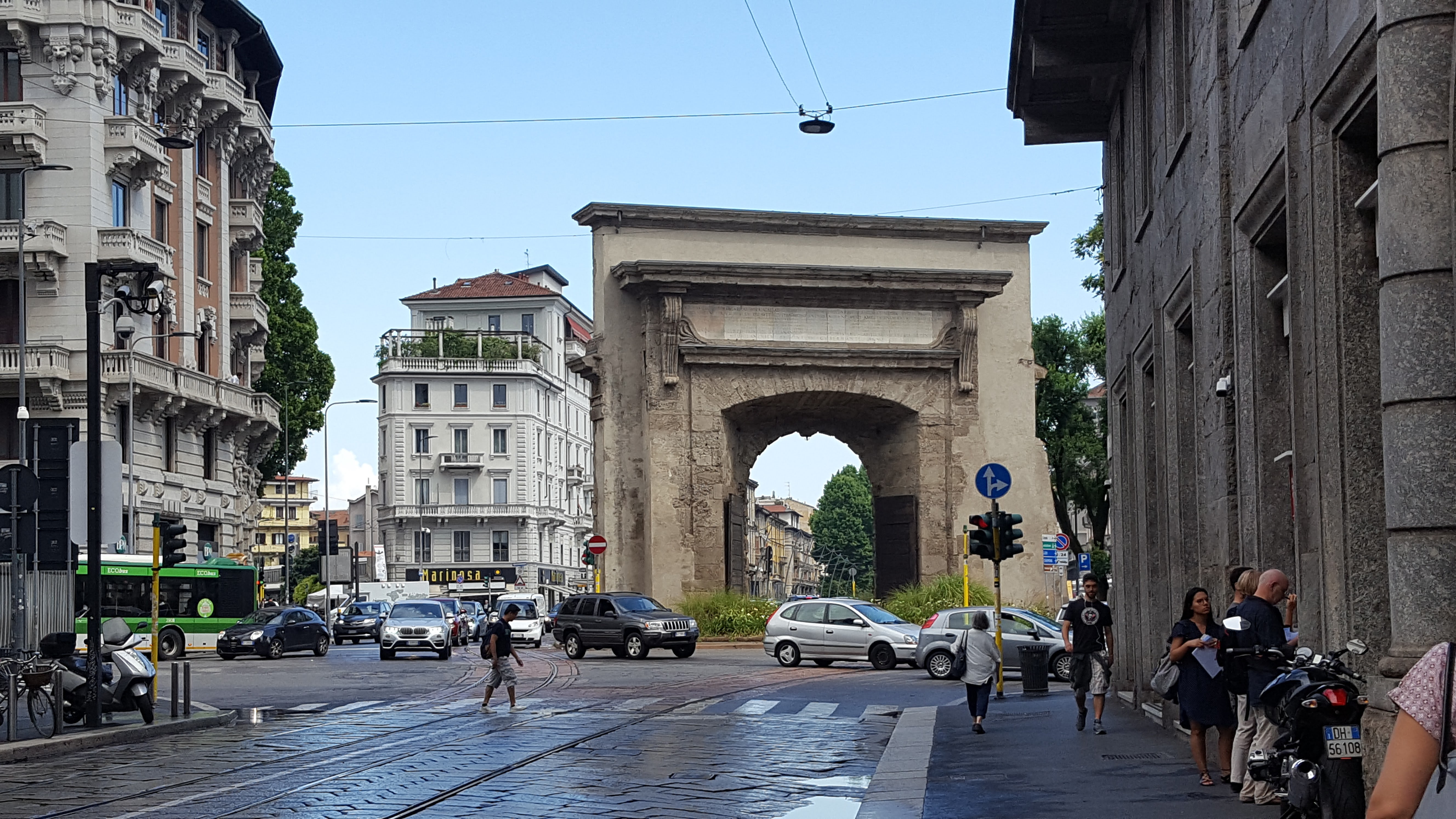
#6. All of the history weights on people. Or maybe there’s some piece of it that I’m not able to see clearly, yet. They love their history in the same way that you might love a family member who is suffering from dementia—truly, and yet some selflessness is required in the process. Italy IS History, and to physically navigate Italy, or at least Milan, you must physically navigate through History and its mad twists and turns, reversals, successes, and failures. Nothing simply is. Everything was, and was before. I think about this as I walk or ride around the zillions of round-abouts that are constructed to direct traffic flow around historical monuments like La Porta Romana, one of the gates that once opened into the medieval city of Milan but that now stands in the middle of it. Since you can’t tear down a thing like that, you go around it. And here, there are a lot of “things like that.” All of it acquires some weight.

And here are some other minor observations in no particular order:
–City-dwellers love their plants! Every balcony and available roof space is crowded with them.
–Before noon, if you want to eat something that isn’t a form of bread, you’d better eat it at home because no one will sell you anything else.
–Baby strollers have the baby turned the other way facing mom/dad. Smart!!
–You’re not supposed to smile and say hi to strangers. That’s not “polite” or “friendly,” that’s creepy.
–“Ciao” means hi and bye, but you don’t say it to people you don’t know. To people you don’t know, you say “salve” which also means either hi or bye.  And I always feel like I’m telling the persons to save her/himself which makes it hard for me to say with a straight face.
–All flowers are beautiful, including “wildflowers” which would be known as “weeds” where I come from.
–Grocery carts are locked together. To use one, you have to put a coin into the lock to open it. Your coin rides around in the cart with you, and when you return and re-lock it, you get your coin back. Again, smart!! Guess what country doesn’t have shopping carts all over the parking lot?

La Porta Romana. One of many ways history affects daily life.

Plan C

Plan A was going pretty well. Nobody’s life is perfect, but we didn’t have a lot to complain about. After five years in the USA, we were back in Costa Rica’s endless summer, working our butts off and surfing. Making decent money, having a good time, riding around on the motorcycle, chilling in our hammocks. Something like that is worth aspiring to. That was Plan A, and it was a really good plan.

In Plan A, there are two of us, and we live in Costa Rica.

Then, two months ago, Plan A crumbled in a major earthquake. Pio wasn’t feeling well. Medical tests revealed a malignant stomach tumor that had metastasized to his liver—and had already made a wreck of it. It is impossible to guess how long all of this was going on without giving any indication except for disturbing premonitions that I refused to listen to, because, how can you tell a premonition from paranoia? (And what do you do about it anyway? Say to your perfectly-healthy husband, “Honey I think there’s something wrong with you?” Probably not.) We got on a plane and came to Italy. Things were sliding quickly down a slippery slope.

So I had to wrap my head around Plan B. In Plan B, there’s only one of us. It’s me, and I am a widow. The doctors wouldn’t say anything more than, “This is very advanced,” and “It’s a shame you’re so young.” For about 6 weeks, I worked on that one. Slowly. In very small increments. One dreadful piece of the puzzle at a time. Just because you think about something doesn’t mean it will happen. But it doesn’t do you any good to refuse to think about the possibilities. So I went there. And sat with that for a while.

I have something to say about Plan B. If you haven’t thought about this before, here’s the newsflash:  in general, women live longer than men. Most of us will become widows. Sooner or later. Tumors aside, there was always every chance that Plan B was going to follow Plan A. I’m not being morbid–I’m being observant. Part of me said I knew that someday this was going to happen, and another part answered that I didn’t expect it NOW.

And then the slide down the slippery slope suddenly slowed. So Plan A is still lying in ruins, while Plan B is also indefinitely delayed, thank God.

Which brings us to Plan C.

Plan C is better than Plan B, because there are two of us. But one of us is sick, so it’s not a happy plan like Plan A. It has happy days, though. It has happy moments. It has scary ones and sad ones too because the ghost of Plan B has been introduced to the scene and stands quietly in the corners. In Plan A, you decide things together. In Plan B, you decide them all yourself. Plan C has some of each. In Plan A, you get to do what you want with your life. In Plan B, you do what you want with what’s left of your life (if you can think of anything). In plan C, you stay in Milan and wonder what’s going to happen to you, how long you’re going to have to stay there. You don’t know if it will be for months or for years, and you don’t know which of the other two Plans this Plan C is going to give way to.

But you know it will be one or the other. Sometime. Whenever that is. Whatever is required of you in between.

Rainbow over Corsico, July 2017

Who Would Have Thought

Who would have thought that being tired could be a symptom of something so sinister?  It seemed so normal, especially for someone who works as hard as my husband does.  Especially in Costa Rica where it’s so hot.

Who would have thought that the pain in his shoulder wasn’t a strained muscle or a pinched nerve?  Who would have thought that it was a reflection of things going wrong in an organ that can’t feel pain–his liver?

Who would have thought?

But then pain started under the right side of rib cage, and the tiredness grew into a constant sort of pallor and an uncharacteristic exhaustion.

Who would have thought that when that ultrasound showed something that the doctor would refer to as “metastasis” in my husband’s liver, I would be the one having to lie on the floor with my feet up because of the dizzy spell that grabbed me and wouldn’t let go?

Who would have thought, or even begun to guess, how many things were silently going wrong?  But blood tests don’t lie.

Who would have thought I would find myself sitting at my desk on a Thursday afternoon, refusing tears, buying plane tickets for Italy two days later?

Not me.

But that is exactly what happened.  As an Italian citizen, his medical care will be nearly free here, and let’s not compare the doctors in Milan with the ones in Liberia.

Who would have thought that it takes 10 days to get the results of a biopsy?

Who would have thought 10 days could take so long?  When you watch your husband become weaker by the day and all you can do is smile and try to breathe, it seems like 100 years.

Who would have thought I could put on my shoes in the morning, go outside for a run, and could run 7 kilometers before I was tired enough to stop?  Not me.  I don’t even like running.  Although I like it better than waiting.

I keep reminding myself of what I wrote a few months ago about being fearless vs being brave.  Right now I am being brave.  Because I am scared to death.  I’m afraid of what might happen.  I’m afraid of what might not happen.

Who would have thought that exactly two years after my husband and I came to Italy on vacation we would be back in the same city, staying with the same brother at the same time of year, but with for the purpose of saving his life?

A month ago, he was complaining about being tired.  He thought he had dengue.  Two months ago he had a sore shoulder.  Three months ago we were getting up at dawn to go surfing.

Who would have thought life could unravel this far in two weeks?  I guess, really, all it needs is a minute.

How to Make Mistakes

Where I come from, girls learn how to play the piano.  If that sounds Victorian, well, now you know something about where I come from.  I don’t have much to show for the time I spent and the money my parents spent on that endeavor, but it wasn’t optional.  Every week, from 3rd grade to 8th, I went to piano lessons.  I liked playing the piano when I was allowed to play what I wanted–but most of the time my teachers made me practice boring exercises and songs I didn’t know.  So, even though I wasn’t a terrible piano player, I was pretty terrible student. At least that’s how I remember it 30-some years later.

The most important thing I learned at piano lessons, I learned from Mrs. Swan, the elderly lady who sat 12-year-old me in her dark living room at her doily-draped piano after school on Thursdays.  She made me play the most dreadful drills.

Another thing girls do, where I come from, is play the piano in church.  This is an honor and a privilege, and it is freaking terrifying because all the older girls who have been taking lessons longer than you have and can play without ever making mistakes will hear you if you mess up.  Everyone will say you did great and it doesn’t matter if you made a little mistake.  But still.  Even the preacher will hear you mess up.

So one Thursday afternoon, I was playing particularly badly for poor Mrs. Swan.  She seemed so discouraged by my lack of love for her lessons, that I confessed.  I had barely practiced my lesson at all that week.  I’d been asked to play the piano in church, and I was madly practicing… “Whispering Hope,” I think it was.  This relieved and delighted poor, discouraged Mrs. Swan.

“Play it for me,” she said.

I gingerly began picking out the notes, pausing where I was uncertain of my finger placement, not wanting to fail at this as well.  When I got to the end of the song, Mrs. Swan gave me a significant piece of life advise which I have called on many times and repeated often.  Whatever the words she used, the message was this:

“Don’t you be afraid to make mistakes.  You just play that song with all your heart, and if you make a mistake I want you to make a big, enthusiastic mistake that everyone can hear.  No little wimpy mistakes!

Something to that effect.  She told me to play it again.  So I played it again, loudly and confidently.  I made some loud, confident mistakes and I had to admit she was right—it sounded a lot better, mistakes and all.

Mrs. Swan isn’t living anymore–if she were she would be 100.  And I can’t play the piano to save my soul, but I know how to make a good mistake.  Big.  Loud.  Not fearfully or shamefully.  I’ve had lots of practice and I’m fabulous at it.

I actually hand myself Mrs. Swan’s advice quite frequently when I’m surfing—who knew that piano lessons could speak to that?  “Don’t worry about making a mistake,” I tell myself.  “Make a giant mistake.  Take the wipe-out of the day.”

I do.

Mixed with my rides, I get me some almighty wipe-outs.  I consider them a success in their own way.  Sometimes going all in is more important than what happens next.


Semana Santa

I love Semana Santa. Grumpy gringos love to hate it, but I just love it and that’s all. I love the chicharras. I love the air that’s too hot to breathe and smells like wood smoke from a fire in the mountains somewhere. I love the hazy stars. I love the badly-acted religious movies from 1970 that they play every year on TV. I love the maranones. I love the jocotes. I LOVE the rosquillas.

When I first came to Costa Rica as a student in 1991, the only time I got little case of Montezuma’s Revenge was because I ate too many rosquillas in Semana Santa. Gotta watch those little buggers with all that manteca. Talk about indigenous cooking. Ground corn, manteca, that hard salty smoked cheese, salt…am I forgetting something? Probably.  They don’t look that good. They don’t sound that good. And the first time I saw my host mother dump a handful of those odd little round biscuits into her tall glass of sweet black coffee? Bleagh! I thought in my innocence.

Oh silly me. Once you start on them, you can’t stop.

I love Semana Santa.  I love everything being closed in the middle of the week.  I love families sitting in the shade of trees in their yards. I love families playing with their fat little babies on the beach. I love drunk uncles lounging in the shade beside coolers full of cold drinks, tuna and soda crackers. Grumpy gringos love to hate it, but I just love it and that’s all.

It’s been a year since I’ve been back in Costa Rica, back home.  Immigration renewed my residence, considering me to have been a resident even during the time I was gone.  (I never thought an immigration document could make me almost burst into happy tears but when I read that, I had to take a deep breath.) I missed Semana Santa so much.  Not the chaos-at-the-beach part of Semana Santa–all the rest of it.  If you live in Costa Rica and you have no idea what I’m talking about, my sincere condolences.  There’s more to it than traffic jams at the coast.

They say every year on Sabado de Gloria, it rains.  And honestly, it usually does.  Maybe it’s the moon, this “Christian” holiday being situated on the Sunday after the first full moon after the Spring Equinox.   The monkeys are in the trees calling for rain.  The chicharras call for it.  The cenizaros don’t make a sound, but you can see them beckon if you watch.

I love Semana Santa.  I missed it so much.  Easter is a nice day, but let’s not kid ourselves.  Latin America knows how to celebrate a thing in a way that North America never will.  Sorry for all the grumpy gringos.

50 Different Words for Children

Who would like to join me in a toast to funny-shaped families: non-traditional, hard-to-explain combinations that don’t fit into a cookie-cutter no matter how you turn them?

Cheers!

. . . . .

The boys have grown into men and they roar up to my house on motorcycles. They peel of their helmets and pick me up off the ground when they hug me. When they were little and I was their dad’s wife, they didn’t call me mamá, but now they do even though I’ve been gone for much longer than I was there. You can divorce an adult, but the kids are another story.

I re-married and have a new set of step-kids who, unfortunately, live far away. My ex’s kids love my husband and he loves them right back, so when we get together it’s a very odd combination of laughter and pizza and reminiscing about things that not all of us remember. But it’s alright. You can open your heart to the people who want to love you, or you can close it.  Heads or tails.

But the language breaks down–all the ones I know do.  Here’s a question: What do I call my ex-husband’s daughter? If I call her my step-daughter, that confuses her with my husband’s daughter. And my husband has a daughter. He has a son, too, so what do I call the young men on the motorcycles? My ex-step-sons? That sounds terrible. Their dad is my ex—they are not any type of “ex” to me. Our relationship is very much in the present.

So here’s another one. What if my ex-step-daughter has a baby? Because she did. What do I call the baby? My ex-step granddaughter?? I’m laughing now. I’m a little annoyed with Webster’s lack of imagination. We don’t have a word for this. We need one.

I need one.

You know what I don’t like about the options my language gives me for naming children who aren’t mine? I don’t like identifying people who I consider family primarily by who they are not. Like calling the infant I hold in my arms my “ex-step-granddaughter.” That language removes her from me twice before giving her to me. It’s backwards. (And I would never call her that anyway, of course!)

The guy married to my sister is my brother-in-law. The woman married to my other sister is my sister-in-law. Those names give the relationship first and take it down a peg second. I like that order better. My sister’s wife is first my sister—and second, not-really-my-sister.

I guess the supposition is that when you divorce someone, the relationship is broken and the family is broken, so therefore the language identifies the break before it reflects anything else. I imagine that most times it is that way. I just wish we had a whole different word for it, is all, if you aren’t estranged. Like a language that has 50 different words for snow. I wish we had 50 different words for children. We have 3: kids, step-kids and grandkids.

Fail.

I especially dislike the vibe of the prefix “step” in front of family relationships. I accept it, but I don’t care for it. Tell the truth: what’s the first thing that comes to mind when you hear the word “step-mother?” A wicked woman who won’t let pretty girls go to parties at best, and feeds them poisoned apples at worst. Please. Being a stepmother is wretchedly difficult, and no matter what you do, it will be the wrong thing in somebody’s opinion almost all the time.

I wish we had a word for my husband’s son that doesn’t start out by telling you that he doesn’t really belong to me. I wish I had a word for my grandbaby’s mama that doesn’t showcase what we are not.

Of course you are thinking, “Just say ‘daughter’ and ‘granddaughter’.” And I do, and I will.  I just feel the need to put my finger on a very personal place where language and life do not match up at all.

When I was college age, I used to say that I wasn’t sure whether or not I wanted to have children, but that I thought I would make an excellent grandmother.  I didn’t expect to pull that off, but look at me now.

And, dear English Language, please evolve.


italia