Jamás

no me busques –
me subí al sol
como agua
and will come down
on nights with heavy clouds.
you will see me sometimes smile
pero jamás me tocarás.

no me busques –
me fuí sin huellas
como el viento.
i have told you i live
in trees, in each of them.
you will search for me in fruit
pero jamás me encontrarás.

How to Make Mistakes

Where I come from, girls learn how to play the piano.  If that sounds Victorian, well, now you know something about where I come from.  I don’t have much to show for the time I spent and the money my parents spent on that endeavor, but it wasn’t optional.  Every week, from 3rd grade to 8th, I went to piano lessons.  I liked playing the piano when I was allowed to play what I wanted–but most of the time my teachers made me practice boring exercises and songs I didn’t know.  So, even though I wasn’t a terrible piano player, I was pretty terrible student. At least that’s how I remember it 30-some years later.

The most important thing I learned at piano lessons, I learned from Mrs. Swan, the elderly lady who sat 12-year-old me in her dark living room at her doily-draped piano after school on Thursdays.  She made me play the most dreadful drills.

Another thing girls do, where I come from, is play the piano in church.  This is an honor and a privilege, and it is freaking terrifying because all the older girls who have been taking lessons longer than you have and can play without ever making mistakes will hear you if you mess up.  Everyone will say you did great and it doesn’t matter if you made a little mistake.  But still.  Even the preacher will hear you mess up.

So one Thursday afternoon, I was playing particularly badly for poor Mrs. Swan.  She seemed so discouraged by my lack of love for her lessons, that I confessed.  I had barely practiced my lesson at all that week.  I’d been asked to play the piano in church, and I was madly practicing… “Whispering Hope,” I think it was.  This relieved and delighted poor, discouraged Mrs. Swan.

“Play it for me,” she said.

I gingerly began picking out the notes, pausing where I was uncertain of my finger placement, not wanting to fail at this as well.  When I got to the end of the song, Mrs. Swan gave me a significant piece of life advise which I have called on many times and repeated often.  Whatever the words she used, the message was this:

“Don’t you be afraid to make mistakes.  You just play that song with all your heart, and if you make a mistake I want you to make a big, enthusiastic mistake that everyone can hear.  No little wimpy mistakes!

Something to that effect.  She told me to play it again.  So I played it again, loudly and confidently.  I made some loud, confident mistakes and I had to admit she was right—it sounded a lot better, mistakes and all.

Mrs. Swan isn’t living anymore–if she were she would be 100.  And I can’t play the piano to save my soul, but I know how to make a good mistake.  Big.  Loud.  Not fearfully or shamefully.  I’ve had lots of practice and I’m fabulous at it.

I actually hand myself Mrs. Swan’s advice quite frequently when I’m surfing—who knew that piano lessons could speak to that?  “Don’t worry about making a mistake,” I tell myself.  “Make a giant mistake.  Take the wipe-out of the day.”

I do.

Mixed with my rides, I get me some almighty wipe-outs.  I consider them a success in their own way.  Sometimes going all in is more important than what happens next.


Semana Santa

I love Semana Santa. Grumpy gringos love to hate it, but I just love it and that’s all. I love the chicharras. I love the air that’s too hot to breathe and smells like wood smoke from a fire in the mountains somewhere. I love the hazy stars. I love the badly-acted religious movies from 1970 that they play every year on TV. I love the maranones. I love the jocotes. I LOVE the rosquillas.

When I first came to Costa Rica as a student in 1991, the only time I got little case of Montezuma’s Revenge was because I ate too many rosquillas in Semana Santa. Gotta watch those little buggers with all that manteca. Talk about indigenous cooking. Ground corn, manteca, that hard salty smoked cheese, salt…am I forgetting something? Probably.  They don’t look that good. They don’t sound that good. And the first time I saw my host mother dump a handful of those odd little round biscuits into her tall glass of sweet black coffee? Bleagh! I thought in my innocence.

Oh silly me. Once you start on them, you can’t stop.

I love Semana Santa.  I love everything being closed in the middle of the week.  I love families sitting in the shade of trees in their yards. I love families playing with their fat little babies on the beach. I love drunk uncles lounging in the shade beside coolers full of cold drinks, tuna and soda crackers. Grumpy gringos love to hate it, but I just love it and that’s all.

It’s been a year since I’ve been back in Costa Rica, back home.  Immigration renewed my residence, considering me to have been a resident even during the time I was gone.  (I never thought an immigration document could make me almost burst into happy tears but when I read that, I had to take a deep breath.) I missed Semana Santa so much.  Not the chaos-at-the-beach part of Semana Santa–all the rest of it.  If you live in Costa Rica and you have no idea what I’m talking about, my sincere condolences.  There’s more to it than traffic jams at the coast.

They say every year on Sabado de Gloria, it rains.  And honestly, it usually does.  Maybe it’s the moon, this “Christian” holiday being situated on the Sunday after the first full moon after the Spring Equinox.   The monkeys are in the trees calling for rain.  The chicharras call for it.  The cenizaros don’t make a sound, but you can see them beckon if you watch.

I love Semana Santa.  I missed it so much.  Easter is a nice day, but let’s not kid ourselves.  Latin America knows how to celebrate a thing in a way that North America never will.  Sorry for all the grumpy gringos.

Tree Poem Week–#6: El Tamarindo

Un Arbol Que Puede Cambiarte La Vida

el tamarindo es un arbol que
puede cambiarte la vida
si nace en la esquina de
la plaza de un pueblo
olvidado por el reloj,
si le construyen un banco de cemento
abajo, y si
llegas alli para sentarte

el tamarindo es un arobol que
puede cambiarte la vida
si lo dejes.
si buscas la sombra de sus
ramas desordenadas cuando la luna
revela los secretos
de la plaza en
blanco y negro.
puedes enamorarte allí mismo
sin darte cuenta,
con preguntas susurradas
detrás de su tronco

el tamarindo es un arbol que
puede cambiarte la vida.
el amor te puede
dislucionar.
puede levantarse de repente
como un pajaro espantado y
ir a hacer su nido
bajo el techo de otra

pero el tamarindo
no,
ni la luna
tampoco

Tree Poem Week–#4: El Guanacaste

Ear Tree

be careful what you say
the guanacastes are
listening

you could mistake them for
dead in early march with
those seed pods on naked branches

their name means “Ear Tree” in
a language none of us speak but
don’t let that fool you

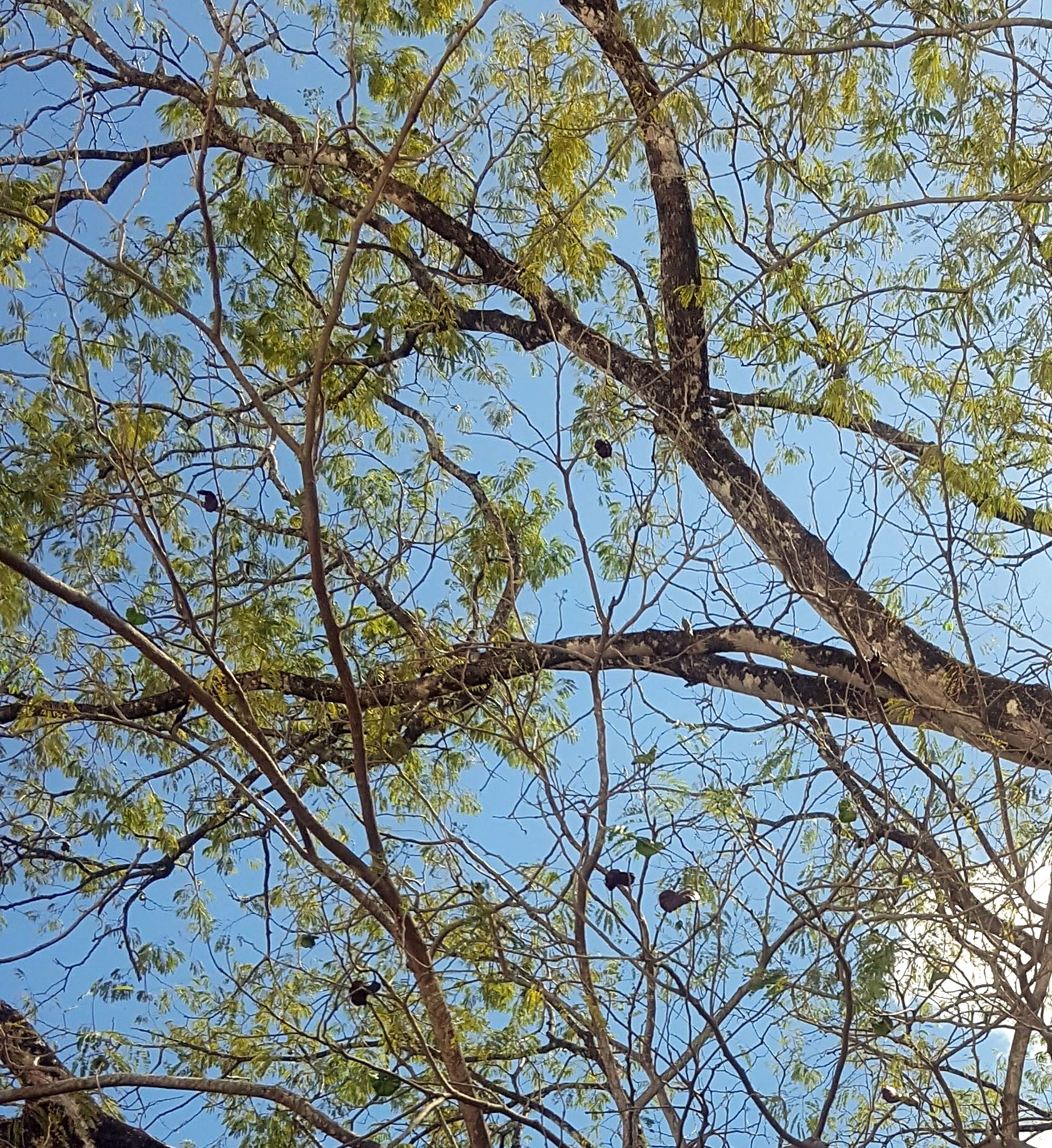
Guanacaste with seed pods, getting new leaves

Tree Poem Week–#2: Los Robles

Los Robles

Gerardo me dijo que los robles
son malos
que yo estaba loca
de no sembrar eso
cerca de la casa

quien sabe porque se secó

ya son veinte años y a mi
lo único que un roble me ha tirado del cielo
es una lluvia de flores
humedas como claveles
con el coraje de nacer bajo un
sol abrasador
en el mes del viento feroz que las
arranca de las ramas donde brotan
apenas se muestran
las caras

Tree Poem Week– #1: El Mango

If you’re not familiar with the trees of the tropical dry forest, let me introduce you to some of my friends.

Company of Mangos

I cannot live one more day without
the company of mango trees.
How am I supposed to breathe
without their green certainty
exhaled into the world?
There is no other way
to survive.
Who else will hear my prayers and
whisper them to heaven?
Their roots pushing down
show me where to
put my feet.
Their parakeets remind me when to
stop sleeping.

50 Different Words for Children

Who would like to join me in a toast to funny-shaped families: non-traditional, hard-to-explain combinations that don’t fit into a cookie-cutter no matter how you turn them?

Cheers!

. . . . .

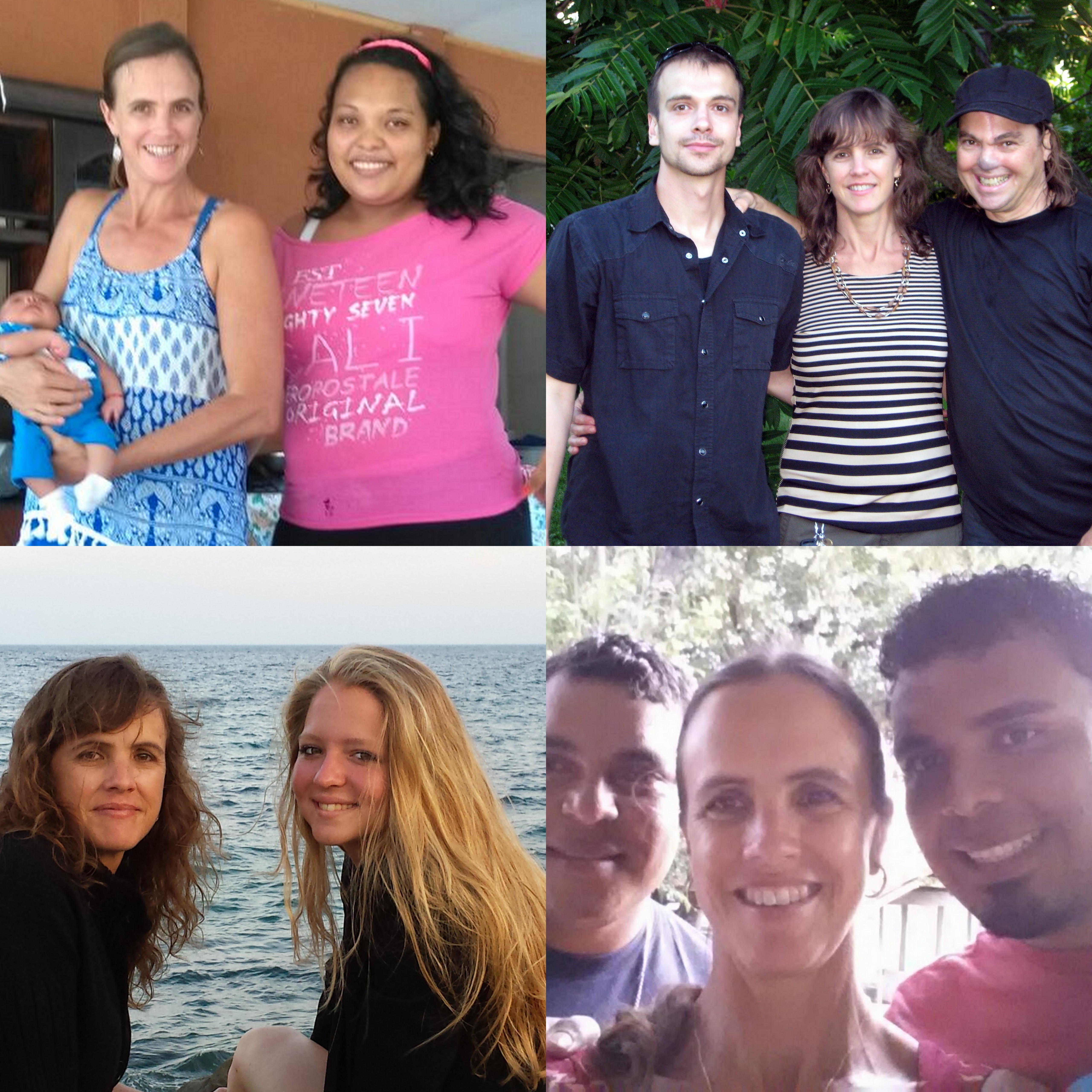
The boys have grown into men and they roar up to my house on motorcycles. They peel of their helmets and pick me up off the ground when they hug me. When they were little and I was their dad’s wife, they didn’t call me mamá, but now they do even though I’ve been gone for much longer than I was there. You can divorce an adult, but the kids are another story.

I re-married and have a new set of step-kids who, unfortunately, live far away. My ex’s kids love my husband and he loves them right back, so when we get together it’s a very odd combination of laughter and pizza and reminiscing about things that not all of us remember. But it’s alright. You can open your heart to the people who want to love you, or you can close it.  Heads or tails.

But the language breaks down–all the ones I know do.  Here’s a question: What do I call my ex-husband’s daughter? If I call her my step-daughter, that confuses her with my husband’s daughter. And my husband has a daughter. He has a son, too, so what do I call the young men on the motorcycles? My ex-step-sons? That sounds terrible. Their dad is my ex—they are not any type of “ex” to me. Our relationship is very much in the present.

So here’s another one. What if my ex-step-daughter has a baby? Because she did. What do I call the baby? My ex-step granddaughter?? I’m laughing now. I’m a little annoyed with Webster’s lack of imagination. We don’t have a word for this. We need one.

I need one.

You know what I don’t like about the options my language gives me for naming children who aren’t mine? I don’t like identifying people who I consider family primarily by who they are not. Like calling the infant I hold in my arms my “ex-step-granddaughter.” That language removes her from me twice before giving her to me. It’s backwards. (And I would never call her that anyway, of course!)

The guy married to my sister is my brother-in-law. The woman married to my other sister is my sister-in-law. Those names give the relationship first and take it down a peg second. I like that order better. My sister’s wife is first my sister—and second, not-really-my-sister.

I guess the supposition is that when you divorce someone, the relationship is broken and the family is broken, so therefore the language identifies the break before it reflects anything else. I imagine that most times it is that way. I just wish we had a whole different word for it, is all, if you aren’t estranged. Like a language that has 50 different words for snow. I wish we had 50 different words for children. We have 3: kids, step-kids and grandkids.

Fail.

I especially dislike the vibe of the prefix “step” in front of family relationships. I accept it, but I don’t care for it. Tell the truth: what’s the first thing that comes to mind when you hear the word “step-mother?” A wicked woman who won’t let pretty girls go to parties at best, and feeds them poisoned apples at worst. Please. Being a stepmother is wretchedly difficult, and no matter what you do, it will be the wrong thing in somebody’s opinion almost all the time.

I wish we had a word for my husband’s son that doesn’t start out by telling you that he doesn’t really belong to me. I wish I had a word for my grandbaby’s mama that doesn’t showcase what we are not.

Of course you are thinking, “Just say ‘daughter’ and ‘granddaughter’.” And I do, and I will.  I just feel the need to put my finger on a very personal place where language and life do not match up at all.

When I was college age, I used to say that I wasn’t sure whether or not I wanted to have children, but that I thought I would make an excellent grandmother.  I didn’t expect to pull that off, but look at me now.

And, dear English Language, please evolve.
 

italia