The Social Worker In The Blue Dress

(A flash of short fact/fiction)

The social worker in the blue dress is not about to be bitten by small dogs today. She came to see you because her boss asked her to, to make sure that you haven’t killed yourself yet, that your baby is getting fat, and that your two-year-old is wearing clothes.

The social worker in the blue dress thinks the evil-spirited pack of chihuahuas is yours. She thinks you have done a particularly terrible job of training them but she doesn’t blame you, having two babies to take care of and a complicated husband. She scurries from the gate into your one-room apartment behind the main house, receiving only one slight sharp-toothed nip to the heel.

You convince her that you’re doing alright. You apologize for the mess in the kitchen. She didn’t exactly call to tell you she was coming, or ask if it was a good time. It’s not a good time. But you don’t exactly have a phone, because your husband takes it to work with him. She’s nice enough and she ignores the mess, points out to you that your baby is really good at following things with his eyes.

As she’s leaving, she asks you to call off the dogs and you tell her that they aren’t your dogs. They are the landlady’s dogs. And the landlady isn’t home.

The social worker in the blue dress walks to the door and the menacing pack of furious chihuahuas is nowhere to be seen, so she steps out into the sunshine of the yard. She is halfway to the gate when they see the intruder, and come snarling at her, needle teeth bared. They take turns lunging at her while she shouts and tries to frighten them.

They aren’t frightened. Each lunge comes closer to her ankles and their camaraderie emboldens them. You scream at them uselessly from the safety of your doorway.

The social worker in the blue dress doesn’t have much time to think, but there is one thing that she is sure of–that she is not about to be bitten by small dogs today. With complete disregard for her dignity, she breaks into a dead run, headed toward the rickrty wooden fence. She won’t have time for the gate. She isn’t even running toward the gate. She hits the top of the wooden fence with both hands and vaults. There is the flash of pink polka dotted panties in the sun.

You stare at the social worker in the blue dress who is suddenly standing on the other side of the fence, panting, safe, looking surprised and a little sheepish. The stunned chihuahuas fall silent for a moment.

“Alright,” she says breathlessly, patting her hair and straightening her blue dress.

The chihuahuas find their voices and leap at the fence.

You don’t quite know what to say to the social worker in the blue dress who just jumped over your fence. She doesn’t seem to know quite what to say to you.

“Sorry about the dogs,” you offer.

“No problem,” she answers, and then giggles a little, accidentally. “Sorry to run away.”

“Oh,” you say, because you can’t think of anything.

“I didn’t want to get bitten,” she says.

“Yeah,” you reply.

She gets into her car and drives away. The dogs look at you disappointedly and begin sniffing her footprints in the yard.

You turn around and go back into the dark, dirty apartment where your two year old is pouring milk on the floor beside a cup. But instead of yelling at her, you sit down on a chair and laugh for the first time since you can remember.

What To Drink With a Pyonder

Ever hear of The Drunken Menno Blog? Don’t miss it! It’s smart. It’s hilarious. It’s sometimes pissy and sometimes sweet, undeniably true and always historically correct. With an original Mennonite cocktail recipe to follow each post. Yes! Where has this kindred spirit been all my life? Um, somewhere in Canada.

I sent the author a copy of “When the Roll Is Called a Pyonder,” she read it and has come up with the perfect drink.  It’s called The “Green Stick.”  If the ironies are too much for you, my apologies. But you are over 21, aren’t you? Then you’re old enough to work it out.

http://imaginarynovelist.weebly.com/drunken-menno-blog/what-to-drink-with-a-pyonder

My favorite part is this:
“No one ever really thought about applying our public pacifism to the private realm until the middle of the twentieth century and even then it hasn’t been done consistently. Children posed something of a problem to early Anabaptists…”

I would not have referred to my childhood spankings as “beatings,” although The Drunken Menno does. And I guess if you’re getting smacked with a stick for the purpose of making you cry over something naughty you have done, what you call it is a matter of semantics.

Have a read.  Have a snicker.  Scratch your head…  Cheers!

The Green Stick, original Mennonite cocktail designed for you and me by The Drunken Menno.  Click the link for the recipe.
The Green Stick, original Mennonite cocktail designed for you and me by The Drunken Menno. Click the link for the recipe.

Pie (a poem for Uncle Roy)

Uncle Roy is the uncle
I don’t remember,
the one who called grandma
on the phone
after Christmas dinner
to say hello.
He was the exotic uncle,
the special one, the uncle
who went all the way west
to Oregon
and stayed.

I know about being the oldest,
about being restless and
how you can love your home
and still not be able
to stay there.

Uncle Roy was the unorthodox uncle
who did what he wanted,
not what he was told.
His mysterious sickness
confounded the doctors and the
analysts who shook their
heads at him as he
walked away.

On his deathbed he
willed us all to eat pie
in his honor—sugar,
in our family, being
the universal language of love.
Now he’s gone again—
off to somewhere we’ve all
heard of, but
none of us have been.

Love Poem to the Sun

a poem from a very old notebook
(If the jungle could write a poem, it would be this one.)

rise on me
scorch me
head to toe

push yellow fingers
through the millions of miles
to love me

come to me
sliding over my skin
and turn me
yellow, brown, red

i will sing for you
scream for you
howl at the moon
and dance

Flock / After the Mennonite Writing Conference

I graduated from Lancaster Mennonite High School many moons ago, so I must have passed my Mennonite History class. Did they not explain the difference between “ethnic” Mennonites (think Canada and the western portion of the USA) and “religious” Mennonites (of the pious Pennsylvania variety)? Or did I not get the memo? Most likely, even the teacher didn’t get it. I get it now.

I thought I had no flock, but I do have a flock. Imagine my surprise.  And I am not even the strangest bird in it.

The best part of all, was seeing a picture of myself reflected back by those around me, that looks like my own image of me. The other 361 days of the year, I am a WIC certifier with a weird pastime: scribbling in notebooks. But this last weekend, for 4 consecutive days, I got to be a writer with a day-job.  This, of course, is what I’ve secretly believed all along.  I just didn’t know anyone else was convinced.

It’s almost enough to make a girl start humming 606.

Células

Si es verdad
que en el cuerpo
humano,
cada célula se repone
en el trascurso de
siete años,
eres, entonces
un hombre nuevo–
y yo soy una mujer
diferente de
la que conociste
al atardecer
con el viento que soplaba
al mar.
Nuestros cuerpos,
hasta las células
cerebrales
donde viven las memorias
más secretas,
nunca se han conocido
el uno sin
el otro.

“When The Roll Is Called A Pyonder”–What Third Graders Want To Know

Adults who read my memoir, “When The Roll Is Called A Pyonder: Tales from a Mennonite Childhood,” often have questions:

Are you still Mennonite?  (click to read my answer) 
Do you attend church?
Do you consider yourself a Christian?
Are your sisters still Mennonite?
What was your purpose for writing this book?
What do your parents think about it?
Why did you change all the names?

Last week I had the opportunity to answer a different set of questions related to “When The Roll Is Called A Pyonder.” A friend of mine teaches 3rd grade at a local elementary school, and, skipping over unmentionables like the day I found out how Baby Michelle got into Mommy’s belly, and how it is that boys get to pee standing up, she has been reading my book to them out loud. On Thursday afternoon, we arranged for me pay a surprise visit to her class. She warned me that I should be prepared for lots of enthusiasm when I walk in the door, but I hadn’t exactly pictured getting mobbed by 23 bouncing, miniature people who are shouting out all of my secrets.

I knocked on the door, nervously, to be honest, and a little boy opened it to let me in. Mrs. Wytko looked up from their math lesson and smiled. “Look!” she said to them. “We have a special visitor today. Guess who this is…”

Somebody gasped, “Diana…??”

I said, “It’s me!”

They jumped out of their chairs and took two running steps toward me, then remembered that I’m actually sort of still a stranger, and stopped.

I sat down on one of the little desks, feeling entirely oversized, held out my arms, and said something like, “So I heard you guys like my book?”

That’s when I got mobbed—group-hugged by an entire 3rd grade class, everybody squealing, and jumping, and saying, “Remember when…?” and, “Why did you…?” then dashing to get their journals to show me the pictures they’ve drawn of my childhood escapades. They showed me their scars, and asked me if chocolate pudding still makes me throw up.

Eventually, Mrs. Wytko herded everyone back to their seats. I read a few pages from “When The Roll Is Called A Pyonder” to them, while they wrote in their little journals about what I was reading, or drew pictures of what it made them think of.

After that, we had Question Time. I sat in the front of the room, and each child had a turn to come to me to tell me something, or ask a question. There isn’t a Mennonite gene in one of their little bodies, but they didn’t seem to notice. Here in the Wild West, everyone is a recent decedent of an outlaw, an immigrant, or both. Forget whether or not I go to church, or what my mother thinks about it. This is what 3rd graders want to know:

Did you ever your mom about the money you took?
Why were the geese so mean?
Did you really kill all the ducks?
Why were the eggs rotten?
Why were you drowning the kitties?
How could you run faster than that truck?
Why is your dad scared of thunder?
Did you pet the snake?
Is there still a hole in your floor?
Why do you hate potato soup?
Remember that mean teacher you had?
Why did you want to kill your sister?
Why did you think you could fly?

I left with a pocket full of love notes, knowing that my book succeeded in communicating the innocence of childhood that hasn’t got anything at all to do with adult problems like religion. And I agree that whether or not chocolate pudding still makes me throw up is much more critical than whether or not I’m still Mennonite.

PhotoGrid_142438810858111017691_10204677680235410_5761157612301501765_n

Hunger Changes Everything

It begins with the sound of Jorge scraping
the bottom of the pot
metal on metal
at six AM.

I don’t need a clock.
By seven, Yolanda’s radio
will play louder than the rain.

From my thin bed, I
listen to him scraping:
the sound of nothing.

Hunger pangs, they say, dull
if you lie on your belly.
I have been sleeping face down for weeks
since the rains began in
earnest, and the buyer of our earthenware
stopped at the dangerous bridge.
It will rain until October.

He scrapes carefully, filling the morning
with echoes of emptiness.
Each grain of rice will be
gone and there will not be one
spoonful left for me.

Who will believe the hot fat
tears that slide around my
nose and onto the bed?
If I say I have wept for a
plate of rice, who will
not politely cough and look away?.

Watch me dry my eyes and pour
thin sweet coffee
from my cup into the hollow space
between these new hipbones.
Watch me look out
at the rain and not at Jorge
chewing.

I will lie on my back tonight
listening to the thunder.
I will be waiting
when Maria lights the cooking fire
in the morning dark.

It begins with the sound of Jorge scraping
the bottom of the pot
metal on metal
at six AM.
A spark ignites the slow-burning panic
of hunger that
changes everything.

Remember Barbara: Afterward

Now, you have suffered with me through the disappearance of my friend, Barbara Struncova.  During the month of December, as I shared her story, I heard from many of you who knew Barbara, and I wove as many of your words as I could into the tale.  I would like to share the following things that I was unable to include:

Barbara may have inherited, or have been set to inherit, money from the sale of a house that belonged to her grandmother, or some other family member, in Europe. “Jim” may have known about this.

As I understand it, Barbara’s family has stated that they do not wish to pursue the case any further.

I contacted one of the investigators that Barbara’s uncle hired, and expressed my interest in this case. He read my message, but he has not replied.

A friend who was having coffee with “Jim” and Barbara one afternoon near the time Barbara went missing, remembers ”Jim” making the comment that Barbara’s uncle would support them. Barbara rolled her eyes and smiled.

No one told Barbara’s mother about Barbara’s disappearance. Her mother learned about it by reading it in the newspaper.

“Ivan” still lives in Costa Rica. I contacted him, requesting help to understand Barbara’s family’s wishes in regards to her disappearance. He politely declined to correspond with me.

No one is able to tell me whether or not the blood on “Jim’s” flip-flop was ever determined to be a match with Barbara’s family.

“Jim” was deported from Costa Rica in 2008.

While “Jim” was in the USA, he stole his brother’s passport, and used it to return to Costa Rica. He used it again to leave in 2010. There is no immigration record indicating that he was even in Costa Rica at the time Barbara disappeared.

“Jim” may have been unable to get his own passport because of criminal offenses in the USA, which may include the failure to pay child support and the writing of fraudulent checks.

“Jim” never suffered a heart attack, did not nearly die, and has not ever been a smoker.

After their investigation in Costa Rica, the Czech investigators hired by Barbara’s uncle flew to the USA, where they watched “Jim”’s house for a short time.

The FBI cannot become involved unless the Costa Rican OIJ specifically requests help from the USA. No such request has been made by the Costa Rican government.

Stories that ”Jim” has used over the years to explain Barbara’s disappearance:
She went to travel in the Caribbean with an ex-boyfriend.
She went to Panama.
She returned to Czech Republic.
Her family quietly shuffled her into rehab for a drug habit.
She had a secret life dealing in/smuggling drugs.
She owed the drug dealers a large sum of money, so they killed her.

 ***

I dream of justice, but my personal quest is for the truth.
Justice will come in one form or another, born from the belly of Karma.
While we wait, we must live patiently and well, telling true stories to each other.

Namaste.

***

Read “Remember Barbara”

PDF of “Remember Barbara”

Rest in peace.
Rest in peace.

Remember Barbara (section 5 of 5)

for Barbara Struncova
1979-2010

Chapter Three, continued

*****

Where are your teeth, Barbara?
Where are your bones?
In the brackish muck of an estuary, delivered by the tide?
On the bottom of the deep?
In the belly of a shark, a crocodile, a worm?
Are you resting near the coast you loved, enshrouded in the makeshift stolen coffin?

 I know you are in the ocean you loved, in the country of your dreams.
The warm touch of the sun is your fingers, the brush of the wind is your breath.
In the thunder, I hear your crying and feel your tears.

*****

None of it makes any sense.

Her family didn’t go to look for her.  No one.  Surely the sister speaks English and could have pressed Jim, if she had gotten there in time.  They could have pressured the police.  They could have raised holy hell, like the parents of the young man who disappeared two years before.  All of us know his name and recognize his face, even if we’ve never seen him alive or dead.

Ivan took everything, even her clothes, and left.  I don’t understand.

Why did they prevent the police from checking her phone, her computer and the rest of her things?  Could they not have realized this would be the result?

Who is Ivan?  Did they really call him?

Why would Jim have left her things untouched in the first place?  Shouldn’t they have disappeared with her if we were supposed to believe she was traveling?  The board bag was big enough.

After the OIJ made contact with Barbara’s family, a terrible silence fell over it all.  The family asked the OIJ not to talk with her distraught housemates, who were facilitating the investigation, and the OIJ asked the housemates not to talk with anyone else.

Barbara’s uncle in Prague sent private investigators to Costa Rica.  They trudged around frowning, sweating, asking questions and taking notes; then they were gone.  Why didn’t he come with them?  Why did a massive search for her body not ensue?


I see there is more I don’t know about Barbara than what I do know.  More I don’t know about Jim, too.  It didn’t matter until now.   We were all expats from somewhere—all of us—with families left behind, the stories we told and the ones we didn’t.  It didn’t matter, then.  We were friends and that’s all—eating together, laughing and playing volleyball on the beach on hot Sunday mornings.  Nothing mattered but us, here and now.  Until, suddenly, everything mattered, and it was too late.

What stories did you not tell us, Barbara?  Could they have saved your life?


*****

I talk to my husband about it.  He calms me, saying it was surely an accident.  A strong man like Jim, with a precisely or poorly aimed blow to the temple, could kill a person, large or small.

“And the blood?” I ask.

He says she could have fallen unconscious to the floor, causing her head to bleed.  We all know head wounds bleed a lot.

But that much?  Enough to fill a closet and leave a trail to the door, then into the trunk of a car?

“And the saran wrap?  And the duct tape?” I ask him.  I can’t help it.

“Drugs,” he says, as if it were obvious.

I should have known he would say that.  Strange behavior, in his mind, is always the result of dealing in drugs.  He says that if you need to pack up drugs, presumably marijuana and cocaine, you wrap them in layer after layer of saran wrap with things like coffee grounds and oregano leaves in between.  If you’re good, you can even fool the dogs.

“So Jim had drugs to pack before he left?”

“Sure,” my husband says, shrugging.

I don’t know.  I don’t see it.  I don’t see it at all.  Of course, I wouldn’t.  No one saw any of this.

“Why do you think her family didn’t come?” my husband continues.  “And why else would Ivan take all of her things and made them disappear?”

He thinks there is some dirty family business going on.  I know he does.  Jim’s dim past, Barbara’s obscure job, and the family with money who gave every appearance of squelching the investigation…  He’s Italian, and can find the shadow of the mob behind every bush in the garden, if he looks long enough.

I’d like to argue with him.  I like think I’m being fair.  I’d like to have something to say in their defense, but when I open my mouth, I have nothing.

Of course there are dangerous sexual practices that can result in death.  Nothing about Barbara leads me believe that she was voluntarily asphyxiated, accidently past the point of no return, but how would I know?  Each possible scenario is more preposterous than the last.

And I insist like the refrain in a song sung by devils: what about all the blood?  Or whatever it was that left a trail from the closet to the car.  Something happened in that room that has not been told.  If Jim is innocent, then why did he run away?


We lost two friends.  Barbara is somewhere turning into sand, her bones in the deep or in the bellies of estuary crocodiles.  Jim turned up in Texas again, but I haven’t exactly wanted to stop by.

I hope it’s all a scam—an elaborate, indecipherable scam to delude everyone who knew them—that Barbara and Ivan are living somewhere on their own paradisiacal island, bought for her by her family with dirty money that was somehow laundered in her supposed murder by her lover Jim.  I hope it was all a setup.  I hope to God that Jim is innocent, and that we have all been cunningly outwitted.

I would love to apologize to him on my knees.

I don’t expect to.

*****


They are still together among my photographs, embraced, smiling.


*****

I remember you, Barbara.  I insist.
Everything is not alright.
May your lover be brought to justice for betraying your life.
Where can he hide from what he has done?

 In my dreams, one day, perhaps very far, Interpol will knock on his door and they will drag him away with metal around his wrists and make him tell what a wicked thing he has done.
I want to see his face in the newspaper, hear he has been captured.
I want terrible men to make him say what he did to you.
I want him to say it, whatever it was.
I want to wring this secret from him with my bare hands.

Haunt him, Barbara
Haunt the ocean.
Look up at him from beds of kelp that wave like your hair.

Haunt him, beautiful friend.
Find him in the country where he is safe because no crime has been committed.
No one wept at your funeral.
No one can prove that you are dead.

 *****

Everyone moved away.   In January, two somber couples moved out of the beautiful beach house that three entered.  None of them could bear, even in brightest daylight, the ominous quiet of the empty room.  At night they jumped at every shift and rustle of the breeze, glimpsing, from the corners of their eyes, the glow of blood.  They took Jim’s belongings and threw them away—all of them.  No one wanted any of it.  Randy adopted the dog.

No one is left at all.  Nothing remains to bear witness:  no monument, no marker, no voice speaking a name in the silence.

*****

 I remember you, Barbara.
I do not forget.

I feel your smile in the sun.
I hear your laugh in the rustling leaves of trees.
I know you are somewhere in the rain, evaporated from the sea.
You are in the mangrove tree, growing from the fertile mud of the estuary, where lies the crocodile who snapped your finger bones.

 I don’t know where you are.
You are everywhere.

*****

Read the “Afterward”
(additional information that I have learned during the writing of this story)

IMG_3412
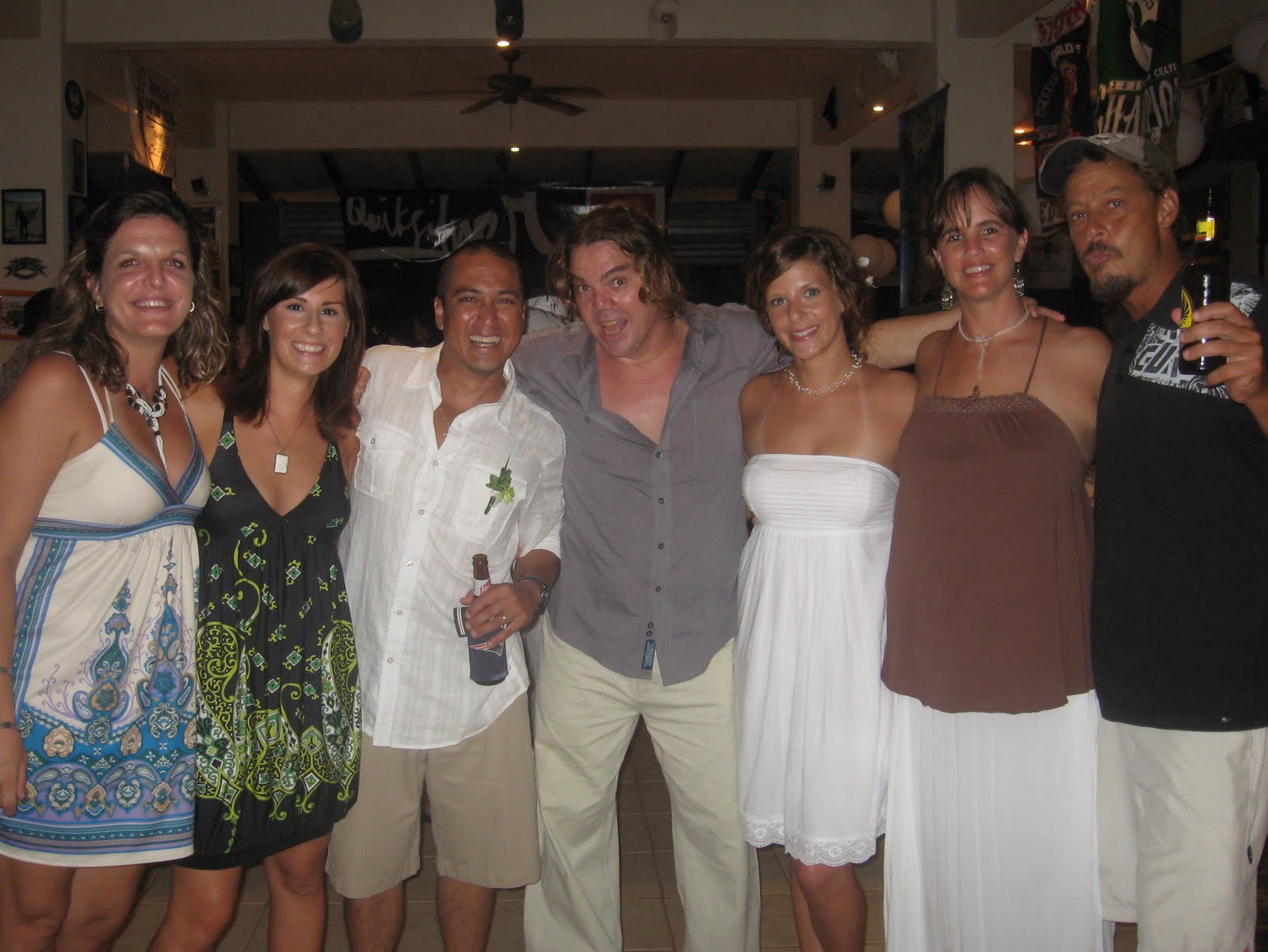
Us (except “Jake,”) at Marco and Rebecca’s wedding, July 2010: Barbara, “Paige”, “Marco”, my husband, “Rebecca”, me and “Jim”


Barbara Struncova disappeared on December 5, 2010 and is still one of Costa Rica’s cold case missing persons.
All of the names of people and most of the names of places have been changed.
All of them except Barbara’s.

Remember Barbara (Section 4 of 5)

for Barbara Struncova
1979-2010

…I promised.
But I am not keeping secrets anymore.

Chapter Two, continued

There were traces of blood all over their bedroom.  The police sprayed their mysterious spray across the floor, and there, beside the bed, a bright puddle began to glow, its center radiating like a dark, terrible sun.  Small fluorescent smudges appeared.  On the wall by the bed, an unmistakable hand print shone clear ghostly fingers.

“Whose hand…?” I asked, not wanting to know.

“We don’t know.”  But there was more.  “And in the closet—   It looked clean in the daylight, but when the cops sprayed that stuff, it glowed.  Bright.  The whole closet.”


What the hell?


Maybe a worker hurt himself during construction. Terribly. Then he touched the wall. Maybe other renters once had a dog that lay there bleeding to death after a vicious fight. In the closet. A dog would like that.

“No, no,” the cops say. “Human blood.”

Is there a way they can be sure of that? What in God’s name happened in there? Is this fluorescent cop blood-spray even real?

I Google it. It’s real. Bleach activates it too, I read, and for a moment I feel better. Maybe it was just bleach. The cleaning lady spilled it.

Then I feel sick again. Who spills that much bleach in a closet? A floor mopped with bleach would have a uniform glow.

“The police think he kept her there for a day or more. They found one of Jim’s flip flops with blood on it and they took it to see if they can get a match from her family.”


Was it in a crime of passion? A fury out of control? Did he plan it?! Impossible.

Jim was as strong as an ox. He could have strangled any medium-sized adult with his bare hands, woman or man. He could have suffocated her with a pillow. Suffocation is quiet and, whatever happened, no one heard a sound.

But why the glow of so much blood? Or is it bleach? Does it make a difference? Even though Jim left with only a backpack, the pillows and bedding were gone from the room, and, in the bathroom, not one towel remained.

He made no secret of owning a gun but nothing suggested that shots had been fired. Did he stab her? Why, if he could so easily have suffocated her? Did her head crash against the cement wall or tile floor? Was she instantly unconscious? Why didn’t she scream?

Did he gag her first? Hold his hand over her mouth? No. He couldn’t have. He loved her.

And the saran wrap? The duct tape? Possibilities occur to me that are unmentionable. Maybe I watch too much TV.

What in God’s name happened to Barbara? Why?


The cops sprayed the blood spray through the common area and stood in stupefied silence as a glowing trail appeared, wide and solid, as if something heavy had been dragged out of their room, across the floor, around the pool, up the stair at the entrance, through the door and onto the front porch.  Then it disappeared.  The cops took their hats off, crossed themselves, and mumbled what sounded like, “Santa Maria.”

Just before the fading cover of that night gave way to dawn, the OIJ knocked on Randy’s door, demanding to examine his vehicle.  Startled and stammering, he rummaged for the keys.  They filled the old Trooper with spray, and there it was behind the last seat:  the same eerie, nauseating glow.

Nobody’s dog died in Jim and Barbara’s closet.  Whatever was in that closet slid out the front door of the house and disappeared forever from the trunk of that car.

And then, after that, nothing. Absolutely nothing. Jim was gone and there was no sign of Barbara anywhere. Ivan took away her things. No sign, ever, of the long board bag charged to the Czechs.

The police, having a crime with no criminal and no victim, turned their attention back to chasing thieves.


*****

Remember Barbara
Part Three

I tell myself the story a thousand ways, asking her silent ghost which version is true, begging her just to nod or twitch a finger when I get it right. I have tried everything. She is motionless.

Surely it must have begun with a fight. Truly.

Give me that much, Barbara.
He left the bar early—tired, bored, and annoyed that even though you all speak English, you kept slipping into Czech as if he wasn’t even there.  Laughing hilariously, and him sitting there like stump.

You came home at 1:00 o’clock, early by Europe’s definition of a night out, late by Jim’s.  But the Czechs came every year, and every year it was the same.  Jim never seemed the least bit jealous.

I guess this time he waited up for you.


And what? Was he angry? Did he accuse you of cheating? Say you didn’t love him? Was he drunk? Were you? Did he ask you for money? Did you refuse? Say you’d had it with him? That you were sick of it? Did you tell him you couldn’t go one more day like this? But why would he kill you for that? Is there any way you are alive?

Did you know something about him and threaten to tell? Did you accuse him of something true and unspeakable? How did he become so terribly angry? Or was it anger at all?

Was he waiting for you in bed feigning sleep? Did you tiptoe in trying not to disturb, brush your teeth in the bathroom with the door closed and slip quietly into bed beside him, sliding a warm arm around his chest and kiss his ear? Did you think he would make love to you when he grabbed you by the throat?

Did he mean to kill you when you opened the door? Did you feel it in the air? Did you know something wasn’t right?

Did you know you were dying, Barbara?


What did he do to her, that beast? Press on her throat until she stopped thrashing? Hold a pillow on her face? Strike a deadly blow to her temple? Split her skull against the wall? Did he cut her with a knife, the animal? Why? What did she do to him but love him? What did he fear she would do?

Did he think we would believe him?  And we might have believed him longer, if his lies had been less absurd, if he hadn’t told them just before her mother’s birthday, just before Christmas.  When both came and went—and really, one was enough—everyone knew she was dead.

If he could have conjured up a sliver of concern, it would have helped. We might have thought for at least a minute that she really ran away, taking nothing, intending to return and perhaps somewhere in her adventures met with misfortune. We might have tried to believe he was innocent. He could have paced, called her sister, talked to the police, twisted his goatee, shed a tear. But nothing. Sneers, sardonic smirks and crazy bitch.


*****

I think if he’d meant to do it, he wouldn’t have done it there. He would have taken her on a trip somewhere to a rented room. He would have taken her alone on a boat into the sea. He would have had the car and the board bag ready if he knew he was going to need them. He isn’t that stupid.

I make up a story to believe because I need one. In it, they become angry and say terrible things to each other. Wine makes her bold. And in a blind rage, he doesn’t care. For one second too long, he doesn’t care.

Then he smacks her face and waits for her to come to. And smacks her harder but nothing happens.

Bitch, wake up.

Now what has she done?

He shakes her and her body lolls.  He presses his head to her chest where he can hear that her heart has stopped, and the flood of sorrow boils into pure rage at her pathetic weakness.

Now look what you have done to me. Got the last laugh. Died, you stupid bitch. Crazy bitch. Goddamn women, man.

cut 4
Barbara Struncova

Read the last section of the story 

 Barbara Struncova disappeared on December 5, 2010 and is still one of Costa Rica’s cold case missing persons. This is her story according to me, as close to the truth as I am able to tell it.
I call it fiction in a fading hope that it is.
Make no mistake: I will never stop hoping that everything I have supposed is wrong.
Everyone in this story is a friend I have lost.

Remember Barbara (Section 3 of 5)

for Barbara Struncova
1979-2010

Chapter Two

On the night of December 4, 2010, Barbara and Jim went out with the Czech friends for dinner and drinks.  Jim was tired.  He’d surfed all day with the Czechs, and while they could sleep in if they wanted, he would have to get up and open the shop in the morning.  When the party decided to move from the restaurant to a bar down the street, he told Barbara he was going home.

Barbara wanted to stay.  They were telling funny stories, and it was only 9:00 o’clock.  So Jim said goodnight and rode his bike home, while Barbara stayed behind with the group. At 1:00 o’clock they left the bar, but the Czechs weren’t letting Barbara ride her bike home alone at that hour.  They put the bike in their rented van, and dropped her off at her front door.  They watched her open it and go inside.  She waved and smiled and said good night.  See you tomorrow.

The house was quiet.  Everyone was asleep.  No one heard anything unusual during the night.

*****

The next morning Jim was up first, as always, but he wasn’t his good-naturedly grumpy self.  He was agitated.  He sneered.  As his housemates woke up and wandered to the kitchen for coffee, he cursed and paced.

“Barbara left me,” he said.  “Crazy bitch,” and a bitter laugh.  “Last night.  She just fuckin’ left, that bitch.  She said some damn shit about goin’ to the Caribbean side.  I don’t know.  She has some ex-boyfriend.  Some guy named Martin or somethin’.  She put some shit in a backpack and left.  Got on the bus to San Jose.”

They stared in disbelief.  Barbara?  Left Jim?  Left them all?  At three in the morning?  Without saying goodbye?  What?  What ex-boyfriend?  Are you kidding?

None of it made any sense.

“Crazy bitch,” Jim spat.

“Jim started acting really weird,” Rebecca told me, “but we figured he was in shock.  We were all in shock.  That was so not like her.  We didn’t want to ask him a lot of questions because we felt so terrible for him.”

Who wouldn’t?  What an awful thing to do.  The break-up we all half expected, hadn’t looked anything like that in our imaginations.  It more likely involved Jim riding off into the sunset on his longboard, while Barbara cried him an ocean of tears.

On December 6, the day after Jim said Barbara left him, he went to the surf shop and asked for a board bag.  He told the cashier on duty that one of the Czechs needed it, just to add it to their bill.  No one asked any questions until weeks later, when the Czechs were settling their accounts and discovered the charge for a board bag big enough to hold three 9 ½ foot surf boards.  None of them had asked for it.  None of them had seen it.  No surfer in his right mind would travel from Europe to the Americas with longboards—the longboarders rented from the shop.  But Jim was nowhere to be found, by that time.  And he had not taken his longboard.

That same afternoon, Jim called Randy, a fellow Texan who worked next door to the surf shop, asking to borrow his car.  Randy said he was sorry, but its tags had expired and he didn’t want it on the road illegally.  Jim became agitated, he said, insisting—demanding, even—but refusing to say why he needed it, or where he would go.  Randy finally gave in, frightened by Jim’s desperation and the rage boiling in his voice.  The next morning, the car was back just like Jim had promised, and Randy forgot about it until Jim disappeared and questions started circulating.

Everyone was frantically worried about Barbara, only Jim laughed it off with a bitter chuckle, saying he didn’t care where she was.  On one hand his anger wasn’t surprising.  On the other hand, after five years together, his disregard for her complete silence, compared with everyone else’s worry, was eerie.

Jim cursed and spat, saying she was crazy and messed up.  That was all.

Finally Marco and Jake couldn’t stand it anymore, and they reported Barbara missing at the town’s little rural police office, where, if you want something written down, it’s a good idea to bring a pen.

He started keeping his room locked, which wasn’t like him.  None of the others locked their door while they were home, and neither had he and Barbara.  Now, he locked it behind him every time he came into the common area, which was suddenly almost never.  He spent hours enclosed in there.  When the cleaning lady came, he said it was clean, and left with the key.  He was sullen, skittish and mean.  He didn’t go surfing.

One afternoon, Jake was scouring the house for surf wax.  Having no luck anywhere else, he tried Jim’s closed door and to his surprise, it opened.  He found several rolls of saran wrap and some duct tape lying on the bare mattress, stripped of sheets.  No surf wax lying around anywhere, though, so he left the room empty handed.

He brought a few bars of wax home from the surf shop that night and tossed one to Jim, saying, “Dude, you’re out of wax.  I brought you some.”

“What do you mean?”

“I looked everywhere.”

“What?  How’d you get in there?!” Jim flashed in fury.  “Oh, so now you go in my room when I’m not home?!”  He slammed down the beer he was drinking and stormed into his room in a sudden rage, banging the door behind him.

Before Jim himself vanished, he took a trip for a few days.  Out of nowhere, he announced that he needed to go look for Barbara—as though for some reason, he suddenly cared, and had an idea where to look.  He packed a backpack and took a sleeping bag, as if he supposed that Barbara might have decided to go someplace where he would not be able to find a bed.

He told Marco he was going to look for her in Jacó.  He told Jake he was going to Limón.  To Barbara’s best friend at the little hotel down the street, he said that he was going to look for her in Puerto Viejo, only to email a few days later, stating that he was in surfing in Dominical, and that Barbara had gone to Panama.

Where ever he went, he did not return with Barbara or any news of her.  He appeared at home again on December 21st and, in spite of his failed mission, seemed to somehow feel better, as if some troublesome load had lifted from his shoulders.  He walked into the house and smiled a little when he said hello.  Carrying the backpack, the sleeping bag and a plastic grocery bag of cleaning supplies.

The next day, Jim told Rebecca that he had an interview for a chef job at a restaurant down the road.  He patted the dog on the head and walked out of the house, with a little bag slung over his shoulder.  Marco, biking home from a surf lesson just then, saw Jim sitting outside a hotel, and stopped to ask what was up.  Jim shook his head and said he was stuck there waiting for some damn guy to wake his lazy ass up and pay him for a surf trip.  And he hoped he wouldn’t have to wait all day.

Shortly after, in front of that hotel, a passenger looking remarkably like Jim, but who identified himself as “Steve York,” boarded the 3 PM shuttle bus to the capital city.  Two days later, on Christmas Eve, Jim arrived in The United States of America using a passport that belonged to his brother.

“We think he did something to her,” Rebecca repeated and disbelief would not let it into my head.

“Did what?”

“We think she’s dead.”
Impossible.

Every day I waited for an email from Barbara, telling me that something awful had happened between her and Jim, which caused her to run away.  I donated money to a search fund.

But no one had seen her.  She wasn’t in the Caribbean.  No bus company had sold her a ticket.  Immigration verified that her passport hadn’t left the country.

Her bank account was empty, and the evidence it showed wasn’t of traveling.  Two thousand dollars was transferred, in mid-December, from Barbara’s bank account into the surf shop account that Jim had access to.  And then withdrawn.  The receipts lay right there screaming in his drawer.

He couldn’t have killed her for $2,000.
Please.

Then Ivan, a Czech friend of Barbara’s who lives elsewhere in Costa Rica, came and took all of her things.  He was a friend from Barbara’s childhood, who visited often and joined us at some of our group dinners.  Ivan held no interest for me at all, and I paid so little attention to him that I would have forgotten him altogether, if he hadn’t stepped right into the middle of the story.

He came to the house scowling and scolding Barbara’s four stupefied friends for publicizing her absence.  He demanded that they be quiet.  Barbara’s disappearance now peppered the Czech newspapers, and this, for reasons that I have not come to understand, was against the family’s wishes.  At least that’s what Ivan said.  The devastated the family, he insisted, called him, explaining that they were too distraught by Barbara’s disappearance to make the trip from Europe.  He said they asked him to collect her things for them—everything.  So he did.  While her helpless housemates looked on, he collected each and every single one of Barbara’s possessions, presumably at her family’s request, and left with them for Czech Republic.

The police got nothing.

*****

The OIJ, the Costa Rican equivalent of the FBI, came to the house to do a different type investigation after Jim vanished and there was still no sign of Barbara. They came to the house at night this time with a special spray. The spray, they said, glows in the dark if or where there is even a trace of blood. No matter what happens, the police told them, they must absolutely not tell anyone. No whispers, no rumors. Jim may not be far away and Barbara may still be alive somewhere. We can’t assume anything. Secrecy is important for the investigation.

“So do not tell anyone,” were my instructions.

And I promised.

But I am not keeping secrets anymore.

Barbara-Struncova_newsfull_h

Read the next section of the story

Barbara Struncova disappeared on December 5, 2010 and is still one of Costa Rica’s cold case missing persons. This is her story according to me, as close to the truth as I am able to tell it.
I call it fiction in a fading hope that it is.
Make no mistake: I will never stop hoping that everything I have supposed is wrong.
Everyone in this story is a friend I have lost.