Feed the Good Wolf

I feel the need to weigh in on the political situation in US of A. I do not believe that I have anything new to say, but when I think that I will therefore not say anything, that feels wrong.  So this, today, is my statement.  Followed by a story that gives me a way forward.

I am not happy with our new president.  I was not happy with him as a candidate, and I am not happy with him now.  I don’t like what he says or has done regarding issues of immigration.  I don’t like his arrogant, self-absorbed demeanor.  I read things that disturb me regarding how he is placing white supremacists in powerful positions around him.  I am told that hate crimes and hateful actions are on the rise.

I know good people who like him, who brush off what I find intolerable with a shrug of the shoulders and say this is the liberal media, not the truth.  All I can say is, I hope you are right.

I still don’t like him.  I feel betrayed by a country that I thought I understood a little, but clearly I don’t.

In the face of discrimination, hate and fear, I feel compelled to wage love.  Wage kindness.  Wield it like a sword.  No one, no matter how hateful, can take away your ability to be compassionate.  Do it expansively.

Here is a small Native American story for us to keep close to our hearts, to give us a way forward, personally.  It doesn’t speak directly to politics, but to individuals–to me.

A grandfather tells a young child that inside each person, there is a good wolf and a bad wolf.  The bad wolf is hate, anger, and arrogance.  The good wolf is love, compassion, and kindness.  The good wolf and the bad wolf are locked in a fight.

The child thinks about the wolves and, as children do, asks, “Which one wins?”

The grandfather replies, “The one you feed.”

Feed the good wolf.


An Inch Too Far To The Left

I wanted to lie in my hammock and look at the moon. It was shining onto the porch through the trees, so if I lie with my head at the feet end, and my feet at the head end, I would be able to watch it rise. Up until that Wednesday night, I kept the hammock tied high and tight. It took some talent to get into, but it’s a much more comfortable position once you’re in, than half-sitting with your knees hyper-extended like what happens to me in normal hammock position.

One second, I was trying to wiggle up into the hammock with my left hip. The next second something slammed my head so hard I knew it was trying to kill me. That is literally what went through my mind: an attempt on my life.

I was lying on the floor. What? The cement floor under the hammock. On my porch. It was very hard to think about things, to understand that one second I was balancing into my hammock and the next second I hit the floor head-first on the other side. Sober, in case you’re wondering. Mortally clumsy.

It seemed clear to me that I might die. The sound I heard inside my own head as it slammed the cement echoed. I put my hand to my head and a soft, hot lump like the skull of a newborn filled my palm. If it’s swelling like this on the outside, what is happening on the inside? Am I going to die?

I called for Pio who was inside watching tv. The moment before, I kissed him and said I was going to go out onto the porch to lie in the hammock for a while. At 8 PM on a Wednesday. The night before full moon when I can’t bear to be inside. Then I was lying there trying to scream for ice.

*****

Clearly, I didn’t die. I walked around in a fog for a few days, and I still have a black eye even though the hit was nowhere near my face.

I’m writing this to tell you what came to my bruised brain as it bounced around inside my skull and decided to keep doing its job of making my body live. This: Pongase las cuentas al día. Get your accounts in order. Literally. And so-to-speak. Leave a paper trail. Say what you mean. Don’t start things you have no intention of finishing. Don’t start things you shouldn’t finish. Because any day, for any stupid slip-up, you could be gone.  Before you know what happened. All you have to do is lean in an inch too far to the left.

Pio got me ice. I don’t know who was more scared–him or me. I lie on the ground with my feet propped up while he iced them to keep me awake. It helps. Keep ice in your freezer. It might keep you conscious some night, which helps. I thought about Jon and the crocodile attack. He held on for 45 minutes or more lying on the beach while he waited for an ambulance. If he didn’t let go, I wasn’t going to. Not that there is any comparison between falling out of a hammock and being attacked by a crocodile. But I thought about it. No ambulance was going to come for me.

Pio called our neighbor who showed up with his truck, they put me in, and hauled me off the the “emergency room” in Santa Cruz, a very bouncy 30 minutes away. At the “emergency room,” they asked me what day it was, how old I am, looked in my eyes, pushed on my arms and told me I was alright. This is the type of free “medical service” available in Costa Rica. I got my first wheelchair ride. They told me if I started feeling or acting strange in the next days, to come back. I left as terrified as I’d arrived. The town I live in has lost more than one person several days after a head injury.

But I feel better now. I think it’s safe to say I made it. The day I leave this world, it will be because of something else. But you know what? I like it here. I don’t want to go anywhere. I’m staying right here if I can help it, in this yellow house with Pio and the cats, my dying computer, the wind, the dusty road and a couple of low-slung hammocks that hyper-extend my knees.

2017 Plans, Starting With Coffee

I was talking on the phone to one of my sisters the other day, and she asked me perfectly normal question: “So what are your plans for the new year?”–or something like that.

For one very confusing moment, I had no idea what to say. I mean, I realize that, yes, we have turned a page on the calendar. I even made a resolution regarding how to (hopefully) be a somewhat better human being. But that’s not the same as plans.

For some reason it felt like a confession of something not very noble to say that I don’t really have any plans.  But I mean that in a good way, if you get what I’m saying.  An expression of contentment.  I have nothing to fix because nothing is broken.

Is that terrible?  I know in my heart that it isn’t, but it’s a 1st World cultural thing:  you need goals.  You need plans.  If you aren’t going somewhere–well.  How dare you?  Let me clarify:  this is NOT said sister’s attitude, nor is it the spirit in which she asked the question.  We were just chatting.  And then I got to… hablando sola.

When I sit down and make a list of what I actually plan to do this year, this is what I come up with:

–In 2017, I plan to wake up every morning.  Early.  Early enough to see the big dipper on the horizon in the south, then watch the sky fade from black to gray to blue.  Roosters, then monkeys, then parakeets.

–I plan to drink hot coffee in the mornings.  A glass of red wine in the evening.  In between, plenty of water.  I fully intend to eat far more plants than animals, and that most of the animals will be fish.

–I plan to surf as often and as well as I possibly can.  It won’t be as often or as well as my heart asks, but I plan to be ok with that.  I know my options.  For five cold years I couldn’t surf, ever.

–In 2017, I plan to feed my cats twice a day.  Religiously.   And pet them and pester them and sing them silly songs.

–I intend to go to work 5 days a week, and remember that this alone makes me lucky.

–I plan to be a good wife.

–I plan to visit my granddaughter.  She isn’t my biological granddaughter, obviously, because her mama wasn’t my baby, but I prefer to define things by what they are, not by what they are not.  She will learn to sit and crawl and probably walk.  I have no plans of being a stranger.

–I plan to look at the sky every night.  Search for certain stars or watch the moon.    On dry nights I may lie for a while on my back on the ground under the sky.  Me and the Milky Way.  Because I can.

–I have a hammock, now, and I intend to use it.

–In 2017, I plan to turn 47.  I feel fine about that.  Next year I plan to turn 48, and I’m not afraid to say it.

–I plan to pay attention to poems, to dreams, to wind direction.  If I can get those things right, the rest will follow.

These are my ambitions.  My goal is to be warm.  My plan is to be content.  On both counts, I am fully self-confident.

A Lesson on Magic

All of the sudden, I’m looking for a point of reference, a place from which to start, something certain. Not to be melodramatic, but it’s been a rough week.  I don’t generally get all wound up about “politics,” but the election we all just survived was more about American morals than American “politics.”  It pulled the rug out from under me.

When I look for a place to begin, I often come back to something I read in college. I’m not going to name the book or the author because, to be entirely honest, I’m not sure how much of what I’m going to say is actually in the book and how much of it I’ve made up since then. College was a LONG time ago. I’ve lived a lot, drawn on this often, and probably molded it to fit me. In lieu of butchering someone else’s book, I’ll just say that these are not original thoughts–they’re second-hand like my clothes.

I read the book for a Women’s Studies class. The author is a Native American woman who, if I remember correctly, was an anti-nuclear power activist in the 1980s (when I was encountering algebra and learning to drive a car). She’s a witch, too–a Wicca witch, not a Halloween witch. The book is about (among other things) magic.

THIS WOULD BE A FABULOUS TIME FOR SOME MAGIC. I would like a fairy god mother to turn vegetables into vehicles, even for an evening. We could use a benevolent woman with a magic wand, a fair although angry woman with a magic wand.

We don’t have one.

But here’s what I learned from the book about how to do magic yourself:

To work magic is to change the physical manifestation of things. Anyone can do it. It takes strength and imagination, not special powers. The author tells the story of her favorite hiking trail in the forest, which people would litter with trash. Time after time she walked by the trash, disliking it and the people who left it there, until finally she decided to use her witch’s powers of changing the physical manifestation of things to make it disappear. She gathered some friends and some trash bags, and picked up the trash. What was the result? Abracadabra: a clean trail.  Just like that.

A thing like that sticks with a girl. So simple. So true.

I want to live in a world that isn’t covered in trash. I pick up what I can.
I want to live in a world that has clean air. I plant things. I ride my bicycle when I can.
I want to live in a world where people don’t walk around the grocery store with concealed weapons. I don’t own a gun.
I want to live in a world where neighbors are nice to each other. I wave and say hi.
I want to live in a world where people look me in the eyes and take me seriously. I look people in the eyes and am serious.

It doesn’t solve everything. It doesn’t solve anything, maybe. Not-owning a weapon doesn’t keep me safe. Pedaling through the rain doesn’t reverse global warming. (But ask me if suiting up for a rainy ride changes the physical manifestation of getting from place to place, as opposed to sitting in a car.) Me waving at the neighbor ladies is not going to end racism any time soon.

But I have strength. I have imagination. I have time. I can make things be different on the trail I walk on. Doing nothing gives you a feeling of helplessness, even if all you are is lazy. Doing something changes things, and that is magic. Getting the stray cat spayed changes the number of stray cats in the neighborhood, and we all know what a downer the physical manifestation of too many feral cats is.

I don’t live in the States. I’m white, straight and of Christian traditions. I’m not sitting here in fear of becoming a target of bigotry–I look too much like the bigots. Nobody is going to beat me up or insult me because of my clothes or my skin or who I’ve married. I am terrified for others, but it’s different because it’s not me. I recognize that as privilege. My greatest privilege, in my opinion, is that I am living in a country that doesn’t suffer from hate crimes and terror. Bad things happen, but the dynamics are not the same.

I don’t know how to do magic that makes hate or fear go away. I don’t know a spell to make privileges visible to those who hold them with blind eyes.  I know how to turn a dirty bathroom into a clean one, and I have the perfect spell for getting trash off the beach.  But how do I make safety appear?

I don’t know.  But I am looking for the answer.  I am trying.  I might turn some princes into frogs by accident along the way, but it’s important to start.  It’s important to try.  If the only things I can change the physical manifestation of are small and insignificant, I will do it anyway.  What is too small to matter when everything is made up of atoms?

Abracadabra.

Hold on to your hat.

Acronyms Meet to Discuss Crocodiles in Tamarindo

These are my gleanings from the meeting held at the Barceló with ADI (Association de Desarollo Integral), SINAC (Sistema Nacional de Areas de Conservacion), CATURGUA (Camera de Turismo Guanacasteca), and MINAE (Ministerio de Ambiente y Energia). The purpose of the meeting was to discuss The Crocodile/s . I mostly went to listen, because that’s always a good start, and I got to ask a few questions. What follows is what I took away from the meeting. This is not intended to be a complete summary—I’m sure ADI will provide that. It is a subjective gleaning and contains editorial commentary and a concerted effort to minimize sarcasm.


MINAE says:

–They carefully observed the crocodiles in the estuary after the July attack. They removed the very big one that exhibited dangerous/unusual behavior, explaining that there was only one exhibiting this behavior and it is certainly the one guilty of the attack. It was taken to Puerto Humo. (I looked it up. It’s where the Tempisque River is born. ) They are still monitoring crocodiles in the Playa Grande/Tamarindo/Langosta area and analyzing their behavior. In the five kilometer marine stretch that they monitor, it is normal for there to be 12-14 crocodiles moving around at any given time.

Laura The Crocodile Expert says:

–It is not true that crocodiles were “seeded” here.

–Salt water crocs are completely natural in the estuaries and oceans of Guanacaste. She says they were depleted in the 40-60s, but that now their populations are becoming “healthy” again.

–It is not true that there is an overpopulation of crocodiles in Tamarindo. Overpopulation occurs when there are so many of a species that there is not enough food for them, and they begin to kill each other. Since crocodiles are not doing this, there is no overpopulation. Lucky for us, crocodiles are of a species that control their own population—as in, crocodiles never have overpopulation because they kill each other first and solve their own problem.

–Swimming in the ocean is normal crocodile behavior. Eating dogs is normal crocodile behavior. (I wanted to ask if eating human preschoolers would be considered normal crocodile behavior, but I was afraid of the answer.)

–Attacking/eating (presumably adult) people is not normal behavior for this species of crocodile. Nile crocodiles, she explained, eat people, but not this kind. She made a big deal about how crocodiles do not hunt people, do not want to eat people and are normally afraid of people.

–The (only) problem in Tamarindo is that crocodiles have been, for so long, fed by humans.

The SINAC guy talked too, but he didn’t say anything that stuck with me. He did take a moment to praise the fact that we have such a wonderful government system that allows us all to participate in decisions, as demonstrated by this meeting.

The meeting, by and large, revolved around how dreadful it is that we have created this dangerous situation for ourselves by feeding the crocodiles. (Which I acknowledge. Our Tamarindo crocs have twisted minds and there’s no one to blame except us.)

But ok. So we’ve corrupted the crocodile population. While we right our wrong, what’s the plan for our safety?
Signs. Signs warning people not to feed crocodiles, and not to swim in the ocean/estuary. (How about a sign asking crocodiles not to eat the people? I didn’t say that, but I thought it.) And crocodile “monitoring.”

That’s when I raised my hand. First, I said why I was there—because I happened to be a first-hand witness of the trauma caused by the attack, and I DO NOT EVER want to see anything like that again. And I don’t want you to, either. The room became very quiet. Then I asked the guy from MINAE: How are you monitoring the crocodiles? And what does a crocodile have to do in order for you to identify it as “malportado? “

They said they are monitoring the crocodiles by observing them. I was imagining chips and tracking devices, but no. That’s way too Animal Planet. “Monitoring” means that MINAE has people watching over the crocodiles. (I haven’t seen these monitors. Maybe you have?) Later in the meeting MINAE stated that they have 7 people in charge of “monitoring” 26,000 hectares. Or maybe I misunderstood that? I hope so. And a naughty crocodile, one who could get itself on the bad-boy list for possible deportation to Puerto Humo, is one that shows abnormal interest in people. Swimming near people. Looking at people. Not humbly slinking away.

MINAE wants us to report to them—that’s the most useful thing I learned at the meeting. If you see a human feeding a crocodile, make a denuncia. If you see a crocodile showing interest in humans, make a denuncia! (I’m not sure it’s called a denuncia if it’s against an animal, but you get what I mean.) MINAE says that for all of the videos on social media and for all the fussing and fuming there is about people feeding crocs, there has not ever been ONE SINGLE denuncia filed against anyone with MINAE. Which is silly. A few denuncias, a long time ago, would have enabled them to act before things turned out the way they did. Or anyway, that’s the story in retrospect. Point being: if you see any funny stuff between people and crocodiles—regardless of which species is the perpetrator—call MINAE. They’ll be right over after they finish observing the other 25,000 hectares they’re in charge of.

Other people asked questions, but I don’t really remember what they were. (I don’t advertise this a lot, but I’m actually quite selfish.) We spent A LOT of time reviewing the evils of people who feed crocs and the wonderful power of signs. Signs in red, to be specific. Red was praised. I’m not kidding. (And all sarcasm aside, red is better than the brown-and-yellow ones originally posted behind the high tide mark.)

I asked my other question to Laura The Crocodile Expert. Because I wanted someone at that table of “experts” to say it to my face. I said, “You’re the crocodile expert. You know these animals better than anyone else in this room. So tell me. Now that the big bad crocodile is gone, but knowing that there are others nearby who were certainly fed by humans, would you , if you were a surfer like I am, put your board in the water and surf in the mouth of the estuary?” Everybody laughed nervously. And Laura said, “No.” Not in the mouth of the estuary, she wouldn’t. No matter how good the waves were. That’s like chilling out on their buffet table.

People surf in the river mouth every day, and so far all of us have been safe. I didn’t say that, because she gave me her honest opinion, which is what I asked for. And she confirmed that my persisting fears are not an irrational.

Now, looking back on it, I feel a small (but futile) twinge of victory. I didn’t mean to set a trap, but if you think about it, I guess the panel of experts admitted that even though they’ve “done something” about the crocodile “problem” in Tamarindo, it still isn’t “safe.” Babies, dogs and surfers, beware: MINAE is working to protect us within the bounds of the law, but the crocodile expert wouldn’t go for a swim.

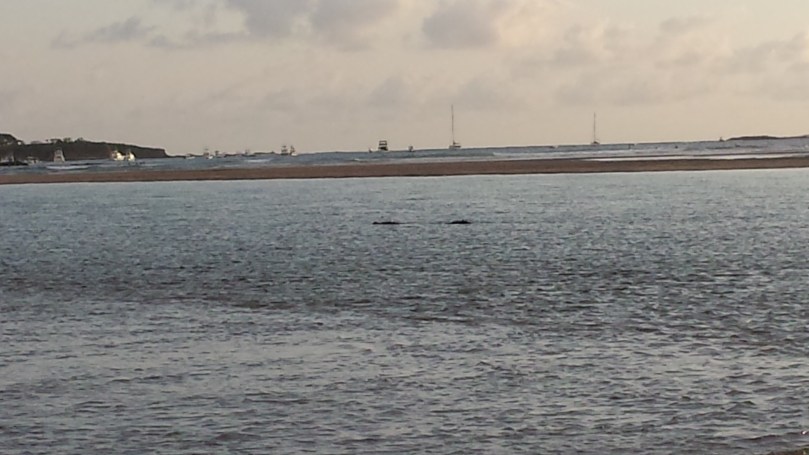
I took this photo in April 2016, of a crocodile exhibiting "abnormal" behavior--chilling there staring me down. If it ever happens again, I will call MINAE.
I took this photo in April 2016, of a crocodile exhibiting “abnormal” behavior–chilling there staring me down.  If it ever happens again, I will call MINAE.

Jungle Problems

My town is having some jungle problems. In case you’re wondering if this is about crocodiles again—yes it is. Sorry. I’m a little stuck on that. But we’re also having a problem with the estuary. You will see, if you don’t already know, how the two are related.

What To Do About The Crocodile(s) is causing firestorms all over facebook—The Estuary Problem, not so much. Not yet, anyway. And hopefully it won’t. I hate facebook firestorms. It’s so easy to type hurtful things onto a screen from the comfort of your hammock, and then lie back feeling smug. I doubt any serious problem has ever been solved by a facebook firestorm. And we have a serious problem.

After the day in July when Jon was attacked by a crocodile in the Las Baulas estuary between Tamarindo and Playa Grande, a bunch of meetings were held order to determine what could be done about The Crocodile Problem. The Crocodile Problem, in a nutshell, is that the area is now populated by a large number of salt water crocodiles that have been fed by humans for the last 15 years. Folks who have lived in Tamarindo since the 70s and 80s, back when it was a beach with no town, say that caimans have always been normal in and around the estuary, but that salt water crocs are new. That concurs with my experience of the last 20 years. So this leads to the argument: Are Crocodiles Native or Non-Native to The Las Baulas Estuary? Perspectives vary. No firestorms, please.

The result of the meetings was the declaration by the Environmental Ministry (I wasn’t there. I was at my sister’s wedding in Colorado) that:
–The crocodiles cannot be exterminated. They are wild animals and to kill them is illegal.
–The crocodiles cannot be moved to another place. The Las Baulas Estuary is a wildlife refuge, and they are wildlife.
–We can put up signs to warn people about the crocodiles.

Meeting adjourned.

Let me esplain The Estuary Problem, now, before I circle back around to The Crocodile Problem and to my own personal proposition. From the beach, the estuary looks like a river mouth, but it’s really the connecting point of an enormous salt water swamp system with the ocean. Its components are water and sand. When I first saw the estuary, as best I can remember, in 1996, it intersected the beach at something like a right angle. Imagine a T, with the top being the beach and the stalk being the estuary. But being as it’s sand and water, it moves. I’ve seen it snake all around during the years I’ve watched it. I remember it curving to the north toward the rocks by Casitas on Playa Grande. I remember it curving to the south. I most prefer it the way it was when I found it, but clearly nobody is asking me.

What I have never seen, is the like of what the estuary is doing now. It is not making the shape of any letter in my alphabet. It hits the sand headed due south and keeps right on going, finally emptying into the ocean directly beside Pico Grande. What does this mean? It means that the beach is bisected by the estuary, that Playa Grande is mas grande que nunca and that the natural habitat of large snaggle-toothed reptiles is right smack in the middle of Tamarindo Beach.

The ironies. Just now, when we have The Crocodile Problem. In fact, if it wasn’t for The Crocodile Problem, I wouldn’t have named The Estuary Problem a problem at all. The estuary is allowed to do whatever it wants. It took out the lifeguard stand, which sucks. Beachfront businesses are nervous about how far inland it will curve. But the thing is, no matter what it is doing today or where it’s path takes it, it’s temporary. For all we know, this is it’s “normal” path, and those 10 or 20 years when it didn’t head straight south are an anomaly. We are privy to all of about 40 years of the history of this beach. We know nothing.

What do we do about The Estuary Problem?  Nothing.  Wait.  Appreciate the mysteries of Mother Nature.  Take photos.  I will  confess that configuration of the estuary, the beach and the saltwater crocs is not to my liking. It has, to some degree, ruined surfing for me. It’s hard to do something for pleasure while trying to ignore fear. I do my best.  There are other places to surf, but not for girls who have long boards, day jobs, and no car.  I take more beach walks on my two good legs.

So, back to The Crocodile Problem. We’re not allowed to kill them. We’re not allowed to move them. Somebody posts a picture of one on facebook with a kind warning for everyone to be careful, and a war of the words ensues. Somebody says we should kill them. Somebody else replies that they were here first and we are in their home. Then we hear the part about how they really aren’t native to this region. Then it turns into Costa Ricans against foreigners and if foreigners don’t like Costa Rica the way it is and can’t leave it alone, then we should go back where we came from. It got ugly. Why do you say we can’t kill a crocodile but you eat cows and chickens? But crocodiles are wild animals and it’s not the same… And so on and so forth.

I think about it a lot. I’m a little obsessed, maybe. But that’s what happens when, one lovely morning in July, you find at your feet a destroyed human being that the crocodile chewed up and spit out. Everything in your spirit stops.
You have to start from scratch.

Starting from scratch:

I’m a farm girl. I grew up on a chicken farm in Pennsylvania, and I have eaten one hell of a lot of chickens. My dad is a hunter. He fills the freezer (even now at age 72) with venison, and sometimes elk from trips to the west. We never ate beef in my home, and my mom hates fish—it was venison, chicken, or breakfast—point being, I have also eaten many many, many wild animals. I’m not a big carnivore anymore. I’m not a vegetarian either, except in my heart. I eat meat because my husband is a fabulous cook, and at my house the cook chooses the menu.

In all honesty, I personally would like to see a significant number of the crocodiles “harvested.” Not out of hate. Out of common sense. Out of the life experience of being a farm girl and a hunter’s daughter. We’re both at the top of the food chain, the crocs and us, and if we use our superior intelligence to choose to let them harm and potentially devour us, what sense does that make? What kind of intelligence is it? And, um, we just took ourselves down a peg.

So in order not to disrespect the life of the crocodile who attacked the man I found looking up at me from the shallow waves that morning, I have a proposition: I will volunteer to eat it– same as it would do to me if given half a chance.  Mammal against reptile.  No hate.  No disrespect.  No life wasted.

It will be a tough chew, I expect.  Maybe I’ll share with the cats.  I have no idea how to cook a crocodile, but bring it to me. I’ll figure it out.

4e19b329-1e80-47c0-817d-a94cb45692f9
I took this photo shortly before sunset on an incoming tide in Aug 2016.


About Being Brave. Or Not.

I’ve always been perplexed by people who tell me I’m brave—or maybe I should say, I am intrigued by the things that people interpret as acts of bravery.

How many times have I heard this: “You live in Costa Rica?  Oh you’re so brave!”  Or in reference to me moving here by myself (even though I was coming back to friends) when I was 24, “That’s so brave!”

The thing is, it’s not brave.  Not for me, anyway.  How can you be brave if you aren’t scared?  If I’m not afraid of something, for me to do it requires no bravery at all.

My boss took the batch of us on a canopy tour, recently, where you harness up, hang by metal clamps from steel cables, and zoom through the jungle canopy from tree to tree.  It’s a lot of fun.  I’ve never been afraid of heights, so it requires no bravery for me to launch from the platform and fly through the air.  Some of the team members, however, were petrified.  For them to do the exact same thing as I did was a tremendous act of bravery.  I watched them struggle with their fear and overcome it (or not).

To be brave is not the same as to be fearless.  If I’m not afraid of the ocean and I paddle out into it on a surfboard, that’s not bravery.  If I am afraid of the ocean and I paddle out into it anyway, THAT is brave.

For me, getting on an airplane is brave.  Getting on the motorcycle is brave.  (I do it all the time, clamped for dear life to the back of my husband who is cool as a cumber.)  Living in Costa Rica?  Not brave.  Getting on a boat?  Not brave.  Canopy tour?  Not brave.  Spelunking?  That’s another story.  I will hang by my tiptoes from a tightrope before I crawl into a small space that I can’t see my way out of.  That would require me to be brave, and I’m not interested.  Call me a chicken.

Up until the end of July, surfing, for me, was generally not an act of bravery unless there were a lot of rocks in the water.  I have this inexplicable panic in the presence of rocks.  Duh.  Rocks.  But yes—seeing dark shapes under me, or feeling them when I can’t see them, has always just about sent me over the edge.  No idea why.  And then the crocodile thing happened.

It didn’t happen to me in the most literal way, but there are ways in which it did.  And I’ve been back surfing, since.  Gingerly, if there is such a thing.  It’s getting a little better.  But make no mistake—surfing, for me, has become an act of bravery in a way that it wasn’t before.  I think I speak for a lot of people in my town when I say that.  Whereas before, perhaps, we are fearless, we have now become brave.

Being fearless, which can be good or bad, is a characteristic, and who chooses their characteristics?  Being brave is a choice.

Where am I going with this?  A ninguna parte.  I’m just saying.  Fearlessness and bravery might look the same on the outside.  On the inside, they’re not.

Crocodiles: The Ugly Side

I don’t know what, unless I was simply supposed to be there, possessed me to get up at the crack of dawn and go down to surf the outgoing tide. I never do that. I don’t like surfing the outgoing tide in Tamarindo now, with the estuary dumping out its murky water practically at the Pico Grande reef. You can see from the beach why it would be better to wait a few days until the early tide is coming in, which is what I usually do.  I live here.  I can afford to be picky.  But on Friday morning, I went anyway. In fact, it was late on Thursday afternoon when, for some reason, I decided to get up early and surf the outgoing tide in the morning, which I know perfectly well I don’t like. And as I might have expected–I didn’t like it. There were plenty of waves, but all swirly and weird, breaking funny like I’m not used to, and the murky water and smelled of the brackish estuary.  The current was pushing me around, and I got a little freaked out about crocodiles.  I know that the estuary is where they live, and I know that some of them are huge and tame.  I tell myself all the time that crocodiles don’t eat people, but  I declare I could feel their beady eyes on me.  So I rode the second wave I caught all the way in to the beach and decided to go home for breakfast.

The last thing in the world I expected was to end up assisting the victim of a crocodile attack.

As I walked down the beach toward the path to the street, I saw something that didn’t make sense. My friend Edgar pulling somebody out of the estuary on the board. A child? No, not a child. A very big person.  Something wasn’t right about the person’s face.  Was that blood on it? And he wasn’t acting right. Edgar wasn’t acting right, either. I put my board down and asked, “Do you need help?” because something was wrong, but I couldn’t tell what.  That’s when Edgar told me that a crocodile had just attacked the man as they attempted to across the estuary.  They fought it until it let him go.

Edgar ran for help and I went to the man. He was lying on a small surfboard, floating in a about a foot of swirling water.  The was conscious and there were holes in his face. Big holes. He looked up at me and I knew there was no way on God’s green earth I could get a man this big out of the water by myself.  I asked him if he could walk. He told me his right leg was pretty f*’d up. I asked him if he could crawl. He said he thought so. So I tried to help this large, terribly injured man crawl from the sea onto the land. His hands and arms were full of bites from crocodile teeth, already starting to swell. Then I saw his leg.

It wasn’t a leg anymore. There was a foot, but it was no longer his foot. It was a foot with an ankle, floating, still attached to various types of flesh and a bare, jagged bone.  I told myself not to look at it.

As soon as he was completely out of the water, I told him to lie down. The tide was going out, like I said, and I knew the water would soon be far away. He rolled onto his back. And there I was on the beach with a mutilated man that I do not know, somewhere between life and death, sometime before 7 AM on a beautiful morning.

I held his head in my hands and he breathed.  I pulled Edgar’s board toward me and propped the man’s head on it. Then I took off the long-sleeved rashguard (which I only wear when I am trying to avoid sunburn, but for some reason put on that day at 5:30 in the morning), and tied it as tightly as I could above his right knee. I knew that the mess below it was not going to be of use to him anymore, but I also knew that he would bleed to death right there in the sand if someone didn’t stop him. Then I did the only other thing you can do at a time like that: I put my hands on either side of his head, held it lightly so he would feel there was someone with him, and prayed to God that he would not feel too much fear or too much pain.

I thought he might die. I know that the human body is amazingly strong, but I didn’t know how much blood he’d lost or how long it would take for an ambulance to come.  Or if they would have what he needed when they got there.  I had a flashback of the man who died on the beach in Tamarindo years ago after a drowning incident because when the emergency team arrived to resuscitate him, no one had charged the defibrillator.

Lots of guys arrived and started running around cursing, exclaiming, bring bandages and ice.  I got up and walked quietly away. There was nothing more I could offer as more capable help began to arrive. That’s when I had to sit, for a minute, with my head between my knees and tell myself not to faint.  I’m choosing not to describe in detail the mutilation that this man suffered.  Even the nastiest pictures the media posted do not do it justice.  Fortunately.

He’s alive. His name is Jon. He is in the hospital fighting for his life as I write this, and winning. Of course–he beat the croc.  He lost most of his right leg below the knee, but the rest will heal as long as infection is held at bay. Crocodiles are dirty creatures with dirty mouths and dirty teeth.

What’s Normal/What’s Not:

I’m no authority on crocodiles, but do know it is normal for large reptiles to live in estuaries, where fresh and salt water mix.  I do know that crocodiles swim in the ocean.  I do not think they generally live in the ocean, but they certainly go out for a swim once in a while.  I know that this crocodile (or these crocodiles, because they all look alike to me) lives in the Tamarindo estuary.  I know that normally crocodiles live on fish, dead things, and small birds/animals that they catch.  What is NOT normal is that this crocodile, or he and his cousins, like to hang out by the boats where people are.  I’ve heard the boat drivers throw food to them so tourists can watch them eat.  I have not seen them do that myself, so I am not saying it is a fact–although people I trust say that it is.  This crocodile will let you walk near as it suns itself on the beach.  I’ve seen people do it.  It will come up out of the water onto the land where people are standing.  In essence, it is not afraid of people, and that is NOT normal.  And it is also not normal for a crocodile to attack a large grown man.  I don’t understand why it would do that. We are not supposed to look like food to them. A dog, yes.  A child, unfortunately, yes.  A man the size of Jon?  No.  How many times have I joked that a crocodile wouldn’t want me because I’m too old and too tough to chew?  Wrong.

Taking risks:

Every surfer in the world is aware that crocodiles live in estuaries, just as we know that sharks lives in oceans and stingrays sleep in the sand. It is a risk, big or small, that we knowingly take, at least to some degree. I used to cross the estuary on my board all the time, but since I’ve been back in Tamarindo I haven’t done it even once. I took one look at that croc when I got back into town and decided that the waves on this side will do just fine for a girl like me. Color me satisfied.  Even that doesn’t make me safe, and that’s exactly my point:  suffers make choices and are aware of at least dangers that fall within the realm of normal.

That crocodile, in my opinion, is not normal.

I worry about visitors. Tourists. People from San Jose or Santa Cruz. People from places like Kansas and Manitoba. People who have no idea. Children.  I hear the authorities are putting up signs.  Is that good enough?

Jon and Edgar are big, strong men. They are both much bigger and far stronger than I am, and they were together as they fought this creature. I’ll be honest: I am full of fear. And this time it’s not fear of something I saw in a movie or dreamed in the night–it is fear of something I held in my hands.

The Ugly Side:

I know I will surf again, but not today. Today I will stand by the water and think about the ugly side of Mother Nature’s beautiful face. I will think about the necessity of a body full of warm blood, and how perfect it is to have two arms, two legs, one head.

Today, that alone is enough of a thrill.

help 2The Man The Crocodile Didn’t Eat
Photo by Leonardo Pinero
What I Know in the Ocean / The Good Kind of Zero

There are some things that I think about/feel/know when I’m in the ocean that don’t come to me in the same way any other time.  It’s not about surfing.  I step into the water and stand there with it swirling around my knees, or I lie on my back and float.  And things come to me.

Lo Que Es La Orilla del Mar:

It’s the end of the world and the beginning of what is after/before.   Es donde la vida eterna se toca con la vida mortal.  It is the place where now meets forever.  Right here.  Right where my feet are.  This is the place.  It’s the end.

It’s also the beginning.  It is the amniotic fluid that carries our planet which is constantly being born.

Skin:

I like to float on my back and look up at the sky.  I think about how only a thin layer of skin separates the salt water I am made of from the salt water that holds me up.  It’s those few millimeters that keep me from blending in with Everything.  On land, I am an individual.  In the ocean, I am molecules of salt water among the others.  It’s not a bad feeling.  I tried to write a poem about it but there wasn’t anything else to say.

The Feeling of Zero:

I step into the ocean and what comes to me is the feeling of zero.  Not in a bad way; in a good way.  You might call it “peace” or “balance” or something, but for me that’s those aren’t the right words.  I feel zero.  My Mennonite upbringing would probably say I am feeling “forgiveness”—but there’s no sense of relief associated with it, and no guilt.  It’s quieter.  Like zero is what I owe and zero is what is owed to me.  Like I’ve done, or am doing, what I have to do, and nothing more is required of me than to be what I am.  Zero doesn’t mean that everything is going to be alright, or the way I like it.  It means that the world was here before me, and it will be here after me, and THAT is what is alright.  I don’t need to do or become or accomplish anything in order to make things different than what they are.  Like I do not owe a debt to the Universe and It does not owe me a paycheck.  Zero.  A good zero.

And one more thing.

I walk in to the ocean, past the breakers when the tide is low.  I lie on my back and float, looking up at the clouds.  I think, “This is where I will go when I die.”  Right there.  In the ocean, past the breakers.  It’s not a major item of concern for me what happens to my body after I die—my main concern is that it happens a really long time from now.  But who are we kidding?  I don’t have children or grandchildren who will want to visit my grave.  Got knows I haven’t got a red cent to leave behind, so I don’t imagine anyone will feel possessed to bury me.

I used to think about that in the States.   “Please, when I die, take me and pour me into warm salt water.  Don’t leave me here.  If I can’t live where I belong, at least take my ashes there.”

So I float in the ocean, miro el cielo, and I wonder if this is not in some ways like lying in my grave for a while on a sunny afternoon.  Just floating.  Checking out the scenery.  Watching some hunting birds glide by now and again.   Sometimes you can see the moon. Feeling the good kind of zero.

Does that seem morbid?  I hope not.  If it does, I did a bad job of describing it.  It’s very peaceful.  Then I have to trudge back onto the sand, pedal my bike up the hill, and decide what to make for dinner.

Bill Ulmer: One Year Behind Bars and Still Waiting For a Sentence

A year ago today I was at work in the clinic in Washington State trying to focus on the tasks in front of me, but I was having a hard time. Bill was leaving for Hawaii that day with his new wife on a belated honeymoon. A lot of us were worried about her. Certain circumstances surrounding the trip made me very nervous—and I’m not the only one. A lot of people were having trouble getting their work done at their desks a year ago today, and a lot of prayers for safety were being said for the new Mrs. Ulmer.

Then something crazy blipped through my Facebook messenger: Bill has been detained at the airport.

What?

Yes. The cops detained him at the airport. He isn’t allowed to fly.

What?!

It took the whole day for details to fill in and confusion to untie itself. All day long, my hands shook. My phone went crazy with messages. At 4:45 PM, as I gathered my things to leave work, my phone rang and the person who called me said words to me that I had not ever been able to dream of hearing. “Bill was arrested. He’s being held in custody. The feds mentioned Barbara’s name in open court.”

I made it past the time clock, out the door and into the car before I burst into tears. Happy tears, because Barbara deserves at least that acknowledgement. Happy tears, because I am not a crazy liar like Bill told everyone who read the story on my website. Happy tears, because I know he laughed when he thought he got away what he did. Happy tears, because Mrs. Ulmer is safe and I will not be looking for her body or listening to lies about false tragedies.

I kept saying, “Oh my God, he killed her,” over and over. Not like that was news to me. Not that murder is among the charges—it isn’t. But it became real to me in a new way when I heard that Bill Ulmer was behind bars and that federal officials know perfectly well that there is every reason to believe he could tell us what happened to Barbara Struncova.

A year has passed. Bill pleaded guilty to the counts of Misuse of Passport and Aggravated Identity Theft. I’ve listened to lots of voices speculate on how long his sentence will be, and I’ve heard numbers ranging from one year to fifteen. I personally have no idea what to expect.

The thing I did not expect—that no one expected—is that one year after being taken into custody, Bill is still awaiting sentencing. If there is any further investigation going on, I am unaware of it. I hear that this is the court system being pokey or backed-up. Hmmm. The longer Bill waits for his sentence, the more obvious is the possibility that by the time he receives it, he may have served a significant portion of its time. I guess I don’t much care why it’s taking so long or how much longer it takes. I only care that he is not done being punished yet.

Barbara, by now, is a fish or a small tree with greening leaves or a bird or all of these things. She is hermit crabs and raindrops and cicadas. We all turn into new creatures, someday.

And Bill, I am sorry you are reading this in a jail cell. I am sorry you didn’t just break up and walk away. I am sorry you aren’t surfing and that Barbara isn’t in Czech Republic with a handsome husband, chasing her toddlers around a park.  But what’s done is done.  And you can’t fool everybody indefinitely no matter how good of a liar you are.

(P.S.  Your friend James Henrickson got two life sentences for his shenanigans, so don’t feel sorry for yourself.)

Shout-Out to My First Surf Instructor

This is a shout-out to my first surf instructor, Court Snider.

At the beginning of 2001, I moved to Tamarindo beach. Everything before that is a long story involving marriage and divorce and coming here a lot for work, but in 2001 all of that was in the past. I decided that I wanted to learn to surf. I’ve always loved water so I had to at least try. Unfortunately, I’ve never been terribly athletic—but lucky for me, surfing is not a team sport so nobody has to pick you. Anybody can play, if you suck you don’t ruin it for anyone else, and as long as you’re having fun, you’re winning. What’s not to love?

You cannot just guess how to surf (unless you’re very young or very athletic—which I wasn’t); somebody has to teach you. Court was in his early 50s then, or at least that’s how I remember it, an American expat with that slow calm that people get after a lifetime of surfing. He borrowed a big foam board from the surf shop where he wife worked and one terribly windy day in February when the there was no swell at all, only flat frothy chop, he took me out in front of the Capitan Suizo Hotel. If I remember right, he didn’t push me into waves—from day one he made me paddle.

It wasn’t pretty. It wasn’t as fun as I’d hoped, either. Court kept grumbling about the “conditions” which meant nothing at all to me—my problem was staying on the board. And I’m not talking about standing up. I’m talking about staying on it lying down. Then you’re supposed to look at what’s coming up behind you while you paddle forward, and the wind is blowing water in your face and you can’t see anything. And then all of the sudden the wave picks up the back of the board and everything goes to hell in a handbasket. I scraped my eyebrow open on the sand on the bottom.

It gets better if you don’t quit.

Anybody who has figured out how to ride a surfboard, even if they screw up a lot, is not a quitter.

Court told me two things I’ll always remember. One, he told me years later as we sat on our boards watching the horizon. It didn’t mean much to me at the time. In fact, to be honest, I thought it seemed a little lame. But I’m closer, now, to his age then. I’ve been surfing longer. I’ve been more places and done more things. Maybe that’s the difference. “Life only makes sense when I’m surfing,” is what he said.

I think about that every single time I’m on a board.  “Life only makes sense when I’m surfing.” Or: my life only makes sense to me when I’m surfing. I have to say, I find it true. When I’m surfing, it’s very clear how everything has converged to bring me right here (right there, in the line-up with the tide coming in). And how everything has converged to bring the sets of waves across thousands of miles of ocean to the shore where one girl has traveled thousands of miles and given up everything to meet them. If we were sitting on surf boards together right now gazing into the horizon and I said that to you, it would make all the sense in the world. Guaranteed.

The other thing I got from Court, not about surfing although it has its applications: “Everything works if you let it.” Not applicable to things like deceased machinery and abusive relationships, but within the realm of the reasonable—everything works if you let it. In one way or another. Maybe in the way you had in mind, maybe not. If It doesn’t work, maybe you aren’t letting it.  Maybe.

Thank you, Court. For taking me out in the water and showing me how to stay calm. You were right about everything.

Angels and Warm Air

Everything is right.

Everything is right. I look out the window at the trees and I know their names. I missed that in the desert. You have no idea how sad you can be without trees until you don’t have any. The ocean is exactly the same. It was here all along just as I suspected. It doesn’t need me to live the way I need it. The air has a faint smell of wood smoke. Maybe from brush fires in the mountains? I don’t know. We saw some as we flew into Liberia at sunset a few days ago. Locusts shrill in the trees, especially at dusk and at dawn. Flocks of silly, exuberant parakeets carry on like wound-up school kids. In the heat of the day, giant iguanas called garrobos scurry across the yard and get into loud scratchy-sounding fights our roof.

It’s hot. This is the hottest time of year, when even people who were born here complain about the temperature. Daytime highs are about 100. The ocean is warm like a saltwater bath, and crystal clear. We’ve been out surfing twice so far, with very little success if you count waves caught, but if you count how happy we are just to be in the warm salty water, we should win trophies. The apartment we’re staying in has screened windows with no glass. “Inside” and “outside” need very few barriers. At night I can finally sleep without the weight of quilts and blankets pushing on me, annoying my feet. I’m all wrapped up in angels and warm air.

Getting Settled

Travel went well, even with our boatload of baggage. We managed to make all of our connections on time and everything arrived with us. Thank you United Airlines for at least making good on the big baggage fees you charged us. A friend picked us up at the airport, took us to his house, fed us, and gave us a place to sleep. The next day we moved our things in to this simple little apartment, and we rented a car for a few days.

We went to Immigration because our residencies are expired. We have an appointment to go back in a month with certain fees paid and papers prepared—I hope that’s the end of the process and not just a little step in a long one. I guess we’ll find out. We can’t renew our drivers’ licenses or buy health insurance until our residencies are renewed. I was afraid that we weren’t going to be able to open a bank account either, but we did, at the Banco de Costa Rica. No problem. Unless you count the hour and a half that we waited in line for someone to help us. That wasn’t my favorite experience, although neither was it a surprise. We went to the phone company and I learned that my lovely Samsung cell phone from the US of A is blocked by Verizon and I can’t use it with a Costa Rican chip until after I go to a Samsung dealer in San Jose who can unblock it for me. But new boss gave me a phone. What a great guy.

We’re still in the middle of getting settled. I’m not going to go over my to-do list here, but I do have one. At the top of it is STAY OUT OF THE SUN FOR A DAY OR TWO because I’m way too crispy.

Did I mention that I can now, finally, wear one shirt at a time? I just have to say that in honor of my co-workers in Moses Lake where I amused an entire clinic by wearing multiple layers, sweaters, and gloves all year long.

Coming Home

As you’re leaving the United States, people can make you question your sanity. Everybody acts a little jealous, but they aren’t, really—because Costa Rica is a 3rd world country and that doesn’t sound safe or comfortable. Are you kidding me? People sell their souls to be safe and comfortable. But any self-doubts that I may have had evaporated during my first trip to the supermarket. I practically bumped into an old friend as I turned up the shampoo aisle. She gave me a huge bear hug and the first, “Welcome home! We missed you!”

“I’m so happy to be back,” I said.

“How long were you gone?” my friend asked.

“Five years.”

“FIVE YEARS?! Wow.” Then she shook her head sadly, thinking that over, and said, “You must be happy. It’s hard being in the States…”

It is. It is hard being in the States. It is hard to be sad for a long time. It is hard to wake up in the cold from dreams of green leaves and warm water. But it’s good to be able to do hard things. I am sure that I will have to do plenty more.

Here’s the thing: I found my tribe. And now I know that. A crazy mish-mash of expats and Costa Ricans who live together by choice. Speaking each other’s languages, making things work, sometimes making each other mad, having each other’s back, being free to leave and choosing to stay.

New Job

And now it’s Monday morning and time to start our new jobs. I’ll be in the office of a property managing company, and Pio will be doing maintenance. I’ll let you know how it goes.

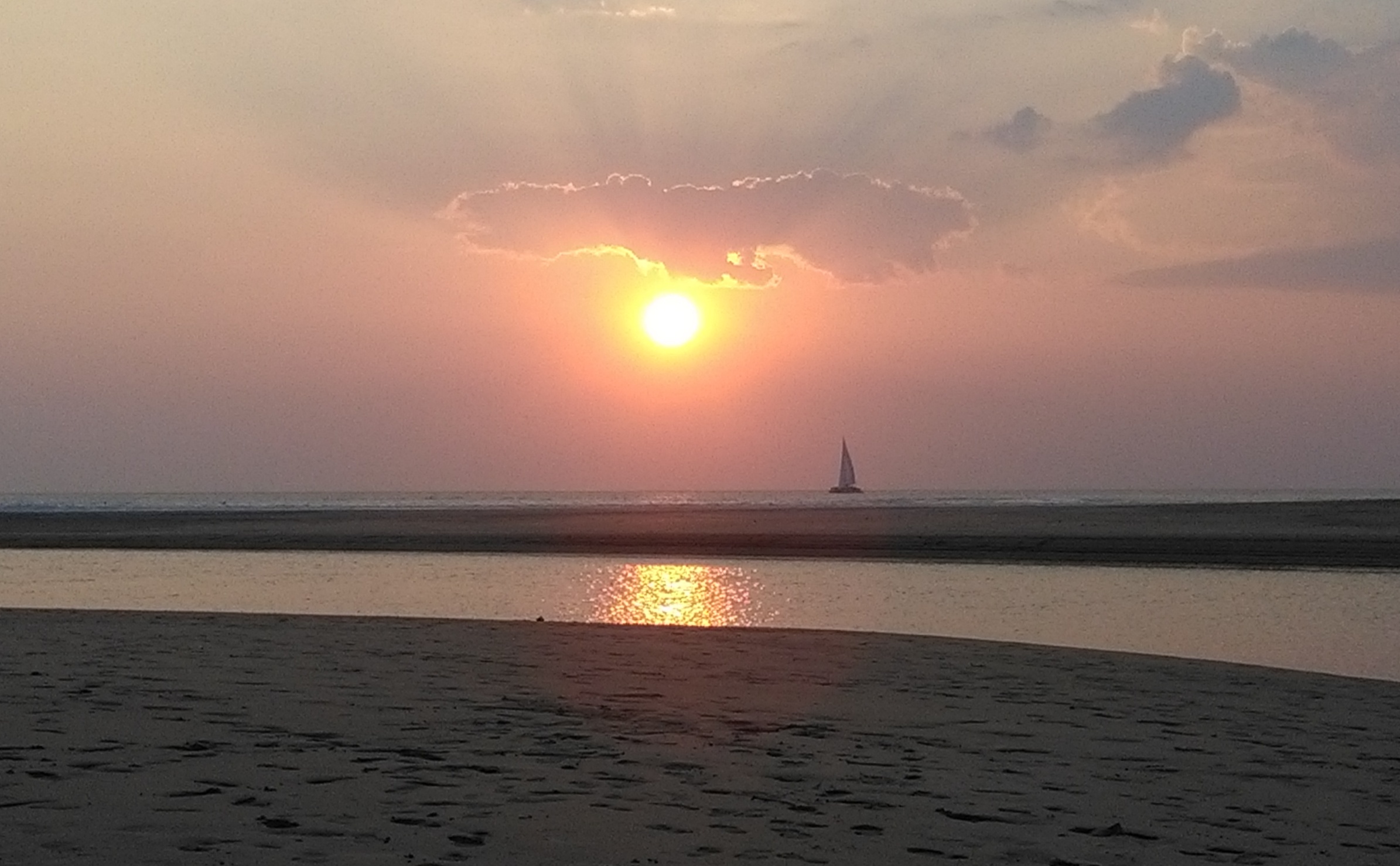
Sunset April 3, 2016