o my pirate,
where is your ship?
the compass points
to water and
there is gold
calling me from
the sea.
Technical Difficulties
I even had a poem picked out to post this week, and then I hit a glitch: no Internet connection at home. No, not in Costa Rica yet, still in Washington. The Universe is clearly preparing me for the place I am going. Being all proactive and such like, I called Century Link last week to request that my service contract be terminated on March 21st. They cut it off the moment I hung up the phone. I can’t see that this was anything other than a blunder in their part, as I would happily have paid for another 20 days of service.
Anyway. No Internet. I have Internet at work, but my computer won’t connect to it. A nice IT guy explained to me how to “update the driver” on my “wireless card” but to do that I need to, um, access the Internet. So. No luck.
Thank Jesus and the saints for Straight Talk and the unlimited data usage they offer! Big shout-out to Straight Talk. Whoot whoot! So I CAN post this uplifting tale from my phone by poking patiently at letters smaller than my fingers.
I hate typing on my phone.
So the posts may not be so plentiful just now, but the blog will go on. I will keep right on talking to myself as usual, and I’ll let you in on the conversation as I am able.
(How can typing on a phone make BOTH hands hurt? I don’t know, but it does.) Pura vida.
And Just Like That
And just like that, we’re going home. Back to Costa Rica where my spirit has been waiting for my body to rejoin it. If I tell you exactly how it happened, I’ll lose you along the way; there are lots of false starts and lots of networking with people you don’t know. Or maybe you do know them. I try to avoid throwing people’s names around on the internet unless unless I’m furious at them for the disappearance of somebody I know.
The road back to Costa Rica started maybe a year ago with my husband trying to make a call on skype and accidentally calling the wrong guy. That led us on a circuitous route to a sudden opportunity for which we ALMOST packed up and moved just after this past Christmas. But it fell through. We were so disappointed. For days, I could barely move. Then it happened again in January—BOOM. A bolt from the blue: a Facebook message from a friend asking if we’re interested in managing a small hotel in our old hometown. Of course we’re interested! And then, as suddenly as the possibility exploded into our lives, the air sputtered out of it like a balloon, and it clearly wasn’t going to happen. Then neither of us could move. We couldn’t even talk to each other—not because we were angry, but because there was nothing to say.
And I decided that this might be God or The Universe (or whoever sends us messages) doing just that—sending me a message. Telling me it’s time. Telling me to take this seriously. Telling me that maybe we’ve done what we need to do here, taken care of what needed attention, repaired what was broken. That you can’t always listen to your heart—sometimes you have to listen to your mind—but that maybe the light is turning green.
So I called the Immigration office in Costa Rica. I could have done that on any day of the last five years, but I was too afraid. My question was, “Can we renew our expired resident status?” and if they said no, I knew that I would have to carry my dreams out the door and drown them in the cold lake. But finally my need to know was greater than my fear of disappointment, so I dialed the number. In short, the answer is yes. A complicated yes, of course, but entirely possible.
Then I sent out two messages to long-time friends. I got two encouraging replies. One of the replies included the suggestion that I contact a third friend. The third friend, who I’d thought of contacting but talked myself out of “bothering” him, was actually actively looking for someone to do what I do and someone to do what Pio does. And the price was right.
And we are going home.
We’d been thinking about visiting Costa Rica on vacation in November of this year, and I was afraid it would destroy me. I was afraid I would do something insane like refuse to leave, or something worse like leave.
Costa Rica isn’t paradise. It’s a place on the map. There are problems and potholes, mosquitoes, mud, cockroaches, scorpions and thieves. Paychecks are small, stuff is expensive. But it is home. I wasn’t born there, but it chose me when I was twenty years old and I can’t help it. I would be happy here if I could. It would be easier, more comfortable and in some ways, safer.
We’ll be leaving Washington State on March 23, flying to Pennsylvania for a week, and then continuing on home to Costa Rica at the end of the month.
To transpose the words of The Good Lord into words of my own: “What does it profit a girl if she gains the world but her soul is so sad that it withers into a dry little nut inside her heart?”
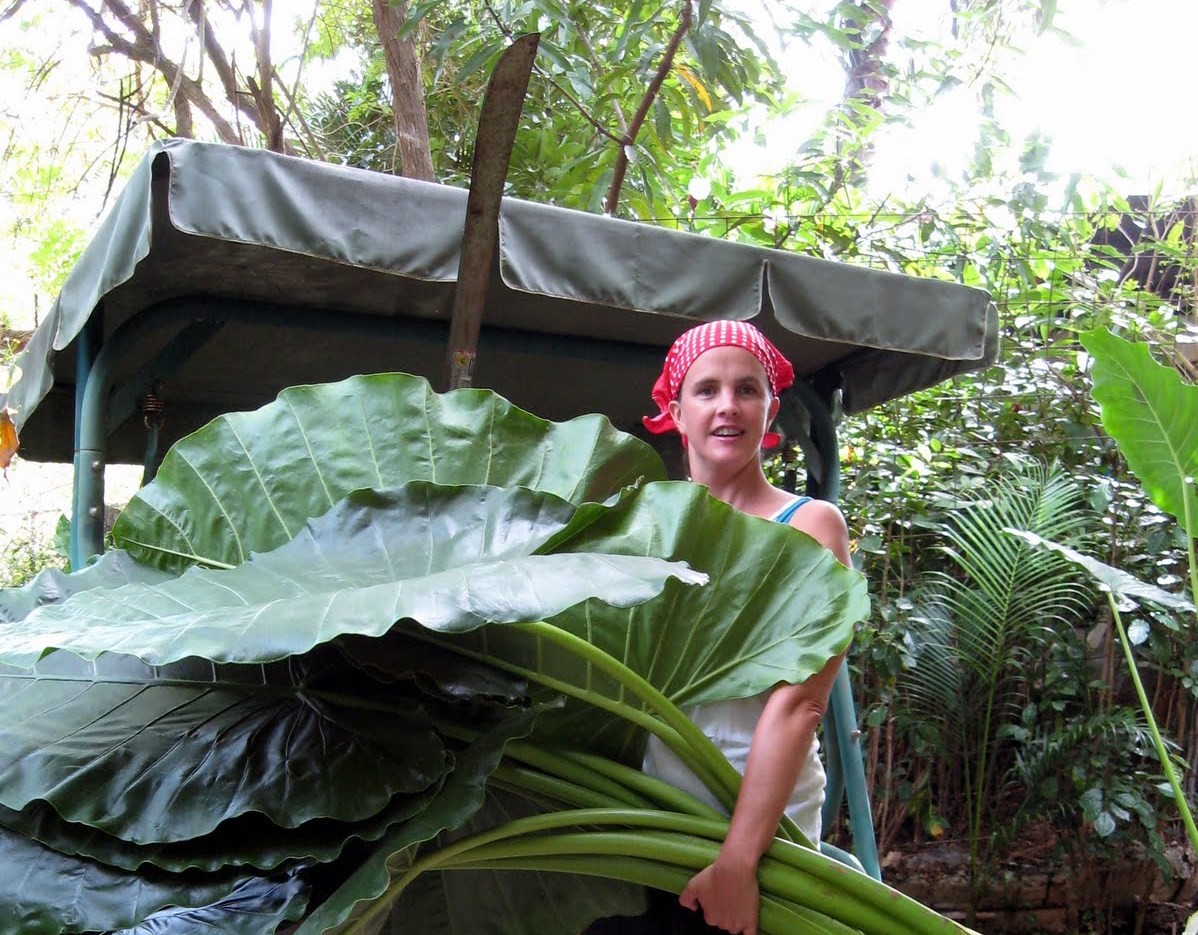
My preferred garden tool: a machete
Mennonite at a Murder Trial
I did something on Friday that I’ve never done before. I went to a murder trial. On one hand, it wasn’t exactly an item on my bucket list. On the other hand, considering what happened to Barbara, it’s still on it. This trial has no legal link to Barbara Struncova or to Bill Ulmer, BUT it does have a personal link to them for me. I consider it to be one of the places Barbara has lead me. It happened like this:
Barbara disappeared, so I can’t very well ask her my questions in person. On my search for answers about what happened to her, I’ve had to follow in the footsteps of Bill. Those footsteps lead, as we all know, onto a plane with his brother Wayne’s passport in hand, and back to the USA. December 2010. Within months, those footsteps climbed into a semi and drove into the chaos of the oil boom in North Dakota. And there they stayed, more or less, hauling water back and forth to fracking sites, until the end of 2013.
I didn’t know anything about fracking and oil drilling. It’s never been a subject of interest for me. I find it all sort of violent, horrible, and terrifying—even minus the actual violent and terrifying human beings that seem drawn to it. So I called up my good friend Google with his sidekick Google Maps and we started chatting. Mother of God, did I get schooled. And meet some interesting folks.
Enter Lissa Yellowbird Chase. Click on her name and look at the link about what she does. I don’t want to re-write the article when you can read the original. Lissa looks for missing people—passionately, furiously, even somewhat madly. So I wrote to her. What did I have to lose? She answered me back. I didn’t expect she was going to tell me what happened to Barbara, but I reached out to her anyway. Some days I feel like I’m spitting into the wind with this, and I guess I hoped for a little hand-holding from a real bad-ass body-searcher.
I’m getting my hand held alright. Turns out that the case she’s worked on for the last 4 years, regarding the disappearance of Kristopher “KC” Clarke in 2012, is coming to trial NOW and only a few hours from where I live. So on Friday, I went with her to the first day of the murder-for-hire trial of James Henrikson. Click that link. This is the first time I’ve ever even entered a courtroom. I had no idea what to expect.
The defendant, James Henrikson, was unrecognizable. Did you see the picture of him on the link? Looking all buff and competent? The guy sitting at the table between two dark-suited lawyers was gaunt and yellow. I have never seen a human being that color. I swear. It was frightening. Terrifying. Sick. He kept his clearly-calculated demeanor calm and interested. Never flinched or demonstrated any reaction whatsoever during the entire court session. Smiled at his lawyers. Looked at Lissa and at me. I don’t have a word for that that glance felt like. “Chilling” is what I’m tempted to say, but that’s not quite right. It made me want to put my clothes in the washer and take a shower. I met KC Clarke’s mom. What do you say to a woman who has to sit there and listen to the story of how her son’s head was beaten soft with the handle of a floor jack? I came up with, “Nice to meet you.”
It was all quite a lot like courtroom scenes on tv, but with no glitz and no drama. Tom Cruise was nowhere to be found. No shouting, no crying, or anything like that. Lawyers on both sides mispronounced things that even I knew were wrong, and demonstrated a disappointing lack of basic acting skills. The judge, who was much less somber and intimidating than tv judges, gently scolded one of the jurors for nodding off.
Then they called in the first witness, a man named Timothy Suckow, who murdered Clarke (allegedly) at the bidding of Henrikson for 20,000$. I’m still trying to get my head around the experience of sitting in the same room with a man who is forced to admit out loud that, essentially, he knows he is going to die in prison no matter what the jury’s verdict is. He wasn’t the least bit surly, like you’d expect the burly tattooed guy in his mugshot to be. He had the high voice of a boy, the demeanor of an old man, the expression of something mortally wounded. He told us he has two teen-aged children.
I won’t be going back for the rest of the trial. I’ll be going to work as usual, learning about the proceedings from Lissa and from the media. Part of me is sorry to miss the intrigue. Most of me is relieved to have an excuse not to sit in the room with so much pain, sorrow and injury. Justice is so terribly painful. So necessary and so gut-wrenching.
It took me back to my History of Theatre class at Goshen College in the 1990s. I could hear Dr. Lauren Friesen’s voice explain to us the difference between modern melodrama and classical tragedy. In modern melodrama, when bad people get the bad things they deserve, we feel relief and even delight. In classical tragedy, the execution of justice fills us with fear and pity.
Those are the right words.
Jetty Edge
We twist around to
look out the rear window
laughing until tears blind us
and I’m afraid you are
going to back off the edge
in the dark, that we will
tumble over the rocks into the
Pacific but I can’t stop
laughing.
I can see the headlines:
Stoned Americans Back Jeep Over Jetty
Edge, Directly Into Ocean.
I say, “Go slow,” and you sputter that
you’re going all of two miles
per hour but my God being
this close to you makes me
so dizzy I can’t see and my
hair tangles in what must be your
solar wind.
Bright white shapes move
behind us, a group of cows wandering
out onto the jetty to graze,
and you say, “What are those?
People?” and I laugh more because
you’re wasted and they are cows.
My sides hurt and I can’t talk.
But then they really are
other people walking to their cars,
people who got off the boat with us.
I say, “I thought they were cows,” and
then you have to stop the car because
you are laughing too hard and you
tell me I’m crazy which we both
already know.
I don’t say it, but I don’t
care if you drive over the rocks and
we drown together tonight.
Go ahead.
All day we sailed
on the boat with the sun
slathering our skin drinking
rum and everybody kept passing
the joints and singing along to Bob’s guitar.
I never even smoke and I
tried not to, but I would do
anything for you.
Try me, I would.
Hope For Things
“New Year’s” is not my favorite holiday. I’m not sure what my favorite holiday is, unless my birthday counts. I like Christmas alright, or whichever thinly-disguised version of Winter Solstice you prefer. I like a holiday of lights in the dark part of the year and giving presents is a bonus—at least during the times of my life when I’ve been able to afford them. Having to tell your family “no presents this year” sucks, and I’ve done it on more than one occasion. It always bothered me a lot more than it bothered them.
I have two problems with “New Year’s.” One is that it comes at the wrong time of year. Um, hello. I’m sorry, but NOTHING is new in January. If you live in the northern hemisphere, it’s the middle of winter. If you live in the southern hemisphere, it’s the middle of summer and nothing is really new then, either. I think that the sensible time to celebrate a new year would be in the spring. Right? Yes. Right. I would even be open to celebrating New Year in the fall—when it’s spring in the other half of the world. I can be open-minded like that. But January? I’m sorry. No. I personally celebrate a new year on the first of May. I started doing that when I was 14, way before my Mennonite teachers spilled it about the Pagan celebration of May Day. When I say I “celebrate” a new year on the first of May, I don’t mean I stay up until the middle of the night drinking or anything. “Commemorate” might be a better word for it. “Observe,” even–I’m fairly passive about it. I just mean it doesn’t go unnoticed.
The other thing that annoys me about “New Year’s” is that it’s so often sappy. None of us have any idea what the heck is going to happen to us in the morning or in the coming year. Some wonderful things. Some terrible things. And we’ll congratulate ourselves on the good ones and try not to take the bad ones personally. We’ll post them on facebook so our friends can congratulate or commiserate. I can pretty much guarantee you all of that and nothing more.
I’m gloriously happy about all the attention Barbara Struncova’s story has gotten in 2015, apart from my voice howling from my little rooftop. I hope the “new” year brings more truth to light, but I try to be realistic about how difficult that will be. Difficult—not impossible. (Why oh why am I not a detective?) As you might guess, I don’t really do “resolutions,“ but I do hope for things. And I really hope that in the near future, some benevolent publisher accepts the book I’ve been sending out like mad. Quién sabe. I’ll keep you posted.
I have to go get in the shower now or I’ll be late to work on the first day of a “new year.” I will make a mess out of writing the date this week, that’s for sure.
So, here’s to you.
Here’s to me.
Here’s to everything that’s about to happen, whatever it is.
Cheers!
“Recordando a Bárbara”: La Historia en Español
Con la ayuda de unas amigas queridas, traducí la historia de Bárbara Struncova en español.
Para mí, es importante contar la historia de la desaparición de Bárbara en la madre lengua del país donde ocurrió. Los Ticos son personas generosas, inteligentes, y orgullosas de su cultura. Yo sé que no les agrada para nada que tragedias como esta ocurran en su país. Tienen derecho de saber lo que pasó en el patio detrás de su casa.
Para quedar claro: escribí la historia original usando el nombre “Jim” para el personaje que representa el novio de Bárbara. Esto hice porque hace 2 años cuando comencé a escribirla, nadie hablaba de lo que ocurrió y “Jim” estaba gozando de libertad aquí en Los Estados Unidos. No quería encontrarlo enojado en la puerta de mi casa. Ahora él se encuentra en la cárcel y todo el mundo sabe la triste historia. Ya no hay secretos. Decidí traducir la historia usando siempre el nombre “Jim,” porque todos los otros nombres han sido cambiados también—todos menos el de Bárbara. Y el mío.
Aquí le presento la historia. Léala en línea o sírvase a bajarla a su computadora. Compártala libremente.
Recordando a Barbara

where the ocean is
warm
on the other side of
my eyes
close and
I am home
deep
in the
blue green
breathing of being
alive in the
sunshine moonlight
first place of
ever love for
my bones
my blood
and the waves
siempre salt
water warm
spilling up and over
out from under
sleeping eyes
in the dark
The Story of Maria Pablo in Ten Scenes
This is a revised story originally posted in May 2013 with the title
“White Buckets”
I
María Pablo is sitting round on her bed with Carlitos when I enter. Carlitos is eating a tortilla and cheese with both grubby hands, and María is petting his hair. It’s another boy, due in May. I don’t take my coat off because the room is that cold.
“No puedo dormir,” she tells me. Her back hurts, the baby moves. Carlitos wants to sleep with her, and Vicente and even Adolfo who is almost 11, when it is cold. There is another bed in the room piled with clothes and broken toys.
II
“Cuántos años tienes?”
“No sé. Como veinticuatro.”
“En qué año naciste?”
“En ochenta y cuatro.”
“En cuál mes?”
“Diciembre.”
“Diciembre? Entonces tienes veintisiete – casi veintiocho.”
“Veintiocho! Sí, sí! Veintiocho!” She laughs.
III
She brings me the letter typed in little black letters with the green logo of the county courthouse. She is dusty and her back hurts from bending between the rows of the onion fields.
“Qué dice?” she asks me.
They want the name of baby Alejandro’s daddy if she’s to continue receiving government cash to pay the rent. I know the answer to the question. She has told me before.
Now she drops her eyes and isn’t looking at me when she repeats it: “Es que no sé.”
This time I have to press her. The blanks on the paper are staring at us. “No sabes su nombre o no sabes cuál es?” I ask in the politest way I can think of.
“Yo sé quien es,” she says looking up, “Pero no sé donde está.”
“Y no sabes su nombre.”
“No,” she agrees.
IV
She comes to me with another green and black letter. Baby Alejandro nurses hungrily. Carlitos stands guard, beside.
“Qué dice?” she asks me, and I tell her. She has to go to the courthouse on Thursday at 2:00 to answer some questions about baby Alejandro’s daddy.
“Es que no sé,” she insists.
I know, I tell her, but you’re going to have to tell them that in person.
“Es que tengo verguenza,” she pleads.
“María,” I ask her slowly, “Te violaron? O fue una cosa entre los dos?”
“No,” she says, looking at the floor. “Fue una cosa entre los dos.”
Did you love him?, I want to ask her. Cuénteme. But I don’t.
V
I meet them at the courthouse: María, baby Alejandro, Carlitos and this time Vicente, too. School is out for the summer. The courthouse clerk speaks Spanish so she doesn’t need an interpreter, but I’m already there. I make myself useful holding baby Alejandro.
“Dónde está el papá de su bebé?” the clerk asks her.
“No sé,” María tells her.
“Cómo se llama?” asks the clerk.
“No sé,” María answers.
Then she does something that I cannot believe. María Pablo opens her purse. She pulls out the remains of a mysteriously masculine-looking wallet stuffed with pieces of paper. And from the wallet, she produces a Washington State ID card with a man’s name and picture. She hands it to the courthouse clerk.
“Es él?” the clerk asks.
“Sí,” replies María.
I all but drop baby Alejandro on the floor. I am stupefied. She doesn’t know his name but she has his ID? I know she can’t read. But? She could have shown me the ID. María is not laying all her cards on the table.
I am somehow delighted. I knew she wasn’t stupid.
Did he leave without his ID? Hardly. His wallet? And never come back? María, did you steal it?!
The clerk writes the name of baby Alejandro’s daddy and gives the ID back to María. María says she thinks he’s in Oregon.
We walk out the door, baby Alejandro safe in his mother’s arms, Carlitos and Vicente in tow. Something stops me from pointing out that she hasn’t been exactly straight with me. For some reason, I have to leave her that little bit of dignity when way say goodbye.
I laugh out loud all the way back to my office–shocked, amazed, imagining a hundred possible scenarios. I am laughing at myself.
VI
Sandra walks over to my desk and says, “I have bad news for you.
“What?”
“Carmen was here filling out housing applications. She said that María Pablo got beat up last night by her husband.”
The f-word flies out of my mouth like a startled bird, and then, “María Pablo doesn’t have a husband.”
“I know,” Sandra says. “But Carmen, who lives with her, was just here, and she said she does. She said last night he was beating her up. Carmen’s husband got involved and María’s husband threatened him, so now they have to move out.”
“Fucking María Pablo,” I say, while I turn off the computer and get the keys. I have to go see her.
I drive to her house in dread. But María doesn’t have a husband. I know she doesn’t. A lover maybe, that, out of politeness Carmen called an esposo?
Now I am going to get to the bottom of this. Seriously.
VII
María is sitting on her bed nursing baby Alejandro. Carlitos is in a corner playing with empty cereal boxes. She smiles widely when she sees me.
Where are the bruises? The eyes swollen from crying? She has nothing. Her round brown face and white shining eyes glow humid in the July heat. Her sleeveless top exposes two plump brown arms, unmarked. Alejandro feeds from a perfect left breast.
“Siéntate,” she says, and I sit on the bed beside her.
This time I register every object in the room. Women’s shoes, and shoes for little boys. Baby clothes. A few broken toys. Her purse. Adolfo’s school books, abandoned. Winter blankets, piled. If María has an esposo, in this world he owns nothing but the clothes on his back. No hat, no shirt, no belt or pair of jeans, no razor, no cologne, no pair of shoes. Or she hides him so completely I cannot find him, even unannounced.
“Cómo está?” I ask her. “Todo está bien?” searching questions without saying Carmen came and told us what happened.
“Muy bien,” she says. “Cansada, porque todo el tiempo este bebé quiere comer.”
“Se siente bien? Necesita algo?”
“No,” María says sweetly. “Aquí estamos bien.”
I walk out the door more confused than I walked in. Relieved not to see bruises, perplexed by her peace. Somebody is selling me bullshit and I am buying it all.
VIII
She comes to see me in the fall, but I am out. Beside my desk, she leaves two white buckets overflowing with onions.
It isn’t fair. I don’t deserve a gift. She is my job, and everything I do for her is paid by the hour. I would like to give a gift to her, but I may not. When I took her the clothes that I bought for baby Alejandro that at Goodwill, I told her
they were something someone dropped off at the clinic.
IX
“Nos vamos con mi hermano a California,” she tells me, as the leaves begin to curl yellow. “Aquí es muy frío y no hay trabajo.”
The last time I see them, somber-eyed Adolfo is bouncing baby Alejandro on his knees, making him cough up bursts of hilarious baby giggles. María, somewhere, has found the money to color her hair a curious shade of red. And that’s it. She’s gone. Adolfo, Vicente, Carlitos and baby Alejandro. Just gone.
I look for her everywhere. Maybe someday she will come back. Maybe in the summer when California gets too hot. I hope she finds a clinic, there, that will give her a shot in three months. If she doesn’t, there will be more babies for Adolfo to play with.
X
María Pablo, with her Nahuatl dialect, her broken Spanish, her sunshine smile and her fearless heart. We’re even. We told some truth, told some lies, everything scripted by the state. Everything but the generous white buckets of onions.
I stand in my kitchen slicing, and giggle at my silly onion tears. She’s somewhere in the world this morning making quesadillas for her boys, working in the fields, telling nosey social workers with bleeding hearts just enough of the truth to get what she needs: help making a phone call, free second-hand baby clothes, a feeling of friendship.
“Lost in Paradise” by Crime Watch Daily: The Story of Barbara Struncova and Bill Ulmer
Last Monday, November 9, Crime Watch Daily dedicated three segments of their programming to the story of Barbara Struncova and Bill Ulmer. They called the story:
LOST IN PARADISE: INTRIGUE AT A TROPICAL SURF RETREAT.
Click to watch it.
I am very happy with their presentation of the story. All of Barbara’s friends, as far as I know, are pleased with the piece. Some of the minor details—like which roommates lived where when, and who started what websites—are confusing or incorrect, but there are no mistakes in anything that matters. Endless thanks to everyone who put themselves out there and shared their piece of the puzzle!
The story is not over. Five years is a long time, but five years is not forever. The earth and the climate in the tropics quickly devour things, but they also spit them up. Crocodiles do not eat board bags, and neither do worms. Earthquake happen and erosion is constant. We may never know what happened to Barbara. Then again, time may be on her side.
If you wish to participate in the effort to create justice for Barbara Struncova, here is a small list of things you can do:
–Like the facebook page Where Is Barbara Struncova?
–Share the video or posts about her disappearance on your timeline (put the audience setting to “public” on those posts, please!)
–Type #justiceforbarbara into the comment box on facebook posts about Barbara or about Bill
–Use #justiceforbarbara if you are a twitter user (I try but it’s so not my thing)
–Send the link to Crime Watch Daily’s report to news stations and news papers
–Write a letter to the North Carolina governor, Pat McCrory (http://governor.nc.gov/contact)
I don’t know exactly what you or I can expect any of those things to accomplish. But you can do them all from your chair. The other option is to do nothing. We all know exactly what that will accomplish.
CrimeWatchDaily SHOWTIME: Monday, November 9, 2015
CLICK HERE
TO WATCH THE TRAILER FOR MONDAY’S SHOW
Alright, World. It’s showtime.
Back in September, I announced in a post called “CrimeWatchDaily Investigates”, that a new daily crime show has taken up the story of Barbara Struncova’s very suspicious disappearance. After two months of waiting, we have a date!
Set your DVR’s!
The show will air on MONDAY, NOVEMBER 9, 2015.
Click this to find out when it will be on in your area.
If you do not live in the USA or if you do not have a DVR (like me!), a link will become available on CrimeWatchDaily’s website. (Oh, and just maybe I will be generously sharing it the minute it’s available.)
…There’s more.
This week, in anticipation of this show (although we had no idea it would be coming on Monday–cross my heart, hope to die) some of Barbara’s friends created a Facebook page called Where is Barbara Struncova? Please “like” the page and share it on your profile if you feel comfortable with that. The more voices that are speaking together, they louder they are.
Look at how much has changed in one year! One year ago here was little me sitting in the dark of early mornings, tormented by this ghost that kept insisting, “Tell my story!” And now? No one was arrested because of anything on this website–the FBI does not get their info from obscure blogs with a few dozen followers–and CrimeWatchDaily found me, not vice versa. But still. I’m not alone anymore, and instead of me talking to myself, we’re talking to each other. Much less maddening on my end.
If you’re the praying type, pray for Barbara’s family.
Pray for Bill and his family.
Pray for peace for hearts of people who are afraid, because some are.
Pray for a miracle in international law.
Amen.
Awake en el País de los Sueños
Me hacen falta los temblores
how the walls shudder when
the ground beneath takes
a deep breath and mumbles in
restless sleep.
I miss the soprano of mosquitoes
around the net, cantando
en la noche de enfermedades que me
darían in exchange for
my sweet blood.
Extraño hasta los escorpiones,
their wicked tails cocked against surprise
in my shoes, the folds of towels,
esperando entre las sabanas
at my feet.
In the silent safety of America,
my loud breath keeps me
awake at night en el país de los sueños
donde lo que amenaza es la
soledad.
 Talking to Myself