Barbara Struncova, Six Years Missing

It’s December, the time of year when I hang up colorful lights, buy gifts, and feel Barbara very close.

Tomorrow, December 4, is the 6th anniversary of the last day of Barbara Struncova’s life. She was 31 years old.

This year, in honor of her life and her disappearance, I am going to share the notes on the timeline I’ve complied during the last six years. I believe this information to be correct. If anyone is aware of errors or has additional information to add, no matter how small, please click the “contact me” button.

Blessings.

Barbara Struncova November 7, 2010
Barbara Struncova
November 7, 2010–27 days before she vanished from her home

Albertina Talking to Jaguars

a poem for a girl who isn’t born yet about a woman who has passed on

Your bis bis abuela
Albertina
knew about the danger of
jaguars at the quebrada.
She remembered when the
mapmakers came to town and
tried to change its name to
something holy like
Santa Barbara down the road, or
San Lazaro further on.
She said she told them no.

Your mamá was
too little to listen to stories back
when Albertina’s mind
was clear, and then Albertina
started seeing angels.
She walked
barefoot to Santa Cruz with
comales on her head and
sold them each for one colon
to buy sugar and
coffee–
things she couldn’t grow or grind herself.
Then she walked home.

She knew the old stories
the old ways.
She had seven sons and
no husband to obey.
Me decía “mi nieta”
because she knew I belonged to her
even after she forgot my name, and
sat on the porch talking
to jaguars until
she turned one hundred.

A Lesson on Magic

All of the sudden, I’m looking for a point of reference, a place from which to start, something certain. Not to be melodramatic, but it’s been a rough week.  I don’t generally get all wound up about “politics,” but the election we all just survived was more about American morals than American “politics.”  It pulled the rug out from under me.

When I look for a place to begin, I often come back to something I read in college. I’m not going to name the book or the author because, to be entirely honest, I’m not sure how much of what I’m going to say is actually in the book and how much of it I’ve made up since then. College was a LONG time ago. I’ve lived a lot, drawn on this often, and probably molded it to fit me. In lieu of butchering someone else’s book, I’ll just say that these are not original thoughts–they’re second-hand like my clothes.

I read the book for a Women’s Studies class. The author is a Native American woman who, if I remember correctly, was an anti-nuclear power activist in the 1980s (when I was encountering algebra and learning to drive a car). She’s a witch, too–a Wicca witch, not a Halloween witch. The book is about (among other things) magic.

THIS WOULD BE A FABULOUS TIME FOR SOME MAGIC. I would like a fairy god mother to turn vegetables into vehicles, even for an evening. We could use a benevolent woman with a magic wand, a fair although angry woman with a magic wand.

We don’t have one.

But here’s what I learned from the book about how to do magic yourself:

To work magic is to change the physical manifestation of things. Anyone can do it. It takes strength and imagination, not special powers. The author tells the story of her favorite hiking trail in the forest, which people would litter with trash. Time after time she walked by the trash, disliking it and the people who left it there, until finally she decided to use her witch’s powers of changing the physical manifestation of things to make it disappear. She gathered some friends and some trash bags, and picked up the trash. What was the result? Abracadabra: a clean trail.  Just like that.

A thing like that sticks with a girl. So simple. So true.

I want to live in a world that isn’t covered in trash. I pick up what I can.
I want to live in a world that has clean air. I plant things. I ride my bicycle when I can.
I want to live in a world where people don’t walk around the grocery store with concealed weapons. I don’t own a gun.
I want to live in a world where neighbors are nice to each other. I wave and say hi.
I want to live in a world where people look me in the eyes and take me seriously. I look people in the eyes and am serious.

It doesn’t solve everything. It doesn’t solve anything, maybe. Not-owning a weapon doesn’t keep me safe. Pedaling through the rain doesn’t reverse global warming. (But ask me if suiting up for a rainy ride changes the physical manifestation of getting from place to place, as opposed to sitting in a car.) Me waving at the neighbor ladies is not going to end racism any time soon.

But I have strength. I have imagination. I have time. I can make things be different on the trail I walk on. Doing nothing gives you a feeling of helplessness, even if all you are is lazy. Doing something changes things, and that is magic. Getting the stray cat spayed changes the number of stray cats in the neighborhood, and we all know what a downer the physical manifestation of too many feral cats is.

I don’t live in the States. I’m white, straight and of Christian traditions. I’m not sitting here in fear of becoming a target of bigotry–I look too much like the bigots. Nobody is going to beat me up or insult me because of my clothes or my skin or who I’ve married. I am terrified for others, but it’s different because it’s not me. I recognize that as privilege. My greatest privilege, in my opinion, is that I am living in a country that doesn’t suffer from hate crimes and terror. Bad things happen, but the dynamics are not the same.

I don’t know how to do magic that makes hate or fear go away. I don’t know a spell to make privileges visible to those who hold them with blind eyes.  I know how to turn a dirty bathroom into a clean one, and I have the perfect spell for getting trash off the beach.  But how do I make safety appear?

I don’t know.  But I am looking for the answer.  I am trying.  I might turn some princes into frogs by accident along the way, but it’s important to start.  It’s important to try.  If the only things I can change the physical manifestation of are small and insignificant, I will do it anyway.  What is too small to matter when everything is made up of atoms?

Abracadabra.

Hold on to your hat.

Acronyms Meet to Discuss Crocodiles in Tamarindo

These are my gleanings from the meeting held at the Barceló with ADI (Association de Desarollo Integral), SINAC (Sistema Nacional de Areas de Conservacion), CATURGUA (Camera de Turismo Guanacasteca), and MINAE (Ministerio de Ambiente y Energia). The purpose of the meeting was to discuss The Crocodile/s . I mostly went to listen, because that’s always a good start, and I got to ask a few questions. What follows is what I took away from the meeting. This is not intended to be a complete summary—I’m sure ADI will provide that. It is a subjective gleaning and contains editorial commentary and a concerted effort to minimize sarcasm.


MINAE says:

–They carefully observed the crocodiles in the estuary after the July attack. They removed the very big one that exhibited dangerous/unusual behavior, explaining that there was only one exhibiting this behavior and it is certainly the one guilty of the attack. It was taken to Puerto Humo. (I looked it up. It’s where the Tempisque River is born. ) They are still monitoring crocodiles in the Playa Grande/Tamarindo/Langosta area and analyzing their behavior. In the five kilometer marine stretch that they monitor, it is normal for there to be 12-14 crocodiles moving around at any given time.

Laura The Crocodile Expert says:

–It is not true that crocodiles were “seeded” here.

–Salt water crocs are completely natural in the estuaries and oceans of Guanacaste. She says they were depleted in the 40-60s, but that now their populations are becoming “healthy” again.

–It is not true that there is an overpopulation of crocodiles in Tamarindo. Overpopulation occurs when there are so many of a species that there is not enough food for them, and they begin to kill each other. Since crocodiles are not doing this, there is no overpopulation. Lucky for us, crocodiles are of a species that control their own population—as in, crocodiles never have overpopulation because they kill each other first and solve their own problem.

–Swimming in the ocean is normal crocodile behavior. Eating dogs is normal crocodile behavior. (I wanted to ask if eating human preschoolers would be considered normal crocodile behavior, but I was afraid of the answer.)

–Attacking/eating (presumably adult) people is not normal behavior for this species of crocodile. Nile crocodiles, she explained, eat people, but not this kind. She made a big deal about how crocodiles do not hunt people, do not want to eat people and are normally afraid of people.

–The (only) problem in Tamarindo is that crocodiles have been, for so long, fed by humans.

The SINAC guy talked too, but he didn’t say anything that stuck with me. He did take a moment to praise the fact that we have such a wonderful government system that allows us all to participate in decisions, as demonstrated by this meeting.

The meeting, by and large, revolved around how dreadful it is that we have created this dangerous situation for ourselves by feeding the crocodiles. (Which I acknowledge. Our Tamarindo crocs have twisted minds and there’s no one to blame except us.)

But ok. So we’ve corrupted the crocodile population. While we right our wrong, what’s the plan for our safety?
Signs. Signs warning people not to feed crocodiles, and not to swim in the ocean/estuary. (How about a sign asking crocodiles not to eat the people? I didn’t say that, but I thought it.) And crocodile “monitoring.”

That’s when I raised my hand. First, I said why I was there—because I happened to be a first-hand witness of the trauma caused by the attack, and I DO NOT EVER want to see anything like that again. And I don’t want you to, either. The room became very quiet. Then I asked the guy from MINAE: How are you monitoring the crocodiles? And what does a crocodile have to do in order for you to identify it as “malportado? “

They said they are monitoring the crocodiles by observing them. I was imagining chips and tracking devices, but no. That’s way too Animal Planet. “Monitoring” means that MINAE has people watching over the crocodiles. (I haven’t seen these monitors. Maybe you have?) Later in the meeting MINAE stated that they have 7 people in charge of “monitoring” 26,000 hectares. Or maybe I misunderstood that? I hope so. And a naughty crocodile, one who could get itself on the bad-boy list for possible deportation to Puerto Humo, is one that shows abnormal interest in people. Swimming near people. Looking at people. Not humbly slinking away.

MINAE wants us to report to them—that’s the most useful thing I learned at the meeting. If you see a human feeding a crocodile, make a denuncia. If you see a crocodile showing interest in humans, make a denuncia! (I’m not sure it’s called a denuncia if it’s against an animal, but you get what I mean.) MINAE says that for all of the videos on social media and for all the fussing and fuming there is about people feeding crocs, there has not ever been ONE SINGLE denuncia filed against anyone with MINAE. Which is silly. A few denuncias, a long time ago, would have enabled them to act before things turned out the way they did. Or anyway, that’s the story in retrospect. Point being: if you see any funny stuff between people and crocodiles—regardless of which species is the perpetrator—call MINAE. They’ll be right over after they finish observing the other 25,000 hectares they’re in charge of.

Other people asked questions, but I don’t really remember what they were. (I don’t advertise this a lot, but I’m actually quite selfish.) We spent A LOT of time reviewing the evils of people who feed crocs and the wonderful power of signs. Signs in red, to be specific. Red was praised. I’m not kidding. (And all sarcasm aside, red is better than the brown-and-yellow ones originally posted behind the high tide mark.)

I asked my other question to Laura The Crocodile Expert. Because I wanted someone at that table of “experts” to say it to my face. I said, “You’re the crocodile expert. You know these animals better than anyone else in this room. So tell me. Now that the big bad crocodile is gone, but knowing that there are others nearby who were certainly fed by humans, would you , if you were a surfer like I am, put your board in the water and surf in the mouth of the estuary?” Everybody laughed nervously. And Laura said, “No.” Not in the mouth of the estuary, she wouldn’t. No matter how good the waves were. That’s like chilling out on their buffet table.

People surf in the river mouth every day, and so far all of us have been safe. I didn’t say that, because she gave me her honest opinion, which is what I asked for. And she confirmed that my persisting fears are not an irrational.

Now, looking back on it, I feel a small (but futile) twinge of victory. I didn’t mean to set a trap, but if you think about it, I guess the panel of experts admitted that even though they’ve “done something” about the crocodile “problem” in Tamarindo, it still isn’t “safe.” Babies, dogs and surfers, beware: MINAE is working to protect us within the bounds of the law, but the crocodile expert wouldn’t go for a swim.

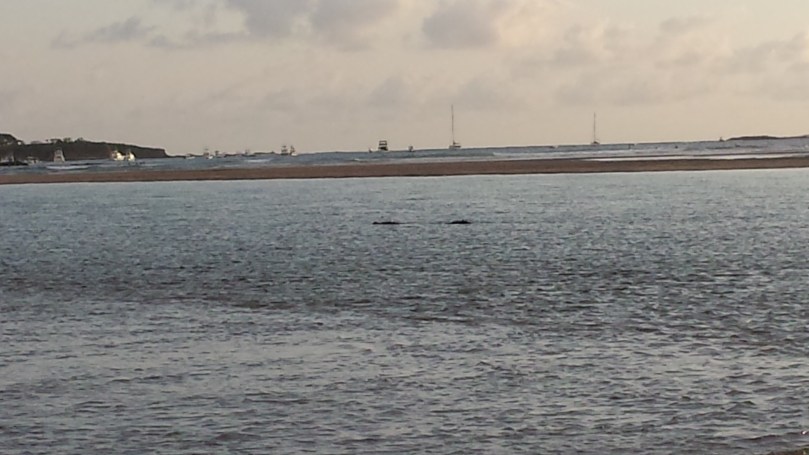
I took this photo in April 2016, of a crocodile exhibiting "abnormal" behavior--chilling there staring me down. If it ever happens again, I will call MINAE.
I took this photo in April 2016, of a crocodile exhibiting “abnormal” behavior–chilling there staring me down.  If it ever happens again, I will call MINAE.

Sudden Handcuffs

A short story about a day at work in Washington.


Camila shows up without an appointment. The receptionist calls my desk in the social work office and informs me that she is waiting. Something personal is going on, I intuit. If she came for help with welfare forms or letters, she would not have waited in the lobby through my lunch. She is asking for someone she trusts.

I call her from the lobby into an empty office where we can talk in private. Baby Diego wiggles happily on her lap when I smile at him.

“Necesito que me ayude con mi hermano,” she says.

“Ok?” I ask. “En qué sentido?”

“Necesito que me ayude a escribir una carta.”

Now she drops her eyes and straightens baby Diego’s little hat. At her full adult height she is four feet tall like her mother and grandmother, and wears clothes she buys in the children’s section at Walmart. All of them, brothers, sisters, wives, husbands and a growing band of cousins have come from a remote mountain village in Mexico. They live together as they did before they stole across the border, in a decrepit three bedroom trailer heated by a wood stove in the living room. I have been there. I sat with her every month on the sagging bed in the living room, in that intimate chaos, discussing baby Diego’s growth from the time he was nothing but a little lump.

“Está en la cárcel,” she tells me.

“Qué pasó?” I ask.

He’s a good man, she tells me, and the family is very sad. She wants to write a letter telling the judge that he should be allowed to come home. He is not a bad person. He is a hard worker and he doesn’t drink. Will I help her?

“Sí,” I tell her. But why is he in jail?

“Lo metieron en la cárcel porque su esposa es muy joven. Ella tiene trece años. Y lo metieron en la cárcel.”

“Lo metieron en la cárcel porque la esposa tiene trece años?”

“Sí.”

Ah, I say. Yes. In this country it is illegal for a man to have a thirteen year old wife.

“Ya sé,” she tells me, “Pero para nosotros, es normal.”

“Yo lo sé,” I say, and prop my head on my hand, looking at her.

I hate this.

“Como está la esposa?” I ask, trying to understand. If he is in la cárcel, something happened. Something.

“Ella está muy triste,” Camila says. “Ella quiere que lo dejen ir.”

“Ella lo ama?”

“Oh, sí. Mucho,” she earnestly nods.

“Él la trata bien?”

“Sí, la trata bien. Es un hombre muy bueno. No toma licor, nunca.”

“Cuántos años tiene él?”

“El tiene 21.”

Well, yes. Indeed.

“Tienen niños?” I ask. I realize I don’t need this much information to write the letter she wants, but I can’t help it. Throughout her pregnancy with baby Diego, we developed a sort of lopsided friendship, and I care about things for which I can offer no remedy.

“No, she says, “Pero está embarazada.”

Quietly, a sigh deflates me.

I can see it perfectly: the thirteen year old girl who speaks no English and very little Spanish goes to the doctor with her mother, or mother-in-law, where it is confirmed that she is pregnant. They do not show their delight or any other emotion in front of the large white strangers. Their round faces are stoic, expressionless, and the nurse sends them directly to speak with a social worker. They do not know what a social worker is, but they know to cooperate with large white strangers.

They answer the interpreter’s questions in broken Spanish.

How old are you?

Are you in school?

Where is the father of your baby?

How old is he?

Where does he live?

The large white strangers note his name, his age, that his address is the same. They do not ask her if she is married, if her baby’s father is her husband, betrothed to her when he was fifteen and she was a child of seven. They read flickers of fear on the face of the older woman and they misunderstand.

“El es muy bueno, y queremos que lo dejen ir,” Camila says. The sadness in her is bottomless.


I write the letter to the judge, stating that Eduardo is a good man, that his family misses him very much and that they need him. That the pregnant child is his wife and that she needs him. That he is a hard worker who doesn’t drink liquor or consume drugs. That the judge may please consider that he is not a criminal and let him go.
I realize, of course, that by my country’s law, he is.

Camila hugs me gratefully and leaves carrying the letter in one hand, clutching delighted baby Diego to her small hip with the other.

I go back into the little room where we can talk in private and sit there by myself, immobilized by a sorrow that seems to expand in all directions. I say a prayer for rain in the high plains of Mexico, that corn may germinate and grow, that the goats may have milk enough for everyone’s babies, that people may find hope in their homelands far away from large strangers with our clipboards, prying questionnaires and sudden handcuffs.
Machetes

She threatens the children
with machetes–
the handle,
not the blade.

¡Si no estudias
vas a quedar como
tu tío
cortando caña
todo el día en el
puro sol!

And the children,
terrified of the sun
which will burn them
through their clothes,
pick up their pencils,
open their books,
grimly copy
A
B
C

Jungle Problems

My town is having some jungle problems. In case you’re wondering if this is about crocodiles again—yes it is. Sorry. I’m a little stuck on that. But we’re also having a problem with the estuary. You will see, if you don’t already know, how the two are related.

What To Do About The Crocodile(s) is causing firestorms all over facebook—The Estuary Problem, not so much. Not yet, anyway. And hopefully it won’t. I hate facebook firestorms. It’s so easy to type hurtful things onto a screen from the comfort of your hammock, and then lie back feeling smug. I doubt any serious problem has ever been solved by a facebook firestorm. And we have a serious problem.

After the day in July when Jon was attacked by a crocodile in the Las Baulas estuary between Tamarindo and Playa Grande, a bunch of meetings were held order to determine what could be done about The Crocodile Problem. The Crocodile Problem, in a nutshell, is that the area is now populated by a large number of salt water crocodiles that have been fed by humans for the last 15 years. Folks who have lived in Tamarindo since the 70s and 80s, back when it was a beach with no town, say that caimans have always been normal in and around the estuary, but that salt water crocs are new. That concurs with my experience of the last 20 years. So this leads to the argument: Are Crocodiles Native or Non-Native to The Las Baulas Estuary? Perspectives vary. No firestorms, please.

The result of the meetings was the declaration by the Environmental Ministry (I wasn’t there. I was at my sister’s wedding in Colorado) that:
–The crocodiles cannot be exterminated. They are wild animals and to kill them is illegal.
–The crocodiles cannot be moved to another place. The Las Baulas Estuary is a wildlife refuge, and they are wildlife.
–We can put up signs to warn people about the crocodiles.

Meeting adjourned.

Let me esplain The Estuary Problem, now, before I circle back around to The Crocodile Problem and to my own personal proposition. From the beach, the estuary looks like a river mouth, but it’s really the connecting point of an enormous salt water swamp system with the ocean. Its components are water and sand. When I first saw the estuary, as best I can remember, in 1996, it intersected the beach at something like a right angle. Imagine a T, with the top being the beach and the stalk being the estuary. But being as it’s sand and water, it moves. I’ve seen it snake all around during the years I’ve watched it. I remember it curving to the north toward the rocks by Casitas on Playa Grande. I remember it curving to the south. I most prefer it the way it was when I found it, but clearly nobody is asking me.

What I have never seen, is the like of what the estuary is doing now. It is not making the shape of any letter in my alphabet. It hits the sand headed due south and keeps right on going, finally emptying into the ocean directly beside Pico Grande. What does this mean? It means that the beach is bisected by the estuary, that Playa Grande is mas grande que nunca and that the natural habitat of large snaggle-toothed reptiles is right smack in the middle of Tamarindo Beach.

The ironies. Just now, when we have The Crocodile Problem. In fact, if it wasn’t for The Crocodile Problem, I wouldn’t have named The Estuary Problem a problem at all. The estuary is allowed to do whatever it wants. It took out the lifeguard stand, which sucks. Beachfront businesses are nervous about how far inland it will curve. But the thing is, no matter what it is doing today or where it’s path takes it, it’s temporary. For all we know, this is it’s “normal” path, and those 10 or 20 years when it didn’t head straight south are an anomaly. We are privy to all of about 40 years of the history of this beach. We know nothing.

What do we do about The Estuary Problem?  Nothing.  Wait.  Appreciate the mysteries of Mother Nature.  Take photos.  I will  confess that configuration of the estuary, the beach and the saltwater crocs is not to my liking. It has, to some degree, ruined surfing for me. It’s hard to do something for pleasure while trying to ignore fear. I do my best.  There are other places to surf, but not for girls who have long boards, day jobs, and no car.  I take more beach walks on my two good legs.

So, back to The Crocodile Problem. We’re not allowed to kill them. We’re not allowed to move them. Somebody posts a picture of one on facebook with a kind warning for everyone to be careful, and a war of the words ensues. Somebody says we should kill them. Somebody else replies that they were here first and we are in their home. Then we hear the part about how they really aren’t native to this region. Then it turns into Costa Ricans against foreigners and if foreigners don’t like Costa Rica the way it is and can’t leave it alone, then we should go back where we came from. It got ugly. Why do you say we can’t kill a crocodile but you eat cows and chickens? But crocodiles are wild animals and it’s not the same… And so on and so forth.

I think about it a lot. I’m a little obsessed, maybe. But that’s what happens when, one lovely morning in July, you find at your feet a destroyed human being that the crocodile chewed up and spit out. Everything in your spirit stops.
You have to start from scratch.

Starting from scratch:

I’m a farm girl. I grew up on a chicken farm in Pennsylvania, and I have eaten one hell of a lot of chickens. My dad is a hunter. He fills the freezer (even now at age 72) with venison, and sometimes elk from trips to the west. We never ate beef in my home, and my mom hates fish—it was venison, chicken, or breakfast—point being, I have also eaten many many, many wild animals. I’m not a big carnivore anymore. I’m not a vegetarian either, except in my heart. I eat meat because my husband is a fabulous cook, and at my house the cook chooses the menu.

In all honesty, I personally would like to see a significant number of the crocodiles “harvested.” Not out of hate. Out of common sense. Out of the life experience of being a farm girl and a hunter’s daughter. We’re both at the top of the food chain, the crocs and us, and if we use our superior intelligence to choose to let them harm and potentially devour us, what sense does that make? What kind of intelligence is it? And, um, we just took ourselves down a peg.

So in order not to disrespect the life of the crocodile who attacked the man I found looking up at me from the shallow waves that morning, I have a proposition: I will volunteer to eat it– same as it would do to me if given half a chance.  Mammal against reptile.  No hate.  No disrespect.  No life wasted.

It will be a tough chew, I expect.  Maybe I’ll share with the cats.  I have no idea how to cook a crocodile, but bring it to me. I’ll figure it out.

4e19b329-1e80-47c0-817d-a94cb45692f9
I took this photo shortly before sunset on an incoming tide in Aug 2016.


Boa

Flash non-fiction from times when the jungle was wilder.

I pull the suitcase down off the shelf above the corner closet, and there she is looking at me—a boa. We are equally surprised, and both jump back. How long has she been with me in my bedroom on top of the closet? How on earth did she get in?

How on earth will I get her out?

Maybe I should leave her there, I think. Maybe I have slept in my bed with her watching over me on many nights.

Maybe so, I think, but no more. We are afraid of each other now, and in this room together neither of us will sleep.

I stand on a chair with a broom and push her onto the floor. She flops helplessly to the tile, and in a desperate speedy wiggle, dives toward the safe darkness under my bed. I swipe at her with the broom – mighty whacks that push her toward the open door. I don’t want to hit her, but I am afraid of her. She strikes at the broom. She is afraid of me.

When I finally push her through the door into the black night, she slithers into the leafy jungle. My heart is pounding fast, as if I have been fighting for my life. Does she have a sister in my bedroom? Will she try to find her way back in?

Now, if she bites me I will deserve it. I hit her hard, and she did nothing to me but enter unannounced.

I lay on my bed in the dark and I am not sleepy. I imagine eyes looking down at me from the shelf on top of the closet. I feel the flicker of a thin tongue that reads my dreams.

I have been wrong. On how many nights have I lamented sleeping alone, while in truth accompanied by a lithe and silent guardian?

Barbara Struncova’s 37th Birthday

Happy birthday, Barbara. From all of us who refuse to forget you.

barbara-at-kellys

You are supposed to be celebrating 37 years, today.

Bill is in jail today, like he was last year on your birthday. The USA did all it could to fight for you in court. They pulled the story of what happened to you from the archives of the OIJ, translated it to English, and presented it in a court of law, so that now what was once secret is public information. The judge, of course, was unable to sentence Bill for a crime that was not one of the original charges, but believe me girl–everyone got the point.

I wish we had more to give you for your birthday, but this is what we hold in our hands.

I know you are very close, or you were. I would like to question the trees, the crocodiles, the owls. When I learn to speak their languages, I will.

Sleep sweetly, friend.

About Being Brave. Or Not.

I’ve always been perplexed by people who tell me I’m brave—or maybe I should say, I am intrigued by the things that people interpret as acts of bravery.

How many times have I heard this: “You live in Costa Rica?  Oh you’re so brave!”  Or in reference to me moving here by myself (even though I was coming back to friends) when I was 24, “That’s so brave!”

The thing is, it’s not brave.  Not for me, anyway.  How can you be brave if you aren’t scared?  If I’m not afraid of something, for me to do it requires no bravery at all.

My boss took the batch of us on a canopy tour, recently, where you harness up, hang by metal clamps from steel cables, and zoom through the jungle canopy from tree to tree.  It’s a lot of fun.  I’ve never been afraid of heights, so it requires no bravery for me to launch from the platform and fly through the air.  Some of the team members, however, were petrified.  For them to do the exact same thing as I did was a tremendous act of bravery.  I watched them struggle with their fear and overcome it (or not).

To be brave is not the same as to be fearless.  If I’m not afraid of the ocean and I paddle out into it on a surfboard, that’s not bravery.  If I am afraid of the ocean and I paddle out into it anyway, THAT is brave.

For me, getting on an airplane is brave.  Getting on the motorcycle is brave.  (I do it all the time, clamped for dear life to the back of my husband who is cool as a cumber.)  Living in Costa Rica?  Not brave.  Getting on a boat?  Not brave.  Canopy tour?  Not brave.  Spelunking?  That’s another story.  I will hang by my tiptoes from a tightrope before I crawl into a small space that I can’t see my way out of.  That would require me to be brave, and I’m not interested.  Call me a chicken.

Up until the end of July, surfing, for me, was generally not an act of bravery unless there were a lot of rocks in the water.  I have this inexplicable panic in the presence of rocks.  Duh.  Rocks.  But yes—seeing dark shapes under me, or feeling them when I can’t see them, has always just about sent me over the edge.  No idea why.  And then the crocodile thing happened.

It didn’t happen to me in the most literal way, but there are ways in which it did.  And I’ve been back surfing, since.  Gingerly, if there is such a thing.  It’s getting a little better.  But make no mistake—surfing, for me, has become an act of bravery in a way that it wasn’t before.  I think I speak for a lot of people in my town when I say that.  Whereas before, perhaps, we are fearless, we have now become brave.

Being fearless, which can be good or bad, is a characteristic, and who chooses their characteristics?  Being brave is a choice.

Where am I going with this?  A ninguna parte.  I’m just saying.  Fearlessness and bravery might look the same on the outside.  On the inside, they’re not.